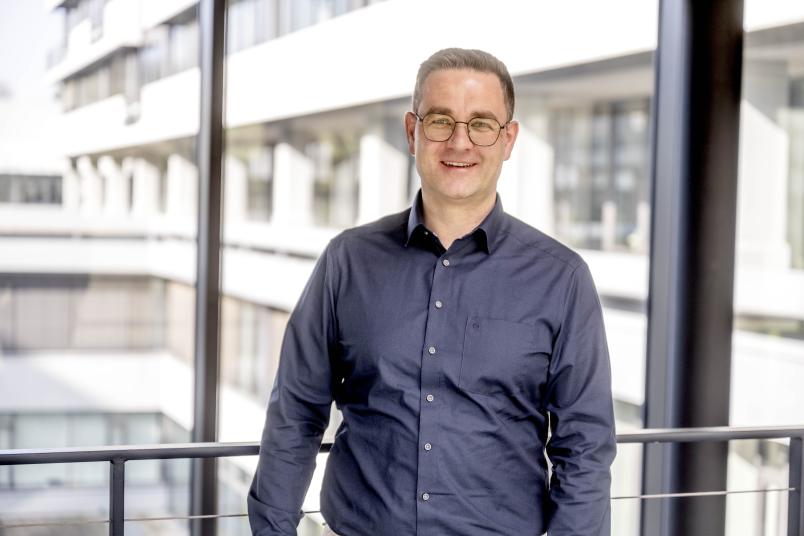
Jens Pöppelbuß is Head of the Chair for Industrial Sales and Service Engineering at Ruhr University Bochum.
For companies
“We Want to Make AI Technologies More Accessible”
Small and medium-sized enterprises can benefit from adding AI-based services to their products. However, they often lack the technical infrastructure and expertise to do so.
“Do AI Yourself” is the catchy name of a project in which Ruhr University Bochum and TU Dortmund University are currently collaborating. Together with industry partners, the team is developing concepts that would enable small and medium-sized enterprises to offer AI-based services without having the technical infrastructure for that themselves. In this interview, Professor Jens Pöppelbuß from the Chair of Industrial Sales and Service Engineering at Ruhr University Bochum explains how this could work.
Professor Pöppelbuß, how could small and medium-sized enterprises benefit from new AI services?
Such AI support could be useful, for instance, in predictive maintenance: when a company sells machinery or equipment, the customer wants it to run without interruption. With the help of machine learning, or AI models in the broadest sense, usage data from the plant can be analyzed to detect irregularities. This makes it possible, for example, to predict when a particular component will overheat.
Then you could intervene before the machine breaks down.
Exactly. If the assembly line suddenly stops in the automotive industry, it costs a lot of money. In other areas, it may not be quite as dramatic, but of course, you generally want to avoid production downtime. It would be an advantage if a company could promise its customers better asset availability.
What are the challenges for small and medium-sized enterprises in this regard?
Firstly, companies need access to customer usage data. Assuming they get this, the company still needs the technical infrastructure and the knowledge to train a machine learning model to detect deviations in usage data and interpret them correctly.

It sounds easier than it is in practice.
How could companies obtain the infrastructure and expertise?
They could purchase them externally from AI service providers such as Microsoft Azure or Amazon Web Services. The company would then use other companies’ AI services to offer its customers machinery with AI-based predictive maintenance. However, this sounds easier than it is in practice.
Why?
Many questions need to be addressed in detail. For example, customers may be reluctant to share their usage data because it could reveal business secrets. In this case, we need to determine whether we can use an on-premises solution rather than a cloud solution so that the data remains with the customer.
How can your project help with this?
In Bochum, we develop business models for data-based services that could work for small and medium-sized enterprises. Our colleagues at Professor Christian Janiesch’s Chair of Enterprise Computing in Dortmund develop concepts for the IT implementation. We cooperate with industry partners, for example, a software company and a manufacturer of CO2 snow-jet cleaning systems.
Ruhr Innovation Lab
How far have you gotten so far?
Together with our industry partners, we have compiled relevant criteria that companies can use to assess whether AI services could open up new business opportunities. Our checklist includes questions such as: What data do I have available? What does my customer expect from me? How could I implement an AI solution?
Ultimately, we want to make current AI technologies more accessible to small and medium-sized enterprises – and draw attention to how they can drive business success.
Do you consider the new business models to be promising?
Basically, yes. Of course, companies must be willing to implement them, and there must be a customer need. In the Ruhr region, Germany and across Europe, we must ask ourselves how we can ensure the long-term competitiveness of industrial companies. In my opinion, it helps to think a few steps ahead and act in a customer-oriented manner. We are working on precisely these challenges together with many other colleagues and companies at the “Zentrum für das Engineering Smarter Produkt-Service-Systeme”, ZESS for short.
About the project