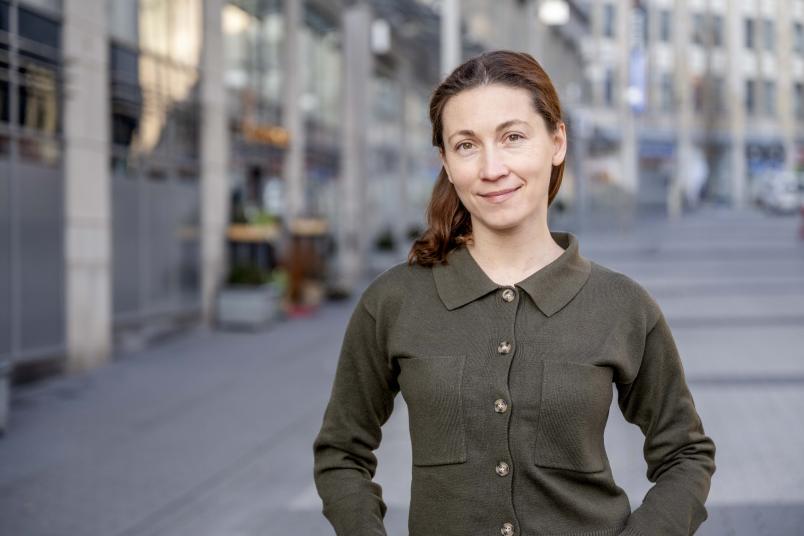
From Dnipro to the Ruhr Region: Olga Matveieva researches at the universities of Bochum and Dortmund.
Internationalization
“I now feel at home in three places”
Olga Matveieva came to Ruhr University Bochum in 2022 with a scholarship from the Philipp Schwartz Initiative of the Alexander von Humboldt Foundation; in 2025, she completed her habilitation at TU Dortmund University.
Olga Matveieva’s hometown is Dnipro in eastern Ukraine. She is an associate professor at the Dnipro University of Technology. The war forced Matveieva to flee to Estonia in 2022. At the University of Tartu, she completed a research stay. At the beginning of the invasion, the social scientist with a focus on gender studies successfully applied for a scholarship from the Philipp Schwartz Initiative for endangered scientists. Prof. Dr. Katja Sabisch, Professor of Gender Studies at Ruhr University Bochum, became aware of her application and her research project and eventually became her mentor, significantly helping Matveieva to maintain and boost her research work.
From Dnipro to Tartu to Bochum
Following the PSI scholarship at the Marie Jahoda Center for International Gender Studies in Bochum, Matveieva was invited to stay in Bochum as a DAAD guest professor. During this time, she developed her research and completed her habilitation at the Faculty of Social Sciences at TU Dortmund University. Today, four years later, the Ukrainian considers Bochum her second home. In the interview, she talks about her research and the people who have welcomed her so warmly in the Ruhr region and made her stay.
Ms. Matveieva, congratulations on your successful habilitation! We are delighted that you found your way to us in the Ruhr region.
Thank you! I love this area. It reminds me very much of my home region of Dnipro from before the war. Dnipro is one of the most important post-mining and industrial centers in Ukraine. The atmosphere here in the Ruhr region is similarly post-industrial, which is why I feel very comfortable here. I love nature, which begins right behind the gates of the university.
What do you like here in particular?
The people. Who from day one have given me every kind of support, have stood by me with advice and action.

I consider myself privileged to be a part of this very intelligent and sensitive network of simply incredible people.
I consider myself privileged to be able to become a part of this very intelligent and sensitive network of simply incredible people. Everyone is committed with so much dedication and passion to their research, to make our future sustainably better. I am really grateful for this experience. And also I am happy to consistently contribute to developments in Ukraine with greater synergy, being engaged in work and meaningful initiatives in two countries.
Do you have a favorite place on campus?
Of course, I love quiet places like my office, but I also like the canteen. For me, it is the place for casual meeting, to network and exchange ideas informally. Some of our joint initiatives have emerged there; some have resulted in book chapters, others in conference contributions and research projects.
What questions drive your research?
The war in Ukraine has led me to deal with the socio-political transformation processes in crisis-stricken regions of Europe. I have studied social mobilization in Ukraine and analyzed the relationship between gender identity, crisis-responsive unity and societal transformation. The questions that have been on my mind: How can we as citizens support a state that is under pressure, vulnerable and struggling with limited resources? What role can we play to not only be users of state services, security and order, but how can we meaningfully contribute, make ourselves valuable to the community, how can organize ourselves in a complimentary, non-interruptive way?
What have you specifically investigated?
Together with colleagues, for example, we have examined volunteer-run donation campaigns in Ukraine during the war. Our study was able to show not only how successful these initiatives are in mobilizing financial resources, but also how they strengthen social cohesion and democratic participation.
When people come to work and co-create together in difficult times, this not only helps to solve problems, but also strengthens democracy.
When people come to work and co-create together in difficult times, this not only helps to solve problems, but also strengthens democracy. They find solutions together and organize themselves, often offering innovative solutions which complement the system of public services. We revealed the decisive role that technology plays in this, because it increases inclusiveness and amplifies the voices of underrepresented groups. This makes democracy stronger against external threats.
How did you proceed methodically?
In order to capture how civil society initiatives emerge in crisis areas, we conducted cross-country surveys and semi-structured interviews with civil society organizations and local governments in Ukraine, Belarus and Moldova.
How can one better network in times of crisis?
In general, we asked: What can be done practically and theoretically to sustainably improve cooperation between the various actors? How can one better network in times of crisis? I myself head a Ukrainian NGO – the Ukrainian Expert Foundation – which informs about the latest developments in Ukraine, advises politics, works closely with universities and authorities. Thus, I already had contacts to local authorities, such as the city council of Dnipro and the regional council.
What do you take away from these surveys for yourself?
I have gained insights into the cooperation between civil society and government. My impression is that in Ukraine, as in many other countries, many informed but not empowered voices from civil society remain unheard and invisible because of a lack or absence of effective formal communication and exchange channels between public authorities, universities, and civil society organizations. This lack creates a separation between them.
How do you explain that?
We are talking about a highly emotionally charged and also polarized situation here. The war continues and we all want to end it. But there are only a few who contribute practically to this. Like the military. This creates a separation between those who act and those who observe. Not every kind of help is perceived equally. The government’s top priority is to keep people in the country. I ask myself: How can we not become estranged from each other? How can we effectively engage and make efforts of individuals and institutions sustainable?
What are your next steps?
I am taking up a guest professorship at the University of Paderborn, but will continue to live in Bochum. When I started thinking about moving because of the new job, I quickly realized that I would miss the people here. Over the last few years, I have actually made many social contacts and now have so many friends here.
I feel at home in Bochum.
My daughter is well integrated, goes to school here happily. I feel at home in Bochum. I have always hoped that the war would end and I would get the chance to return to Ukraine. But reality is much more complicated. And now I am glad to have two or even three places that I can call my home.
Support for endangered scientists in the Ruhr Innovation Lab