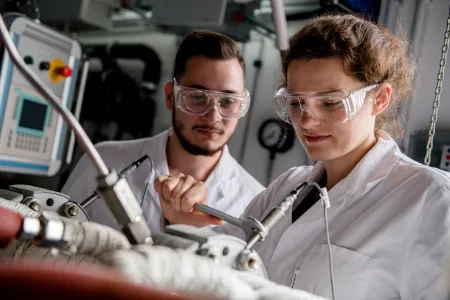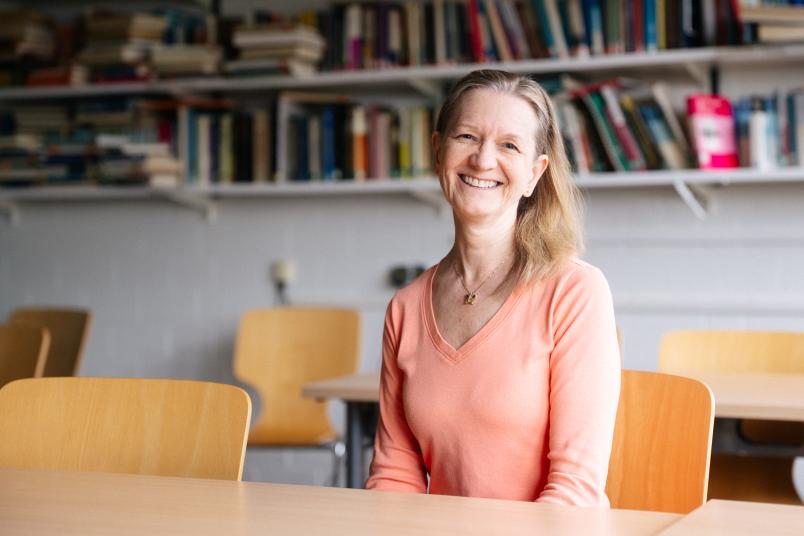
Ingrid Fritsch is visiting Ruhr University as a recipient of the highly competitive Fulbright U.S. Scholar Grant to Germany.
Chemistry
Three Months in Bochum
Ingrid Fritsch is conducting research as a Fulbright scholar at Kristina Tschulik’s department.
Professor Ingrid Fritsch has received one of the coveted Fulbright fellowships and is now conducting research for three months at the Chair of Analytical Chemistry led by Prof. Dr. Kristina Tschulik. We introduce our guest in the form of a profile.
Name: Professor Ingrid Fritsch
Field of Study: Chemistry and Biochemistry
Home University: University of Arkansas
Type of Scholarship: Ingrid Fritsch is visiting Ruhr-University as a recipient of the highly competitive 2025-2026 Fulbright U.S. Scholar Grant to Germany. Open to all academic disciplines, the award drew 63 applications, of which 49 were advanced by the Institute of International Education to the German-American Fulbright Commission for review, and only 10 were ultimately selected, placing this among the most selective U.S.-German academic honors.
Host: Prof. Dr. Kristina Tschulik, Analytical Chemistry
Duration of the visit: March 1 to May 31, 2026
Research focus and main objectives of the visit to Ruhr University: Ingrid Fritsch's research across two German institutions centers on the project "Improving Energy Efficiency: Multimodal Analysis of Nanoparticle-Catalyzed Electrochemical Reactions," in collaboration with Professor Christian Cierpka at Technische Universität Ilmenau (January 2026) and Professor Kristina Tschulik at Ruhr-University Bochum (March-May 2026). The work targets development of lab-on-a-chip devices integrating digitized micro- and nanoelectrode arrays with dark-field and fluorescence microscopies, enabling simultaneous characterization of nanoparticle size, composition, and spatial location during electrochemical reactions, with microfluidic integration providing high-throughput capability. The primary focus is the direct electrochemical synthesis of hydrogen peroxide from molecular oxygen as a sustainable, energy-efficient model system. Successful completion would establish an analytical platform for structure-function-guided catalyst development spanning electrochemical reactions from energy to biomedical diagnostics.