
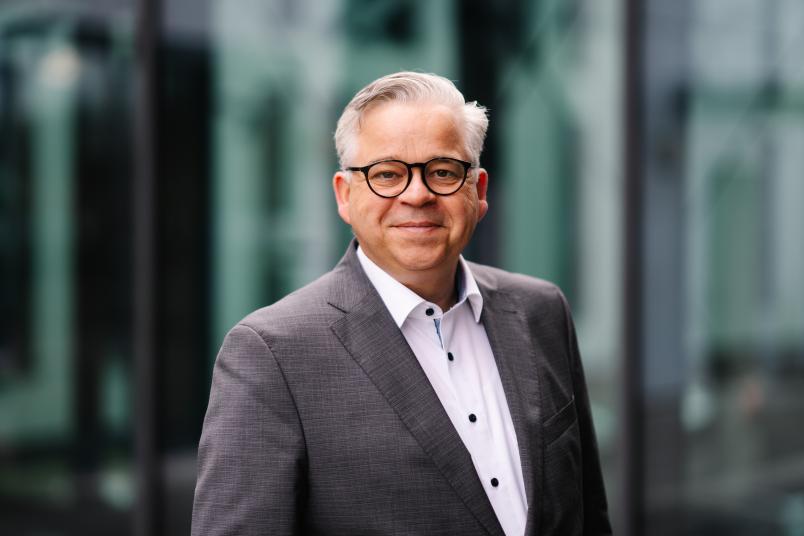
Dr. Achim Dilling has been Chancellor of Ruhr University Bochum since January 2026.
Interview
This entire region is like a buzzing beehive
Achim Dilling was appointed chancellor of Ruhr University in 2026. After 100 days in office, he takes stock and discusses how the university will continue to develop.
Mr. Dilling, 100 days into your tenure. Time to look at your start here. How were your first three months as the new chancellor of Ruhr University?
Intense, but inspiring. Ruhr University is a dynamic and immensely energetic university, I noticed that from day one. That’s because of both the people and the diversity. I have come to know a university that thinks big, is capable, and has the clear desire to shape the future. At the same time, of course, I had to quickly get involved in the issues, structures, processes, and the financial framework. My first impression: Ruhr University has enormous potential and the determination to meet it.
What do you appreciate most about Ruhr University?
The mix of openness, energy, and professionalism. I like the mentality and the clarity with which people take on the day. People here work with high technical competence and dedication, but without the morosity you find in other places. This creates an atmosphere where you can shape things. I feel like this entire region is like a buzzing beehive and seeks to move things forward. That’s what really hooked me.
In addition, there is still room to grow. I think the region can be more courageous in many regards, take a confident stance and say, “Look what we have to offer!”

In no other state can universities do as much as they can here.
Where do you see the similarities and differences between Ruhr University and your previous workplace, University of Passau?
Both universities strive for quality, scientific excellence, and the people’s strong identification with “their” school.
The main differences lie in the dimensions and context: Ruhr University is in a whole other league as the state’s largest campus university, both in terms of organization and infrastructure.
On top of that, the Universities Act in NRW offers a lot of freedom for configuration. This is a significant benefit, as it opens up opportunities that I find very appealing. NRW has the most innovative Universities Act in Germany. In no other state can universities do as much as they can here. University management largely hinges on university law frameworks, which was actually one of the reasons I moved from Passau to Bochum.
Do you remember your first impression of Ruhr University? Has that impression remained?
From the start, I was impressed by the size and dimensions, and to be honest it took a little work to find my bearings.
My impression of the unique mix of creative drive, professionalism, and composure has stuck with me.
What has changed is that I get lost much less often.
In your short tenure, you created a new format for discussing the reduction in bureaucracy: Faculty Conference Plus. Is simplifying administration not just a project to you, but also a personal matter?
Absolutely. Universities are bound to truth and knowledge. They are tasked with improving people’s lives and life within society from technical, scientific, ethical, and medical perspectives. This is something positive and forward-facing. In order for this to succeed, scientists have to be able to focus on their own work. This requires an administration that listens, supports, and facilitates instead of inhibits. It’s challenging, sometimes even stressful. But it’s necessary and, above all else, it makes sense.
Faculty Conference Plus
What are the next steps for Faculty Conference Plus?
We will take a structured approach to further advancing this topic. One core component is the planned Service Board with Jörg Bogumil as a place where science and administration can develop solutions together. I’m very grateful that Jörg is involved in this, he is one of the leading experts in the administrative sciences.
The first step is to establish this Service Board with the appropriate administrative and research staff, and to focus on structural discussions. The dialogue is very particular in many areas, at times too particular and self-serving. We have to think more in terms of the big picture and expand beyond our individual silos.
Simplification, trust, and a constructive culture open to mistakes have to be part of our self-perception.
There will also be a corresponding format for technical and administrative staff, because simplifying administration has to be a joint process. The cultural dimension is just as important to me as the structural side: Simplification, trust, and a constructive culture open to mistakes have to be part of our self-perception.
What other strategic goals do you see for Ruhr University?
One core topic is support for the Excellence Strategy. There is nothing more important than preparing Ruhr University for future international competitiveness.
Another aspect is resilience. We are living in a time of permanent crises and upheaval. For me, resilience doesn’t mean keeping your head down and pushing through, but rather formulated working conditions that link effectiveness with awareness. This definitely comes with the territory of leadership.
Thirdly, there’s digitalization, especially in the alliance. Many challenges can only be overcome together, like when it comes to the computing capacities we will need in the future.
Finally: Consistently making use of the potential of the University Alliance Ruhr. We are in the process of consolidating various things at the administrative level. These branch out in different directions, including expanding the task portfolio and the alliance’s action environment—such as activities for continued education—and more efficient configuration of processes.
Anyone can be a fair-weather chancellor.
You start out with difficult financial conditions and the need to save. Would you have wanted a different environment?
(laughs) Anyone can be a fair-weather chancellor.
It always comes down to shaping the future with the hand that is dealt to you. For administration, this means improving processes and advancing digitalization. For science, it means smart and strategic investments, such as in the Excellence Strategy. Challenges are just part of it, but how you deal with them is what matters.
What is your view of Ruhr University’s financial situation?
In short, it’s currently stable but under pressure. This is not only the case with Ruhr University, but the entire system. The causes are primarily external, from the pandemic to geopolitical crises and rising costs. These effects impact public budgets down the road, and universities in turn.
Our duty is to ensure financial stability and sustainability under these conditions. We rank eighth among universities in Germany with the strongest research. It’s a huge amount: 180 million euros in third-party funding, enormous growth rates in this area, 48 million euros annually for the Research Alliance Ruhr, permanently included in the basic budget for the three UA Ruhr universities. This is a clear commitment from the state government.
If the rules of the game change and research receives more discretionary funding, it wouldn’t harm an institution as well-positioned as Ruhr University. We’re able to take an optimistic view of the future. At the same time, we are under pressure in matters of liquidity and profitability. So, is the core funding an issue? Absolutely.
We see that basic funding in particular is under pressure.
What is your view of university financing in NRW compared to Bavaria?
The financial slowdown is a nationwide phenomenon. We see that basic funding in particular is under pressure. In times like these, the priority is differentiating between that which is wanted and that which is necessary.
I see a clear trend away from even distribution toward more priority-oriented financing. In NRW, I think this has gone well, especially due to the dialogue-based process between universities and the government.
At the same time, funding is being specifically invested in top-level research. Ruhr University is in a good position here, not lastly because of the strengthening of the UA Ruhr. This provides a great basis for the Excellence Strategy.
In closing, please complete these sentences:
I spend my free time …
… watching soccer in the stadium, running, or engaging in athletics. I also enjoy reading or visiting the theater to balance out my time.
In ten years, I see Ruhr University …
… as an internationally visible, excellent, fully-fledged university with a service-oriented and digital administration that listens to the university community. I also see a key driver of structural change in the Ruhr region.
My favorite place at Ruhr University is …
… the Chinese Garden.
For me, Bochum is …
… diverse, vibrant, and surprising.