
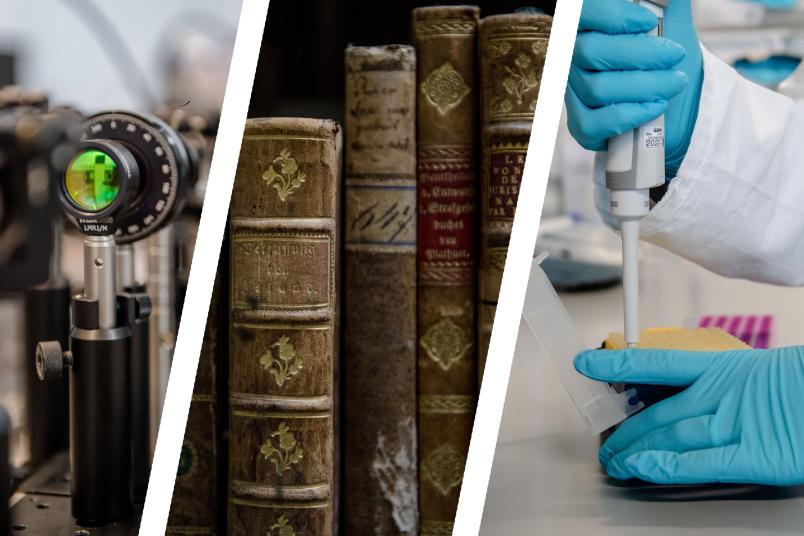
Ruhr University is proud of its achievements across all academic disciplines.
Grants
Four Bochum-based Collaborative Research Centers (SFB) to be extended
The humanities, natural sciences, and material sciences are pleased about the continued funding, including SFB 1491, in which RUB and TU Dortmund University collaborate. We also participate in a new SFB led by Freiburg.
This time, Ruhr University Bochum had many Collaborative Research Centers (SFB) in the running for continued funding from the German Research Foundation (DFG). The university is pleased to announce the renewal of four major research networks in the humanities, natural sciences, and material sciences. The SFB “Historical and Transcultural Narratology” at the University of Freiburg, in which researchers from Ruhr University are participating, has been newly approved.
Metaphors of Religion
Whether “path,” “light,” or “heart”: religions communicate primarily through metaphors, since the transcendent cannot be expressed directly. Guided by this fundamental idea, Collaborative Research Center 1475 “Metaphors of Religion” has analyzed numerous languages and religious traditions spanning the past 4,000 years. Researchers in the consortium coordinated at Ruhr University Bochum can now continue this work. The German Research Foundation (DFG) has approved continued funding for 3.5 years. In addition to texts, the second funding phase will also focus on images and artifacts, as well as religious parodies alongside established religions.
Cosmic Interacting Matters
All hell is breaking loose in the sky: stars are born and die, charged particles, rays, and neutrinos collide and influence one another. Since 2022, Collaborative Research Center (SFB) 1491 “Cosmic Interacting Matters” has been investigating these interactions in space. The researchers will be able to continue their work for another four years: The German Research Foundation (DFG) has approved continued funding for the SFB led by spokesperson Prof. Dr. Julia Tjus at Ruhr University Bochum, effective July 1, 2026. In this SFB, researchers from RUB work closely with colleagues from TU Dortmund University.
Virtual Lifeworlds
Virtuality has long since become part of everyday life. Since 2022, Collaborative Research Center 1567 “Virtual Lifeworlds” has demonstrated the profound impact it has on communication, knowledge transfer, bodily and affective practices, social negotiations, economic structures, language, subjectivization, and forms of coexistence. In the second funding phase, now approved by the German Research Foundation (DFG), the consortium is turning its attention to active design. “For us, virtuality is not a tool for efficiency, but an open space for design that requires critical reflection - from the creation of new realities to AI - and demands responsibility, transparency, and participation,” says spokesperson Prof. Dr. Stefan Rieger from the Institute for Media Studies at Ruhr University Bochum.
Heterogeneous Oxidation Catalysis in the Liquid Phase
The team at Collaborative Research Center/Transregio 247 is developing new high-performance catalysts made of mixed metal oxides. The goal is to make chemical processes in the liquid phase more efficient and sustainable - particularly selective oxidation reactions, which are used in many sectors of the chemical industry to produce starting chemicals for further syntheses. Researchers at Ruhr University Bochum, the University of Duisburg-Essen, and other participating research institutions (Christian-Albrechts-University Kiel, MPI CEC, FHI) will be able to continue their work for another four years. The German Research Foundation (DFG) has approved a third funding phase for the SFB/TRR.
„Historical and Transcultural Narratology“
People have always told stories. Across all eras and cultures, narratives have played an important role in social cohesion. The new Transregio Collaborative Research Center (SFB) “Historical and Transcultural Narratology” examines premodern - that is, ancient, medieval, and early modern - narratives from various cultural contexts. The Collaborative Research Center aims to develop a new historical-transcultural narrative theory that overcomes the biases of current narratologies and their narrow focus on Western and modern or postmodern traditions. The narrative theory that the SFB aims to develop is intended to encompass diverse historical narrative formats and functions from vastly different cultural contexts and to open new avenues for comparative, interdisciplinary literary and cultural studies on a global scale.
Researchers from the consortium of the universities of Freiburg, Bochum, and Bonn aim to both explore and further develop the potential of Digital Humanities in order to more firmly establish comparative narrative studies within the digital realm. Ruhr University Bochum is a co-applicant in this project.