
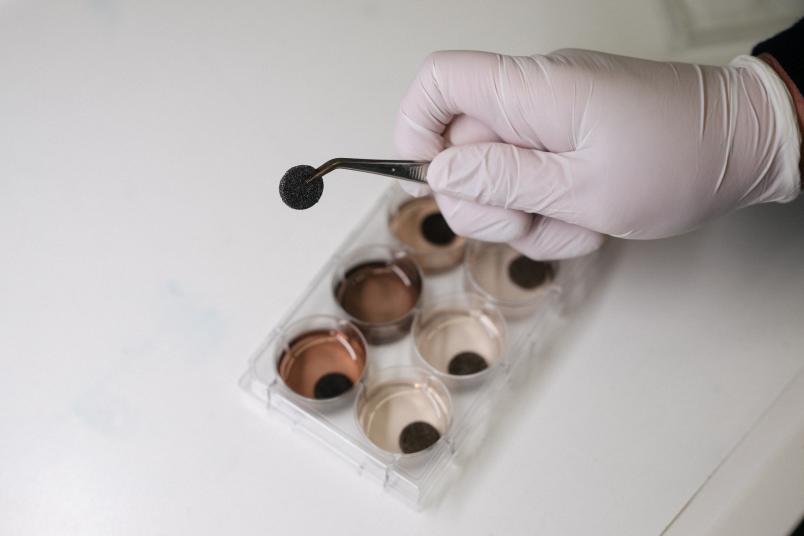
This button is made of nickel foam. Enzymes are attached to its surface.
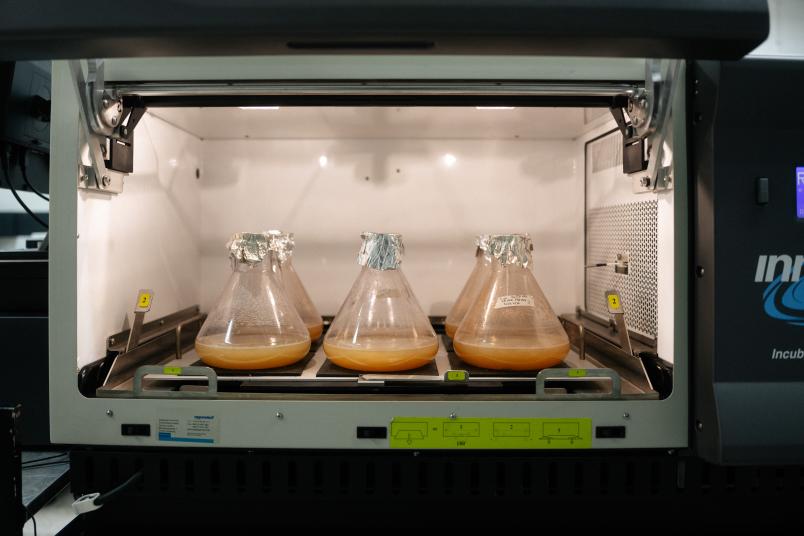
Anna Ngo cultivates genetically modified bacteria so she can later extract the enzymes she needs from them.
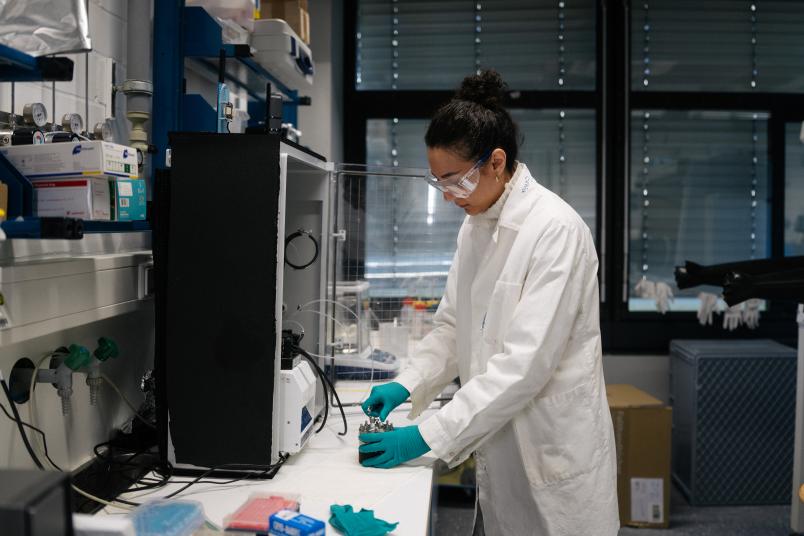
Ramineh Rad is loading an electrocatalytic cell.
Catalysis
Electron Theft for a Good Cause
Ramineh Rad and Anna Ngo combine the best of electro- and biocatalysis. They hope to obtain sought-after chemicals in a sustainable and cost-effective manner.
A modest, gray button in a transparent bag is where everything happens that is intended to lead toward more sustainable and cost-effective production of valuable materials for the chemical industry. The button is made of nickel foam, and Anna Ngo has attached certain enzymes to its surface. These enzymes come from genetically modified E. coli bacteria that Ngo multiplies in the lab. “I can selectively extract the enzymes from the cells,” explains Ngo, who is working as a postdoctoral researcher in Professor Dirk Tischler’s Microbial Biotechnology research group at Ruhr University Bochum. The enzymes then independently attach to the chemically-modified surface of the nickel foam.
The Nickel foam is subsequently inserted into an electrocatalytic cell, where it serves as an anode. “We are developing a combined bio-electrocatalysis as a modular cascade for coupling electrochemical processes with biocatalytic reactions,” explains Ramineh Rad, a doctoral student in Professor Ulf-Peter Apfel’s research group at the Faculty of Chemistry and Biochemistry at Ruhr University Bochum. The two researchers are focusing on the anode, as the cathode is out of the equation for now. The electrocatalytic cell is filled with a buffer solution. Depending on which enzymes are attached to the nickel foam and which base material is added, various reactions occur simultaneously on the anode.
Cascade in three steps
“We started to test the last enzyme from the enzymatic cascade that we want to immobilize,” says Ngo. In this case, the enzyme on the anode is called formate dehydrogenase. When formate is added, the enzyme steals electrons from it. CO2 is left over. The enzyme requires NAD+ as an electron acceptor that incorporates the stolen electrons to become NADH. This is where electrocatalysis comes in: When voltage is applied to the anode, NADH gets oxidized, meaning it loses the electrons and becomes NAD+ again, and can be further re-used by the enzyme as long as formate is supplied.
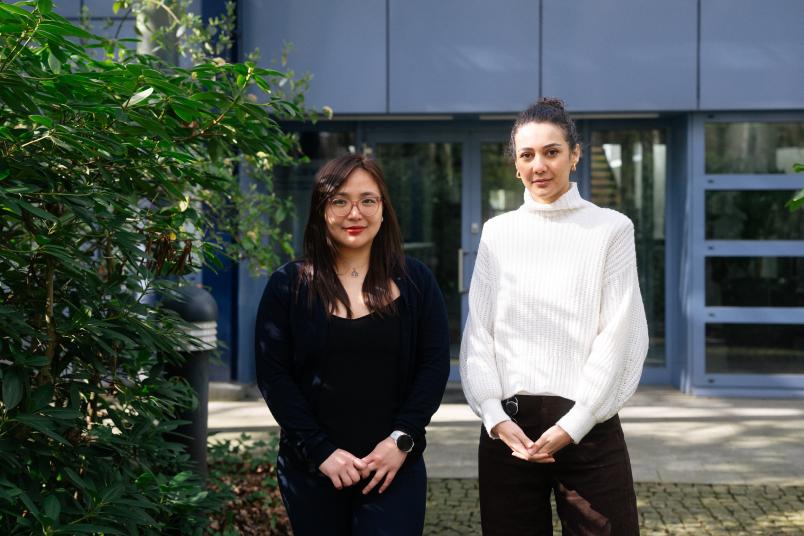
Anna Ngo (left) and Ramineh Rad are collaborating on a project at the intersection of chemistry and biology.
The system becomes really interesting when two or three enzymes are active on the anode. “Our planned cascade is set up such that we can also attach the enzymes alcohol dehydrogenase and formaldehyde dehydrogenase to the anode,” says Ngo. “If we then add methanol, a cheap industrial waste material, formaldehyde is created. This is a base substance for certain synthetics. At the same time, the electron transfer converts NAD+ into NADH, which is regenerated through electrocatalysis. In the next step, the appropriate enzyme is used to turn formaldehyde into formate, which can in turn be used to produce precursors for fragrances.” The enzyme that is used determines the end product.
Producing expensive cofactors
The researchers are also very interested in the cofactors and co-substrates. While NAD+ is already rather expensive at 20 USD per gram, NADH is worth about twice as much. “If you turn off the current, you can produce and extract the more expensive co-factor,” says Rad.
In another step, the researchers want to influence the enzymes such that they can accept different co-substrates. NADP+, which is even more expensive at around 49 USD per gram, is another possibility alongside NADH. However, the enzyme reaction creates NADPH, which costs approximately 275 USD per gram.
All these reaction steps can also be accomplished using electrochemistry alone, but this requires environmentally harmful substances and energy-intensive temperatures. The biological components render these unnecessary. “We have optimized the temperature, pH level, electrical voltage, and other parameters to ensure stable operation,” explains Ngo.
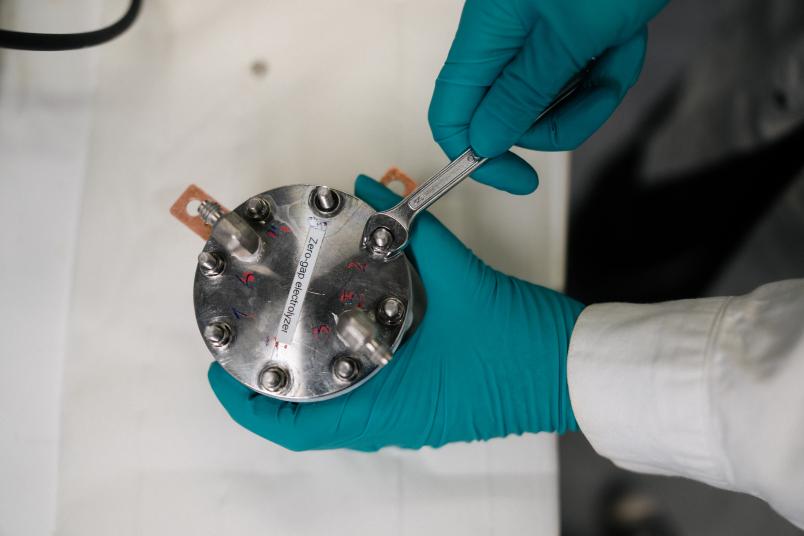
This is where the reactions take place.
“Our enzyme cascade allows us to sustainably obtain valuable substances from waste,” explains Rad. “And it can be operated modularly, meaning flexibly.” Because the cofactors continuously regenerate, the reactions can occur in a stable manner over a long period of time. “We have already run our system overnight,” says Ngo. “The effectiveness wanes slightly over time, but the system remains stable.” If the researchers fill the cell with more buffer, cofactors, and base substances, they can reuse the same anode. “We have already successfully tested two cycles, and are planning up to ten,” says Rad.