Organizations from across North Rhine-Westphalia are part of the new network.
Collaboration
European AI Network Has Established New Unit in NRW
More than 40 leading AI researchers from the region will be driving the development of open-source models and trustworthy applications. Bochum and Dortmund are participating in the initiative.
The European Laboratory for Learning and Intelligent Systems (ELLIS) is one of the leading European networks for research in the field of Artificial Intelligence (AI). It was founded with the aim of strengthening excellent AI research and creating internationally competitive centers across Europe. Now ELLIS is further expanding its network and has approved a new unit in North Rhine-Westphalia. It brings together leading AI researchers and computing infrastructures from the region in order to advance open-source foundation models, trustworthy machine learning and real-world AI applications.
Cooperation partners
Open models and applied AI research
The NRW team will develop and investigate so-called “Open-Source Generalist Foundation Models.” These serve as central building blocks for research in the field of machine learning. The researchers will examine how such models can be trained openly, made more reliable, and safely adapted to a variety of application domains. The group has also set itself the goal of strengthening research into trustworthy AI, particularly in areas such as healthcare, autonomous systems and critical infrastructures. In these areas, AI systems must operate under uncertainty, with rare events, or under sensitive real-world conditions. In addition, machine-learning methods are to be transferred to application areas such as sustainable agriculture and autonomous robots. To this end, the researchers combine their expertise in robotics, computer vision, natural language processing, AI in healthcare, and neuro-symbolic systems.
Raising the region’s international visibility
The ELLIS Unit NRW will encompass more than 40 leading researchers and over 300 doctoral candidates and postdocs across NRW, and will have access to the major computing infrastructure of Forschungszentrum Jülich. It will also expand ties to international open-source initiatives such as LAION. In doing so, it aims to provide a framework for joint activities and to raise the international visibility of the region. Planned activities include joint research initiatives, doctoral training, summer schools, and collaborations with partners from industry and the public sector.
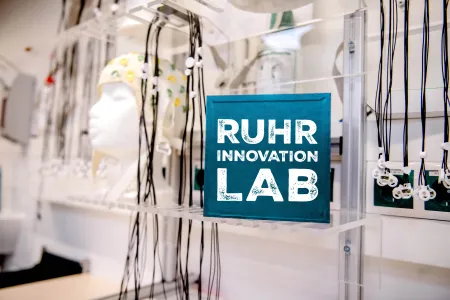
Ruhr Innovation Lab: research for resilient digital infrastructures
Ruhr University Bochum and TU Dortmund University are already setting European benchmarks in research on secure, trustworthy and sovereign digital systems. In one of a total of four research priorities of the Ruhr Innovation Lab, which the two universities established as part of the Excellence Strategy, they bring together Germany’s only Cluster of Excellence for cybersecurity, CASA, the Max Planck Institute for Security and Privacy in Bochum, and the Lamarr Institute. In the research priority “Building a Resilient Digital Society,” the researchers from Bochum and Dortmund combine cryptography, statistics, AI and human-centered research on trust and usability. In this way they address systemic risks emerging in 6G, the Internet of Things (IoT) and data-driven societies.