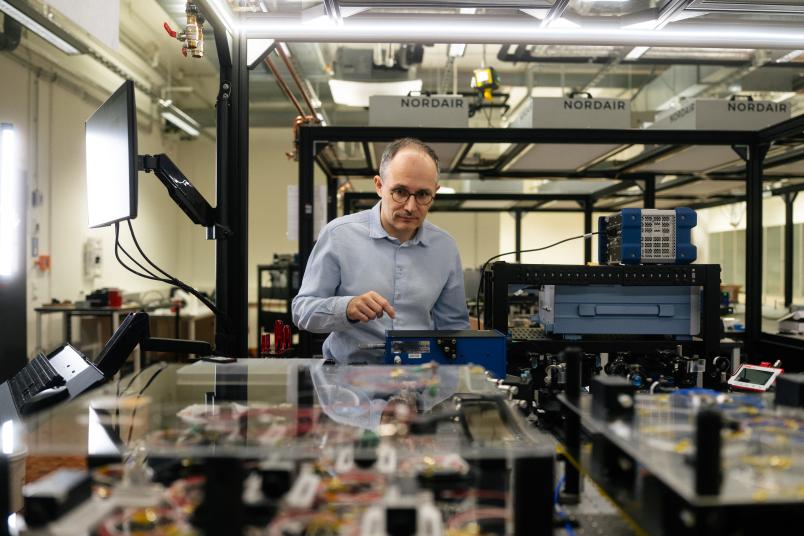
Store-bought lasers are out of the question for the working group “Nonlinearity Engineering.” The researchers work hard to construct all their systems themselves, which can take months or even years.
Electrical engineering
When Laser Light Dances by the Rules
Nature organizes itself: For example, individual cells create an organism. Researchers are translating the principles of self-organization to technical applications, in the hope of developing an atomic 3D printer.
“Computer, one cup of coffee, black.” The air begins to glow, the beams thicken and take the form of a cup. It materializes with clear contours and is filled with a dark liquid. Replicator technology is likely one of the most coveted inventions from the TV series “Star Trek”. The device prepares all manner of foods and beverages on request and in a matter of seconds. It sounds like science fiction, but it has inspired researchers at Ruhr University Bochum to undertake an ambitious project.
Professors Ömer Ilday and Serim Ilday are working on a 3D printer. It is supposed to arrange materials in one of many possible atomic patterns, such as honeycomb or cubic patterns. “Of course, we won’t have a finished printer here in just five years,” says Ömer Ilday. “We do not want to control where each atom goes – it is probably impossible anyway, but steer them into any one of their possible atomic structures, and we already have some good ideas for how to achieve that.”
The principle of self-organization
Ömer Ilday left Ankara in 2023 as part of a prestigious Humboldt professorship at the Ruhr University Bochum Faculty of Electrical Engineering. He specializes in laser development and laser-matter interactions and is the founding director of the Center for Complex Interactions at Ruhr University. The key word in his research is “self-organization.” Ilday explores the principles by which components of a system independently arrange themselves in a structure that behaves differently than the individual parts – be they light particles in a laser, atoms in a material, or cells in an organism.
Center for Complex Interactions
“Ever since my second semester at university, I have been fascinated by self-organization,” explains Ömer Ilday. “The fact that it occurs in nature proves that it’s possible.” The researcher hopes to understand the underlying mechanisms and transfer them to new applications.
Faster and stronger lasers
The research conducted by Ömer Ilday’s work group “Nonlinearity Engineering” focuses on lasers, meaning sources that generate energy-rich, focused light; they could be optimized using self-organization.
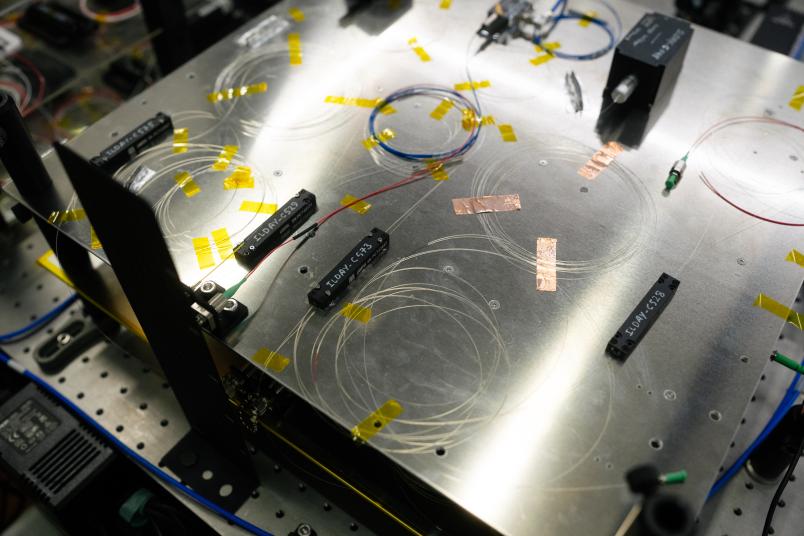
Ömer Ilday’s lab jokingly speaks of Frydays instead of Fridays, because the lasers are pushed to such high levels of performance that some of their components end up cooked through. The metal construction shown here is supposed to redirect the resulting heat from the fibers.
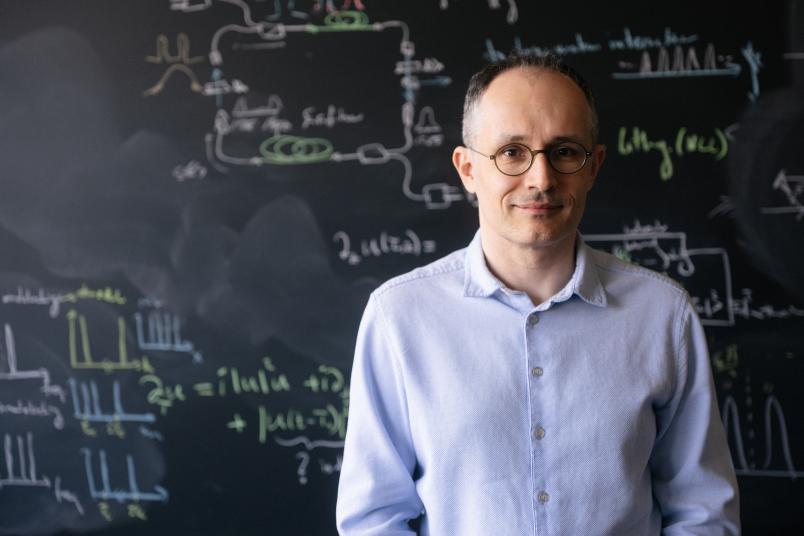
Ömer Ilday is one of the world’s leading experts on lasers. His ambitious research projects focus on the long term. “To realize something like an atomic 3D printer, you need a stable research environment you can rely on for ten years,” he says. “Germany can offer that. I’m very happy here.”
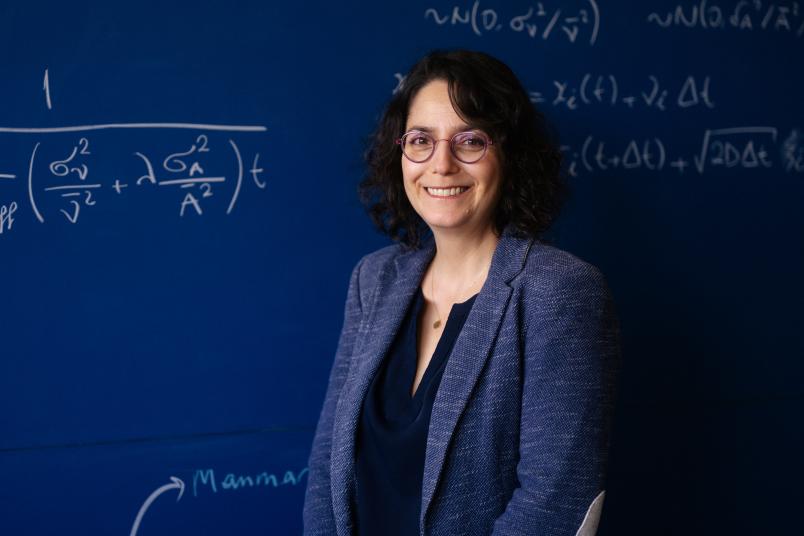
Serim Ilday heads the Simply Complex Lab at Ruhr University Bochum.
Many groups around the world are looking for ways to make lasers faster and more powerful. In this context, faster means that they generate light pulses in ever shorter intervals. One method for achieving this is making the resonator of the laser smaller. At some point, however, a physical limit for the smallest possible resonator is reached. “It’s also very difficult to achieve high levels of energy with small resonators,” explains Ilday.
Resonator
Resonator
The researchers in Bochum produce ultra-short laser pulses not with the smallest possible resonators, but rather with self-organization. They use a relatively large resonator in which the light field organizes into a sequence of regularly spaced pulses—like pearls on a chain in time rather than space. The individual pearls of light exit the laser in the form of short, high-energy light pulses.
Lining light particles up in a string of pearls
However, light particles, also known as photons, do not accumulate in certain points out of nowhere. “When you turn the laser on, the photons always start out randomly arranged,” explains Ömer Ilday. “We integrate certain rules into our system that cause the photons to arrange in the desired structure on their own. We’re investing a lot of brainpower into figuring out how to do this.”
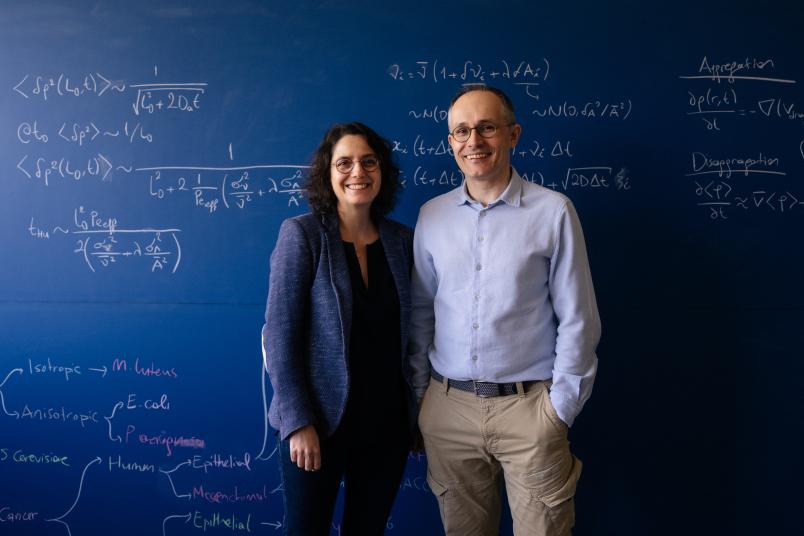
Ömer Ilday transferred to Ruhr University Bochum with his wife Serim, director of the Simply Complex Lab. This is where the couple’s individual research areas overlap, resulting in visionary projects like the atomic 3D printer.
Ilday’s team installs a sort of a “nonlinear” gate in the laser: Weak light suffers high losses passing through, while strong light suffers much less. “You can picture it like a barrier that one person can’t get past, but a group of people pressing against it can break through.”
Simply put, the system follows two rules. First: Weak light is strongly attenuated at the nonlinear gate, while intense light passes through with much lower loss. Second: The laser continuously replenishes the remaining light through its gain medium, so that stronger pulses are preferentially sustained.
In the laser resonator, the light particles never stop, and go round and round the resonator, always reaching the nonlinear gate. If fluctuations lead to locally higher intensity, that portion of the light experiences lower losses at the nonlinear gate and is preferentially amplified. Spread out light particles are largely extinguished. Through this feedback, the light field self-organizes into short, intense pulses that repeat at regular intervals.
The magic word for this self-organization process is “feedback.” The result – in this case, the likelihood that a light particle can pass through the barrier – depends on prior results, namely whether multiple light particles have grouped together.

At times, the energy levels are so high that the technology fries itself. That’s normal and comes with the territory.
An ultra-short pulse laser based on this principle would not only be potentially faster than systems that rely on especially small resonators, but its advantage would also lie in potentially greater powers. Yet the researchers do encounter hurdles in the practical implementation. “We build all of our laser systems ourselves and are constantly pushing them to achieve higher levels of performance,” explains Ömer Ilday. “At times, the energy levels are so high that the technology fries itself. That’s normal and comes with the territory. But you have to make sure there aren’t any chain reactions that will wreck one part after another.”
Fast and powerful – but is it stable?
The technical realization of the concepts is not the only challenge. The idea of creating a great many ultra-short pulses inside the same resonator has been around for decades, and research groups around the world have been struggling with it for just as long. This is because the timing and interactions between the pulses can be difficult to stabilize, and do not yet operate reliably over long periods of time – yet. “I think that we will get around this problem in the near future,” predicts Ömer Ilday. “We’ve already made significant progress.”
Interactions between lasers and matter
Ilday’s research no longer focuses entirely on lasers, but also on the interactions between lasers and matter. This idea came from his wife and cooperation partner Serim Ilday. The principles of self-organization are the same as in the laser itself: Feedback, non-linearity, and fluctuations in the noise play a major role. Hierarchical organization is also important; multiple levels of self-organization ultimately lead to complex behavior. In the case of the laser system described above, for example, one level of the hierarchy ensures that light particles accumulate in a certain point in time, while another level causes them to line up in equal increments like along a chain.
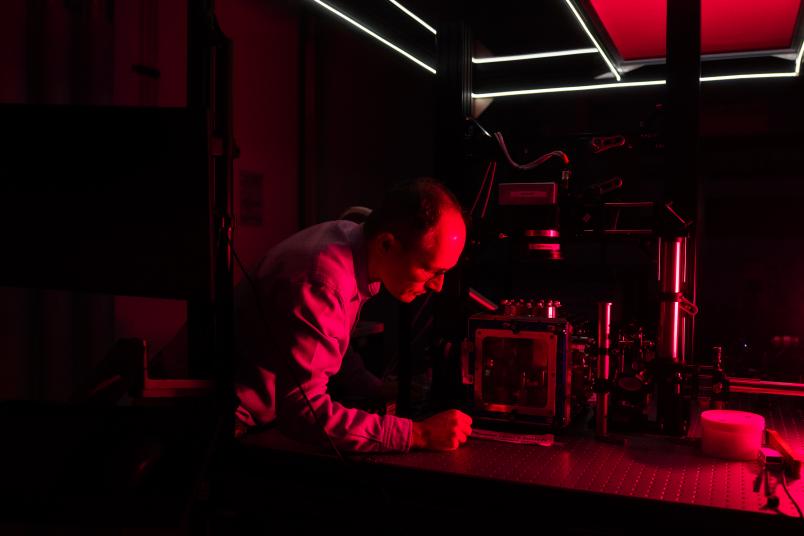
This chamber is where the researchers test the fundamentals of an atomic 3D printer. A laser beam is divided into two bundles, which are then modified differently on their way to the chamber. One bundle vaporizes the atoms of a solid material while the other aims to steer how the vaporized atoms reconstitute themselves.
Once the fundamental principles of hierarchical self-organization within a system are understood, they can be translated to another system. This is precisely what Ömer and Serim Ilday’s groups are working on in order to realize the atomic 3D printer.
Every day that I can spend thinking about the concepts of self-organization and working on formulas, I’m happy.
A cup of coffee won’t appear out of the blue in their labs anytime soon, but this is not their goal. “We don’t want to print anything specific,” says Ömer Ilday. “We’re interested in the scientific questions that we have to ask in order for an atomic 3D printer to one day become reality: What does it take to make it possible, and where are the physical limits?” Ilday’s heart beats for the theory, the formulas. “My job is my hobby and my hobby is my job – I love what I do and am very grateful that I have this opportunity,” he beams. “Every day that I can spend thinking about the concepts of self-organization and working on formulas, I’m happy.”