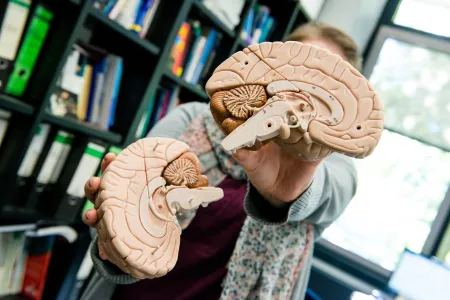
The research building THINK will be opened in 2027.
Research Building THINK
Computing Power for Neuroscience
The high-performance computing cluster at Ruhr University is being expanded. The additional computing power will primarily serve cognitive and neuroscience research. However, other areas can also benefit from it.
With the research building THINK, the Theoretical and Integrative Cognitive and Neuroscience at Ruhr University Bochum will have a new home in the fall of 2026. Around 2 million euros of the budget will be invested in computing power: Specifically for THINK, a High-Performance Computing (HPC) cluster has been purchased, which will be connected to the existing HPC cluster “Elysium” at Ruhr University. The computing power for the research building will thus be centrally provided in the data center on campus.
Research Building THINK
The central location of THINK’s HPC cluster has advantages: “If the THINK team does not fully utilize the computing capacity, the unused capacities will benefit the entire campus,” says Dr. Nina Winter, head of Research Data Services at Ruhr University Bochum. “This structure is in line with the HPC concept across North Rhine-Westphalia.”
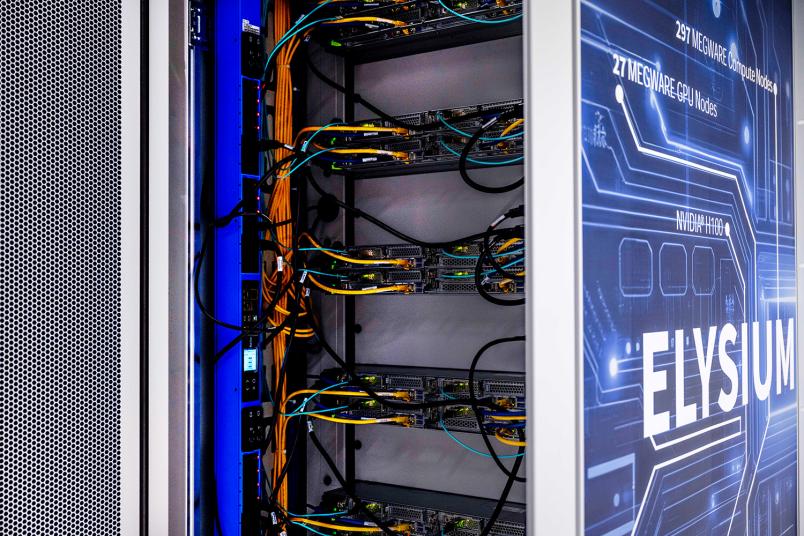
The High-Performance Computing Cluster “Elysium” was inaugurated at Ruhr University Bochum in December 2024.
With the THINK expansion, the computing power of Elysium will increase by 16 percent; the storage capacity will increase by a factor of 2.7. The infrastructure has already been operational since the end of May 2026.
Planned Research Projects
With the HPC cluster, the THINK team will be able to analyze and visualize highly complex data in real-time. For example, magnetic resonance tomography data can be reconstructed during acquisition using advanced and computationally intensive algorithms to check the consistency and quality of the data.
Furthermore, the researchers want to investigate the role of the brain’s anatomical, physiological, and network properties in cognitive processes using computer simulations. In doing so, they simulate individual neurons in detail as well as large networks of abstractly represented neurons. On conventional PCs or workstations, such processes would hardly be possible.
With the HPC cluster, the THINK team can also use modern methods of machine learning for modeling and data analysis. By these means, the scientists, for example, want to investigate in Virtual Reality how navigation behavior is learned.