
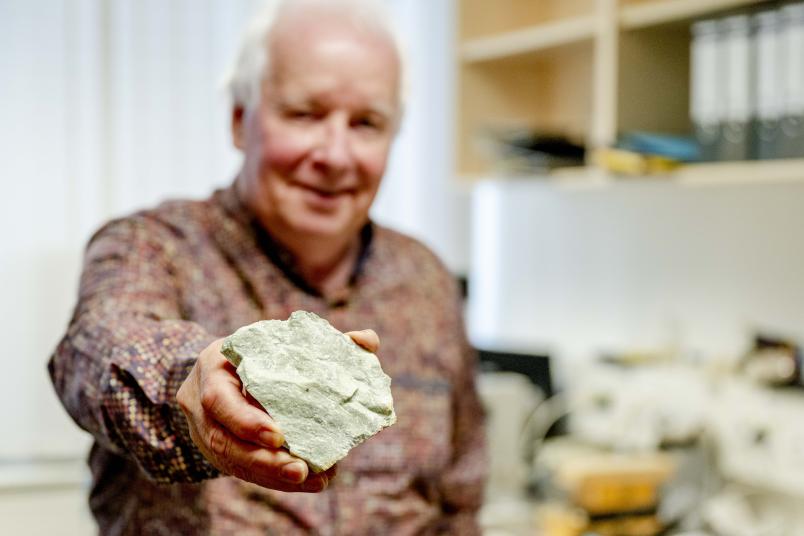
“Jade has become a passion project for me. I can’t get away from this topic anymore,” says Hans-Peter Schertl.
Interview
Serendipitous Discoveries, Jade, and Lunch at a Chinese University
Mineralogist Hans-Peter Schertl is officially retired. However, one guest professorship follows another. His expertise in the mineral jade repeatedly brings him to China.
In 2008, Dr. Hans-Peter Schertl and colleagues from Ruhr University Bochum accidentally discovered an important jade deposit in the Dominican Republic. In this interview, the researcher tells how this discovery happened, what research connections arose from it, and how it granted him several Chinese guest professorships, despite him being officially retired.
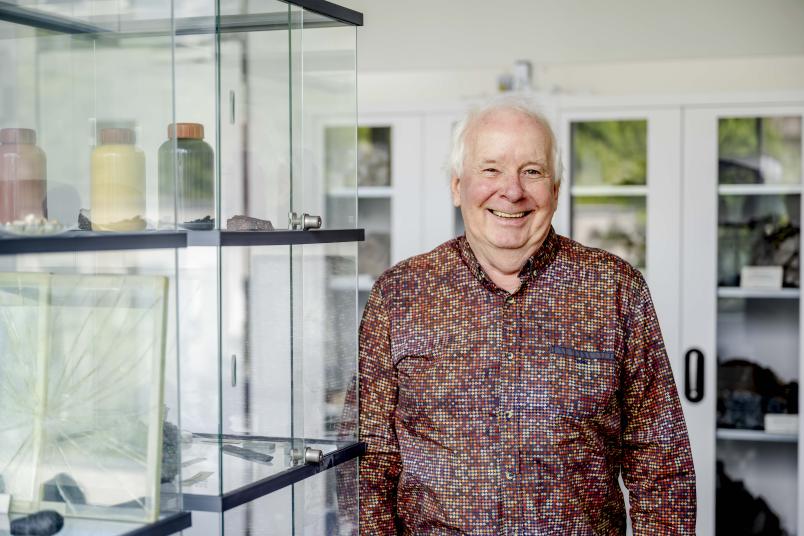
Hans-Peter Schertl worked for 37 years as a mineralogist at Ruhr-Universität Bochum and remains loyal to it even after his official retirement as a senior researcher. He is an expert on jade.
Mr. Schertl, your expertise in the mineral jade has already earned you several invitations to China. But first, please tell us how you came to focus on this research area.
It was pure chance. In 2008, I visited the Dominican Republic with colleagues for a research project on high-pressure rocks. These are rocks that were subducted to great depths by plate-tectonic events. During this time, we found some strange green stuff. It was incredibly hard and almost impossible to separate anything from a bigger block using a hammer. But we finally took a few pieces with us.
You didn’t know what you had in your hands at the time?
No, at that time, nobody knew that there is jade in the Dominican Republic. Worldwide, there are only about 20 natural deposits known today.

To be honest, we had the green chunks we brought back from the Dominican Republic sitting in a drawer for two, three years after our return.
To be honest, we had the green chunks we brought back from the Dominican Republic sitting in a drawer in Bochum for two, three years after our return. Other samples were of higher priority. At some point, we stumbled upon them and thought we should take a look at what they actually are. We prepared thin sections, thin slices only 1/40 of a millimeter thickness. Under the microscope, we were able to recognize the typical properties of jade.
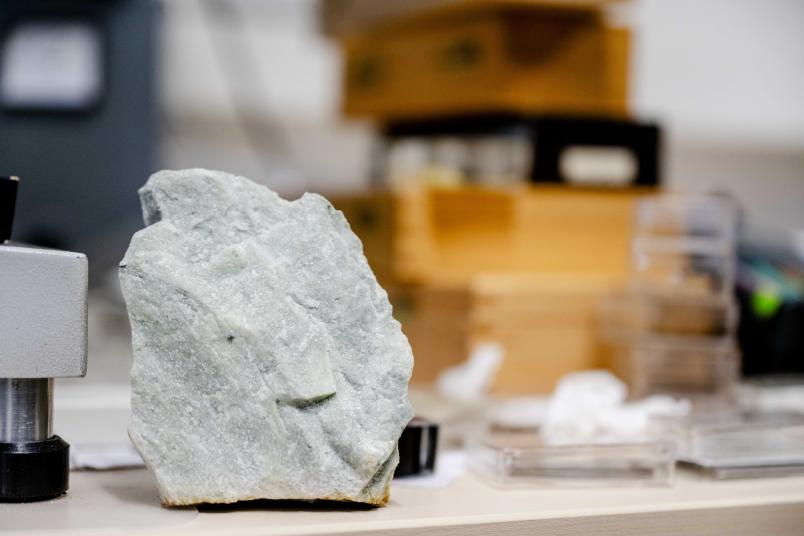
Hans-Peter Schertl and his colleagues collected such rock samples during their excursions to the Dominican Republic and brought them back to Bochum
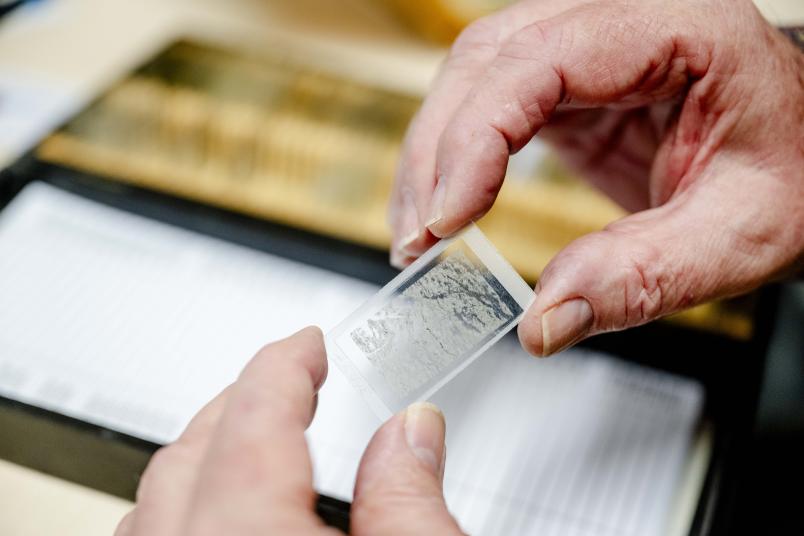
To investigate the properties of rocks under the microscope, mineralogists manufacture so-called thin sections.
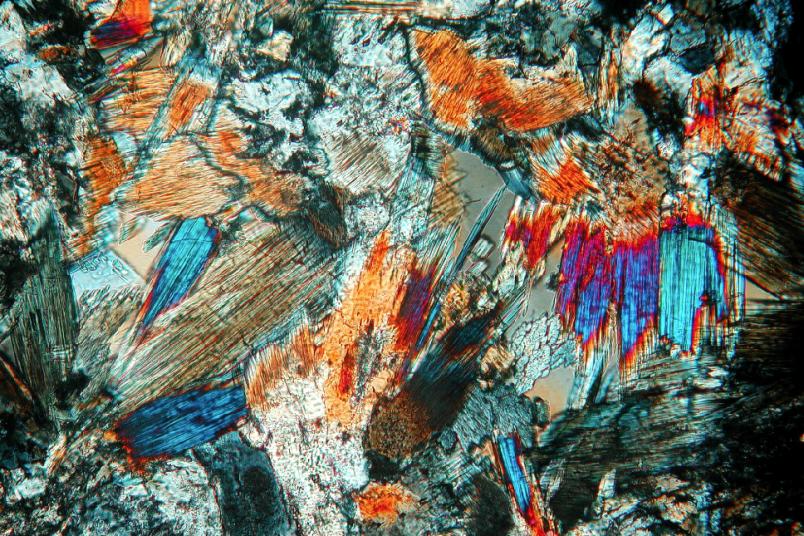
Under the microscope, you can see how the individual jadeite crystals are interlocked, making the material particularly tough – although single crystals are nowhere near as hard as diamond.
And then what happened?
Once we realized that it was jade, we applied for a German Research Foundation project. With the funds, we searched for jade in the Dominican Republic for three years. However, we are not gemstone hunters. We are interested in the formation history of the rock; for example, we are reconstructing conditions such as pressure and temperature, under which it was formed. Finally age dating methods enable us to determine when precisely the jade started to develop.
During our stay in the Dominican Republic, we met some archaeologists – and that led to another research topic.
Which one?
Jade has a high cultural-historical significance, especially in the Mesoamerican, Caribbean and Asian regions. It has been repeatedly processed into numerous pieces of jewelry, cultural objects and tools over several thousand years. Using our mineralogical methods, we can trace the source of jade used to make a particular archaeological object. The findings about the jade deposits in the Dominican Republic opened up new theories about ancient trade routes for the archaeologists at that time.
Meanwhile, you are officially retired, but your jade expertise still brings you the occasional overseas trip.
I am still conducting research at Ruhr University Bochum as a senior researcher. In 2025, I was invited twice for a five-week stay as a guest professor to Hefei, China, to pass on my knowledge about jade to students and to conduct research with colleagues. It was a great experience and a very intense time.
I won’t forget the food in the university canteen.
What impressed you the most?
Several things. For example, how wonderfully I was taken care of by the hosts. Or the overwhelming initiative and interest of the students. Last but not least, I won’t forget the food in the university canteen.
What was so special about the canteen?
The food was incredibly delicious, like in a restaurant, and at the same time very reasonably priced compared to our standards. There was a long buffet from which you could put together small bowls with different dishes and a bowl of soup free of charge was offered every day. That was phenomenal.
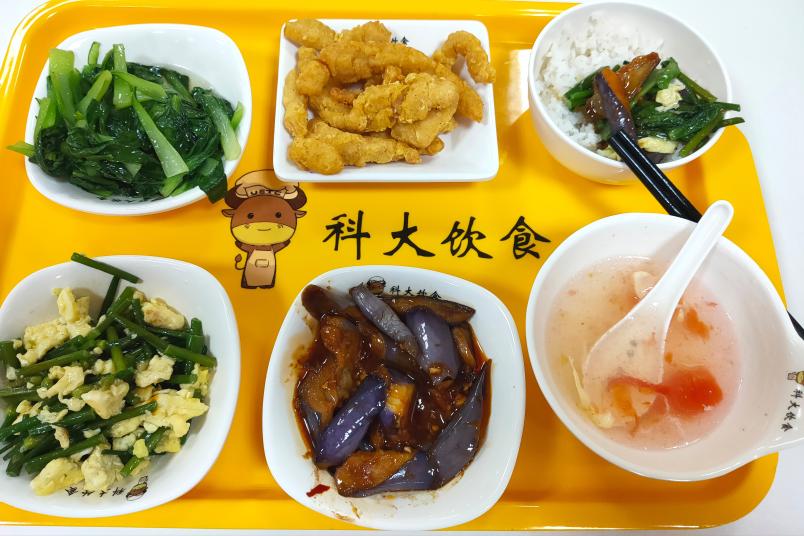
A typical meal in the canteen at Hefei University of Science and Technology in China
Do you actually speak Chinese?
My wife is Chinese, so I can say a few simple phrases. But it is a very difficult language. During my last stay, I was delighted that everyone now speaks English. When I was in China 20 years ago, I hardly dared to move 30 meters away from the hotel because I couldn’t communicate. Now that’s no problem at all.
Have you noticed any other changes?
The culture in research and teaching has changed a lot. In the past, the views of leading academics were widely accepted. Today, there is controversial discussion. I also noticed that Ruhr University Bochum is known at several Chinese universities. At the Department of Geosciences, we now have applications from Chinese students and doctoral students, and those that are here fit seamlessly into our team. Of course, like everwhere else, also in China not everything is perfect. However, a collaboration like ours in the geosciences is highly valuable and beneficial for both parties. Cooperation is the driving force behind new findings and innovations in science.
Will the story of you, the jade, and China continue?
I have just been awarded a three-year guest professorship at the Ocean University in the Chinese city of Qingdao, which involves, among other things, jade. I can’t get away from this topic anymore – and I can’t get away from the wonderful country of China as well. Jade has become a passion project for me and I have made many new friends over the past 20 years in China.