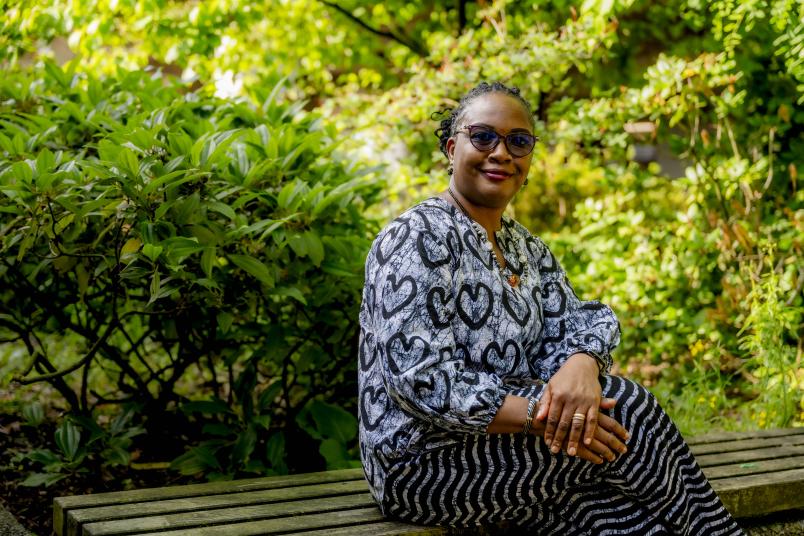
The African scientist Sharon Adetutu Omotoso is drawn to Ruhr University Bochum for the second time. This year, she is a guest at the Marie Jahoda Center for International Gender Studies.
Internationalization
“The real exam takes place out there”
The Nigerian researcher Omotoso loves the lived openness and diversity at Ruhr University Bochum. As an activist, she encourages women to take on leadership roles.
In 2024, Dr. Sharon Adetutu Omotoso set off from Ibadan to Bochum for the first time. Now she has returned with her family for another research stay. As Marie Jahoda Fellow 2026, she is conducting research in the field of Media and Gender Studies.
Ms. Omotoso, what do you like about Ruhr University Bochum?
For me, Ruhr University Bochum is a truly friendly, open place. The people here have welcomed me so warmly and have been so helpful. And their enthusiasm for research – I really like it here. I particularly appreciate that RUB lives and stands for diversity and freedom. I notice this every day on campus.
In what way does RUB differ from your home university in Nigeria?
The University of Ibadan is also a very open university. It is the oldest in Nigeria. And the management is very keen to make the campus even more accessible. Just like here in Bochum, we are used to international guests coming to the campus. Our students are open-minded and both the academic and the non-teaching staff are always there to help you find your way around.
Congratulations, by the way, on the Marie Jahoda Fellowship. How did the contact with Bochum come about?
Thank you! I first heard of Ruhr University Bochum when I was a scholarship holder at the Institute for African Studies at the University of Bayreuth. There I met Henriette Gunkel from RUB, who was doing a research stay there at the same time as me. We stayed in touch. After I had successfully applied for the Alexander von Humboldt Fellowship, she became my host at the Institute for Media Studies. During my first stay here in Bochum, I also took part in the activities of the Marie Jahoda Center, got to know the team and their wonderful work. That’s why I’m so looking forward to being a fellow here this year.
What specific project are you currently pursuing here?
I keep criss-crossing media studies and gender studies. In general, I deal with the lives of wmen, women in leadership positions, women in politics, the political communication of women and similar topics. During my stay here at the Marie Jahoda Center for International Gender Studies, I will be speaking on decolonization in gender studies. We want to show that knowledge is not a monolithic whole, but pluriversal.
Please explain that further.
The idea that there is a universal knowledge is outdated because knowledge is often found where you least expect it. For example, on the streets of Africa. People who have not attended university are still repositories of knowledge. My work focuses on the field of knowledge of gender studies. Gender studies are now widespread worldwide and go beyond traditional women’s research. However, it is misleading to think that these studies are universal. We must listen to different parts of the world and be open to new knowledge. There are not only two sides of a coin, but possibly also a third.
Invitation to her talk
Invitation to her talk
And this has consequences for teaching: How will we teach gender studies in the future? What are the most important topics? What threatens the discipline? And how can we spread this knowledge and use it for social impact? It’s not just about teaching theories in the classroom, but also about the connection to practice and cooperation with decision-makers.
What do you hope for from the exchange here at RUB?
We deal with similar topics worldwide in gender studies: there is the struggle for the recognition of gender studies as a discipline, institutional challenges, as well as the tension between the academic world and civil society actors. These patterns are similar worldwide, but there are also differences. For example, in the way gender studies are taught or theoretically conveyed. Theories discussed in Bochum may differ from those in Africa. And I look forward to the exchange on this.
How did you come to your research area, gender studies and media studies, in the first place? You are also active as an activist. Who has inspired you?
In Nigeria, I headed the oldest women’s research and documentation center on the continent. The Women’s Research and Documentation Center was founded in 1987 by Bolanle Awe. We are fortunate that our matriarch is still among us - she is 94 years old and an inexhaustible source of inspiration and motivation for me. She was the first professor in Africa for oral history - at a time when the world only believed in written history. But she insisted that knowledge lies in our words: in the stories of the elders, in our conversations and our connection to nature. And so she had to fight for this chair as well as the founding of the women’s center.
That was almost 40 years ago. Since then, a lot has changed.
Yes, the center has expanded. We now offer gender studies as a graduate program. We have a gender office that is active in the administrative area of the university. In addition, there is a women’s law clinic, and we also promote masculinity studies. Although the Nigerian system still does not recognize the LGBTQ community, we also conduct research in this area. So it’s no longer just about studying women.
As an activist, you also strongly advocate for women to take on leadership positions. During your stay at RUB, you will also give a workshop on gender leadership. What drives you and what can participants expect?
In the workshop, we broadly deal with mainstreaming gender in administrative settings covering, gender analysis, budgeting, gender audits and so on. We want to examine how gender aspects are integrated into official documents, systems and leadership levels. We will discuss problems based on real case studies and try to solve them.
Gender Leadership Workshop for Students
Gender Leadership Workshop for Students
I always tell my students in gender studies that the real exam is waiting for them out there. I expect them to write articles and do paperwork, which is good for the academic world, but the real exam is out there. For example, when they are invited for public enlightenment on the radio. When they enter rooms where people are oppressed and they have to speak for them. When they talk to decision-makers and have to convince them to implement certain things for the benefit of people with disabilities and the disadvantaged.
Your advice to our female students?
Think about leadership ahead of time. This starts with commitment on campus and voluntary work. These experiences are the starting point for leadership qualities. So don’t just focus on learning. There is more to impactful living than good grades!