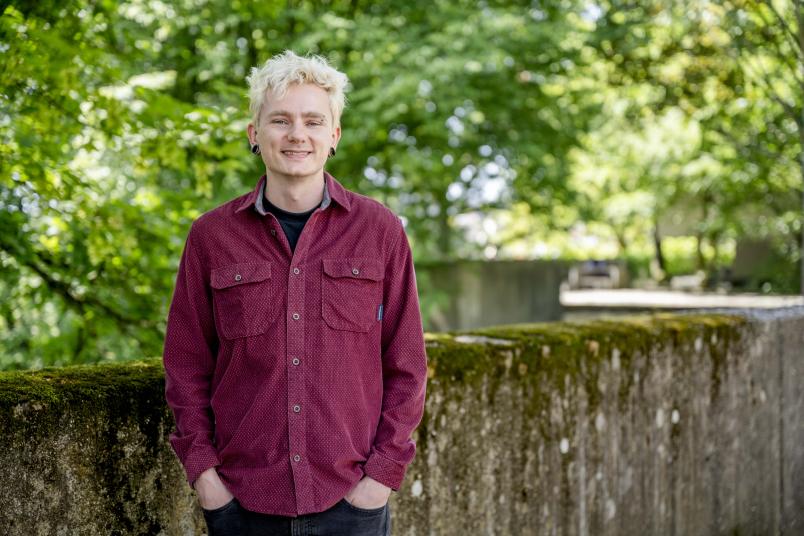
Lithuanian PhD student Erik Ilkevič was a guest at the Chair of Cognitive Psychology at the Faculty of Psychology for three weeks.
Internationalization
“Reach out and network”
Erik Ilkevič from Lithuania gained insights into the research at the Institute for Cognitive Neuroscience.
Spending time with researchers whose publications one admires – this opportunity was offered to Erik Ilkevič from the University of Vilnius thanks to the German-Baltic cooperation project “Feelings in the Eyes: Toward Standardized Pupillometric Analysis in Emotion Regulation Research.” In this interview, the PhD student reports on his research as well as the boundaries and possibilities of pupillometry. Ilkevič also tells us what he likes so much about the RUB campus and why he leaves inspired and can only recommend such a research stay to other PhD students.
Mr. Ilkevič, you spent three weeks at the Department for Cognitive Neuroscience at the Faculty of Psychology. How did you like it here at Ruhr University Bochum?
It was all great. The weeks flew by and I would have liked to stay longer. I met all these brilliant minds here, the PhD students were all very friendly, benevolent and helpful. And I am very grateful to Oliver Wolf and Katja Langer for taking care of me and inviting me here, and of course I hope that further cooperations will result from this.
Did anything strike you in particular?
The size of the campus. I wouldn’t have thought it was so huge. Also, in Lithuania, especially the older generation doesn’t like this brutalist architecture, as it mostly dates back to the Soviet era. I can understand that. But I find this architecture here on campus simply wonderful. I took a lot of photos of all the plants that greened the concrete. It reminds me of some old science fiction movies.
The campus is probably very different from your home university, the University of Vilnius?
Vilnius University is almost 450 years old. We have a smaller university campus, but many different buildings and faculties are scattered throughout the city.
What brings you to Bochum? Your doctoral thesis?
Yes, for my doctoral thesis, I investigate how emotion regulation relates to hormones, particularly testosterone and cortisol. Here in Bochum, Oliver Wolf and Katja Langer at the Chair of Cognitive Psychology conduct studies on emotion regulation using cognitive reappraisal – this is also the topic we are working on in Vilnius. And like us, the researchers here in Bochum use pupillometry as a measurement method.
How did the contact with Oliver Wolf’s chair come about?
I have read many articles by Oliver Wolf and Katja Langer and thus became familiar with their work. Their research is extremely relevant to my dissertation. In addition, I met Katja in June last year at a conference. We talked and then decided to apply for funding.
Cooperation
Cooperation
What was the aim of your stay?
When reading articles about emotion regulation and pupillometry, it becomes apparent that each lab has developed its own methods for data analysis. This leads to problems regarding reproducibility and transparency. Since each lab chooses the method it deems most suitable, it is difficult to determine which method is actually the best one. My goal here in Bochum was to learn more about data analysis. Under the guidance of Katja, I examined various parameters and analytic approaches for their dataset during this internship. Perhaps we can identify optimal parameters specifically for cognitive reappraisal and jointly write a paper on it.
What exactly does pupillometry measure?
What exactly does pupillometry measure?
So it’s about developing recommendations for standardized data analysis?
Exactly. Our wish is to develop a standardized approach that can be applied to different data sets and deliver consistent results. The challenge in studies of emotion regulation is to distinguish, using pupillometry, which part of the pupil dilation is due to stimulus excitation and which is due to cognitive effort to regulate evoked emotions. This is a central topic for us, and we are looking for methods to separate these components more clearly from each other.
In what ways do the previous methodological approaches differ from each other?
Different labs often examine different time periods when conducting experiments with participants: some analyze the early pupil response to stimuli, others focus on the late response, although both are relevant for emotion regulation. Some labs do not differentiate at all and simply consider the entire amplitude of the pupil change. In addition, there are various statistical methods, such as measuring the area under the curve or more differentiated analysis methods. In short: there is a variety of parameters that are used in different ways.

It would be nice to identify the optimal parameters that explain the different aspects of the pupil reactions.
What do you hope to be able to standardize?
It would be nice to identify the optimal parameters that explain the different aspects of the pupil reactions: which ones are related to emotional reactivity, which ones to regulation, and finally which ones to arousal after regulation. Theoretically, these three phases can be distinguished, but in practice they are often difficult to separate from each other. Once we have determined these parameters, we can transfer them to other studies.
How would this knowledge help you in your research?
In my doctoral thesis, I am investigating how the hormones testosterone and cortisol are related to emotion regulation. For this purpose, I used self-reports, pupillometry, and electroencephalography (EEG). Interestingly, studies indicate that cortisol is associated with more efficient emotion regulation, whereas testosterone is associated with the opposite.
Pupillometric data could serve as an indicator of the success of emotion regulation.
Now I want to investigate whether these relationships are also reflected in the pupil responses. Pupillometric data could serve as an indicator of the success of emotion regulation. With this method, it could be assessed whether the hormonal effects are also reflected in pupil responses and whether they align with my EEG measurements.
Apart from research, what personal learnings are you taking with you?
It is really inspiring to read the publications of these admirable researchers and then to find out on site that they are just like us – that is really reaffirming. I felt so welcome. And here on site you can talk about things that are never mentioned in the articles, the daily work, failed approaches. That is incredibly enriching.
Particularly valuable for me was to visit the lab and to get to know the way of working of the different research groups.
Particularly valuable for me was to visit the lab and to get to know the way of working of the different research groups. I was fully integrated into the daily routine, attended colloquia and journal clubs and will certainly adopt some ideas at home. My advice to all PhD students: reach out and network!