
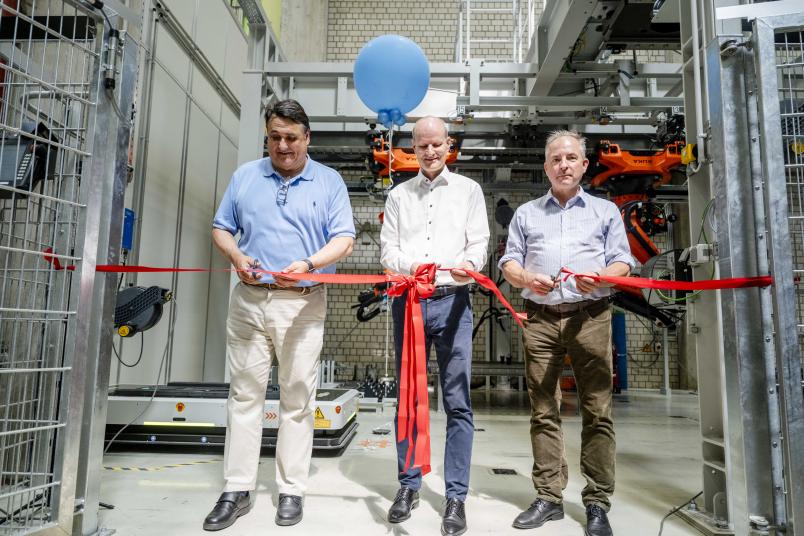
Ruhr University Rector Martin Paul, Professor of Structural Engineering Dr. Peter Mark, and Felix von Limburg, CEO of BT Innovation, (from left) cut the symbolic red ribbon.
Large-Scale Machine Unveiled
Robots Produce Precise, Durable Concrete Components in Three Hours
Complete a highway bridge in a week? Build a house in two days? That would be possible if building components were manufactured the same way cars are, for example.
Assemble the formwork, place and secure the reinforcing steel, pour in liquid concrete, and pop it into the oven. In just three hours, the globally unique CREATE system – short for Concrete Robotics Engineering in Automation Technology – produces a finished concrete component. It is not only fully cured and fully load-bearing, but also precisely manufactured and quality-tested. This digitally controlled workflow could revolutionize construction, as all those agree who took part in the inauguration of the new large-scale system on July 15, 2026, in the KIBKON test hall at Ruhr University Bochum; they watched in fascination as the three industrial robots went to work.
The idea dates back to 2020, reports Peter Mark, Professor of Structural Engineering. “We wanted to draw inspiration from manufacturing methods in mechanical engineering for the construction and put this theory into practice,” he explains. A grant application for major equipment funding submitted to the German Research Foundation was successful, and everyone involved – from the researchers to the RUB administration to the manufacturer BT Innovation – has been deeply committed to the project. “The fact that civil engineering, computer science, robotics, and automation technology come together here is typical of Ruhr University Bochum,” says Rector Professor Martin Paul. “We think beyond disciplinary boundaries and bring scientific excellence to industrial applications.” He also highlights the fact that various research groups from across the entire field of structural engineering will share the new facility. “Civil engineering is truly a trendsetter in this regard.”
13 Tools for Each Robot
Each of CREATE’s three robots has 13 tools that allow them to perform tasks such as gripping, welding, or screwing. They select the appropriate tool themselves. Using self-propelled industrial vehicles, they position the formwork, whose shape can be freely adjusted, and reinforce it with steel rods. The rods are connected by welding or with wires, and then the form is filled with concrete. The component is then transported to the oven, where it is cured. “Basically, it’s like a waffle iron,” explains Peter Mark. All work steps are digitally recorded; the entire process can be tracked using augmented reality glasses.
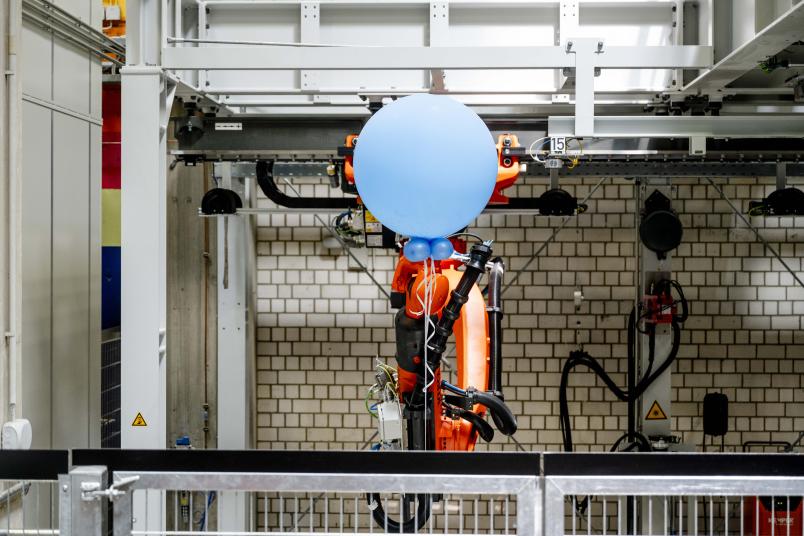
Everyone holds their breath: The robot precisely targets the balloon with its tool.
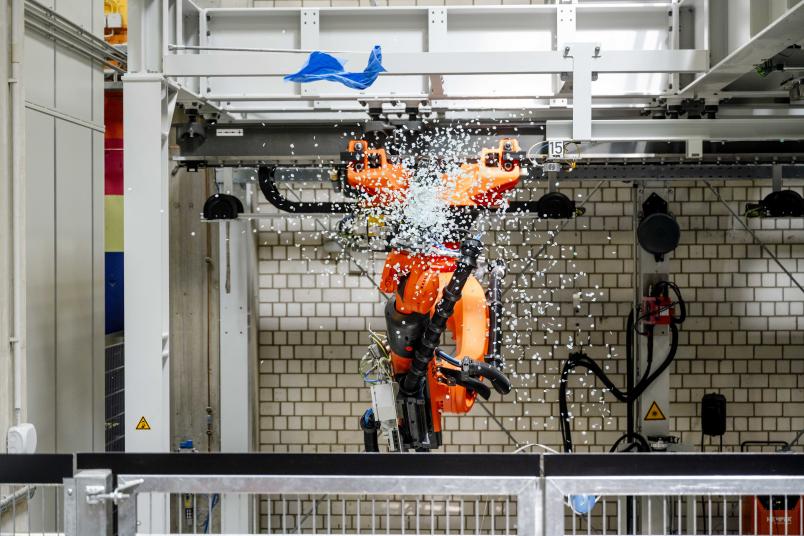
Confetti! The new large-scale machine has been inaugurated.
This process significantly speeds up the construction of buildings for several reasons: “On a conventional construction site, each formwork is built by several workers using wood. They have to tie the concrete reinforcement together with wire. All of this involves a great deal of manual labor, even in precast concrete plants,” reports Dr. David Sanio from the Chair of Structural Engineering. After the liquid concrete is poured, it takes three to five days before the forms can be removed. The concrete then needs to continue curing until it reaches full strength after 28 days. “Labor shortages further prolong these processes,” explains Sanio. “It’s not a pleasant job to work on a hot construction site.”
Faster and More Precise
Digitally controlled robots, on the other hand, can work day and night and also produce more precise, standardized components that differ from one another by only a few submillimeters. Curing within two hours in an oven at 80 degrees Celsius drastically shortens the manufacturing process.
The new facility is intended to help optimize processes on a laboratory scale. It is also available for collaborative projects with industry partners. The researchers plan to use it for tasks within the Collaborative Research Center 1683 “Modular Reuse,” such as processing reusable concrete components.