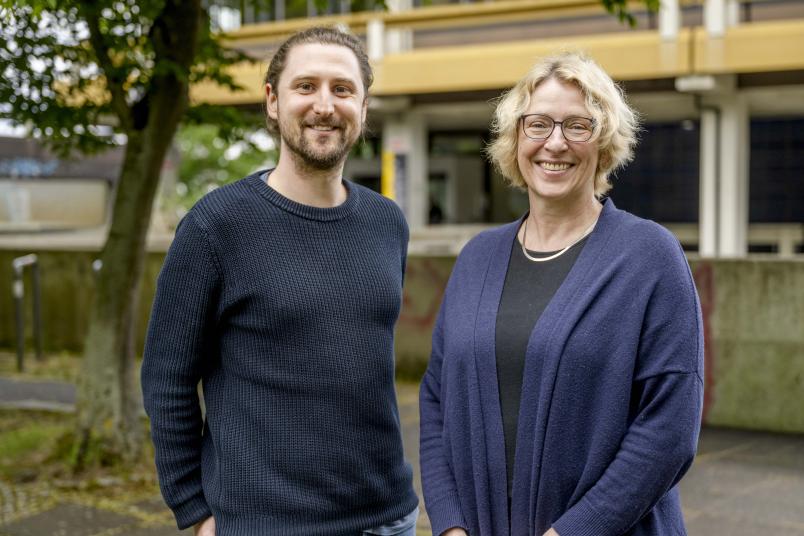
What opportunities and challenges are associated with the use of generative AI in the field of cooperative learning? Nikol Rummel and Sebastian Strauß conducted a systematic review of studies for the OECD.
Artificial intelligence
Powerful with Language – But Also Pedagogically Sound?
The new AI models are linguistically powerful, but can they also aid in learning? Researchers from Bochum take stock for the OECD.
Learning in small groups can be tough. Could AI make a difference in the future? Could it support our joint learning as a chatbot, help us with our group work, or improve our team skills? The potential is quite promising, but research into this topic is still very sparse. Such is the conclusion reached by Professor Nikol Rummel and Dr. Sebastian Strauß. Nikol Rummel is currently leading the research program Educational Technology and Artificial Intelligence at the Center for Advanced Internet Studies (CAIS, Bochum). Sebastian Strauß is a postdoctoral researcher at the Educational Psychology and Technology Research School at Ruhr University Bochum and in the research program at CAIS. For their article in the OECD Digital Education Outlook 2026, they examined current research in the field of cooperative learning in small groups. The OECD Digital Education Outlook 2026 is a collection of articles that take a closer look at the role and effects of generative AI in various teaching and learning settings.
Professor Rummel, what hope is placed in generative AI with regard to cooperative learning?
Rummel: In the case of large language models (LLMs), which we often associate with (generative) AI, there is the hope that they can provide students in small groups with specific, linguistically accessible feedback and prompts tailored to their respective need for support. This opens up a range of roles in the context of collaborative learning that an artificial agent like a chatbot that communicates in natural language can adopt in order to support the collaborative learning process.
Before we get into these roles: Is collaborative learning the same as what is generally known as group work?
Rummel: Collaborative learning generally focuses on situations in which two or more people come together to learn something, and in particular how they do so. It’s about how they interact, communicate, discuss, share information, ask each other questions, think out loud, and handle conflicts amongst each other to develop a joint solution or understanding of the learning material.
For example, collaborative learning can manifest as brief discussions in groups of two, working in jigsaw groups in which individuals share their own (expert) knowledge, or solving a complicated problem together. The idea of cooperative learning is that everyone advances through interaction and everyone has learned something new. Group work as we see it in school or universities is more often the division of labor, so the processes I just mentioned are less likely to occur.

The question the learning sciences have been dealing with long before the development of generative AI is which processes make collaborative learning productive and how we can promote and support the collaboration.
To what extent can generative AI support collaborative learning?
Rummel: Many of us have had the experience that learning with others can be tough or even unproductive at times. This phenomenon has been the subject of research in social psychology for many years. The question the learning sciences have been dealing with long before the development of generative AI is which processes make collaborative learning productive and how we can promote and support the collaboration.
Specifically, researchers have looked at what are known as collaboration scripts. You can imagine them like screenplays or theater scripts. It quickly became apparent that there was either too much guidance, with students feeling restricted by the script, or too little. The idea that computer systems can be used to automatically extract data on collaboration and interaction, and selectively adapt the script, that is, the support, has been around for a long time. This was already a focus of computer-supported collaborative learning, or CSCL. There is a wealth of research on this topic already. Now the question is whether and how LLMs can improve the targeted, customized support of collaborative learning.
While working on your OECD Digital Education Outlook report, what have you discovered about how support systems based on large language models have been used so far?
Strauß: We looked at a lot of studies and identified ways in which LLMs can be used to support groups with their learning. The simplest use case is every group member being given access to an LLM chatbot and using it while working with the team to conduct research. This knowledge is then presented to the group and discussed. In this instance, generative AI is used solely as a source of information, which does of course come with risks. Secondly, AI is used to create personalized material. For example, the chatbot can present an alternative solution that the group can compare with their own and reflect on. Third: Groups jointly delegate tasks to the AI, such as by having it create diagrams or summaries.
At this point, we cannot express any evidence-based recommendations. But the way in which collaborative learning functions has not changed since the introduction of LLM chatbots.
It sounds as though the groups have simply been given a new tool to work with. Are there also ways to directly support the learning in the group?
Strauß: Yes, there are. We identified a second set of possible uses: The fourth is that an LLM-based system can also function as an instructor or facilitator that monitors the collaboration, influences the interaction and collaboration process, and provides pedagogical support when necessary. To do so, the system can formulate rules of collaboration or encourage group members to be more involved, justify their reasoning, or even be more polite to each other.
Number five is that a system can take on the role of a tutor or dialogue partner in one-on-one situations. Number six: An LLM chatbot is integrated into the group as an artificial group member. In this role, the system contributes technical knowledge to discussions or solutions to problems, or asks the other group members to explain something again. This promotes behavior in the group that is associated with learning – but from within the group itself.
Such generative AI systems thus affect the collaboration process. This begs the question of whether the support actually improves learning, too.
Rummel: Such is the hope, at least. Put simply, we differentiate between two learning goals in collaborative learning: We collaborate to learn something new and acquire knowledge about a subject, like biology or math. But you also learn teamwork. Acquiring this future skill is a goal in itself.
Strauß: However, the sobering response with regard to the effects on learning is that the amount of research in the winter of 2025 was still very sparse. We analyzed about 40 studies for our article in the OECD Digital Education Outlook. Only three studies actually looked at subject-specific learning, two others at the acquisition of collaboration skills. That is not much. There is also a lack of methodologically rigorous studies.
At this point, we cannot express any evidence-based recommendations. But the way in which collaborative learning functions has not changed since the introduction of LLM chatbots. We assume that a system has positive effects when it is able to stimulate collaboration processes that foster learning, like explaining, discussing, or combining information.
That is surprising. With how rapidly the technology is advancing, a layperson would have assumed that there would be some initial, groundbreaking studies already.
Rummel: There is quite a lot of system development in this field, of course. AI-based support systems are being developed and integrated into teaching. However, during development, utilizing established learning theories and findings to design systems is often neglected. Furthermore, while there are surveys regarding the use of a system, the extent to which a new tool has actually led to improved learning is often not accurately determined.
What is on your mind currently?
Rummel: We are asking ourselves how we can ensure that knowledge gained from years of research into learning and teaching can be integrated into the design and study of computer-based support, including systems that leverage the capabilities of large language models. We hope that the effects of generative AI support on collaborative learning are investigated using more rigorous methods.
We ourselves have conducted many studies on collaborative learning and adaptive support. Now we are interested in what the (perceived) sociality of such systems does with learning in small groups. However, we have to clarify that a linguistically powerful system alone is not enough to support learners. This is the dilemma the current research faces.
Ruhr Innovation Lab