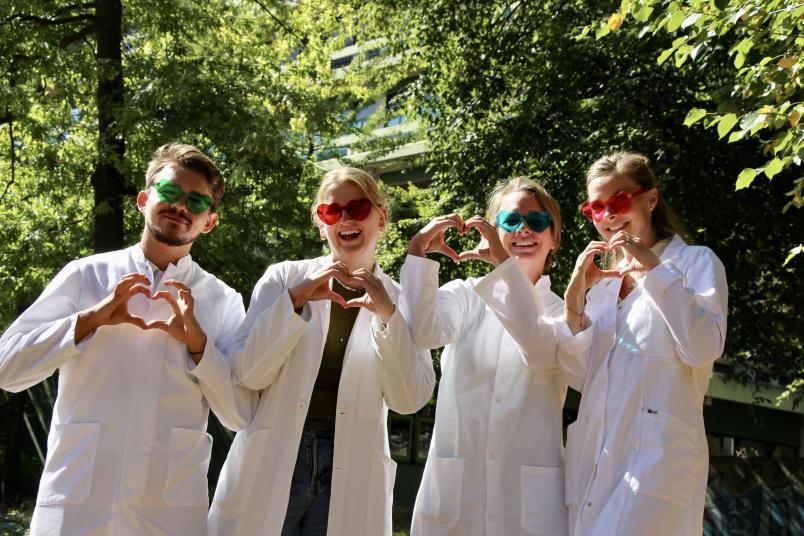
Part of the research team that developed the optogenetic tool with the evocative name “InLOV”: Lennard Rohr, Anna-Lena Linke, Ida Siveke, and Bianca Preissing (from left). The term is a combination of “In” for insulin and “LOV” for light-sensing oxygen-voltage.
Optogenetics
Activating the Brain’s Insulin Signaling Pathway with Light
Insulin regulates many processes in the brain. Until now, insulin signals have primarily been studied using pharmacological methods. Now, researchers are pursuing a much more precise approach with light.
Researchers at Ruhr University Bochum have developed a novel optogenetic tool called InLOV, which enables precise control of insulin signals in the brain using light. Insulin not only regulates blood sugar levels but also plays a key role in learning and neural plasticity. Using InLOV, the team led by Dr. Bianca Preissing and Associate Professor Dr. Ida Siveke demonstrated in mice that insulin signals in the cerebellum regulate specific forms of spatial orientation. The researchers from the Department of General Zoology and Neurobiology published their findings in the journal “iScience” on July 17, 2026.
Precise control of insulin signals
Insulin signals in the brain are conventionally studied using pharmacological methods, such as administering a substance that activates or blocks insulin receptors. However, these receptors can be controlled with much greater precision using optogenetic methods. To achieve this, the Bochum researchers fused a light-sensitive protein with a portion of the mouse insulin receptor, enabling the insulin signaling pathway to be activated by blue light. They then introduced this modified protein into specific cells of the cerebellum known as Purkinje cells, which are crucial for motor function and spatial learning.
Better navigation skills in the dark
When the team activated the insulin signaling pathway, it triggered a typical memory effect in the Purkinje cells known as long-term depression; that is, the synaptic strength of the cells decreased. In behavioral tests, the mice demonstrated improved navigational abilities – particularly in the dark, when they relied on information about their own movements.
The study thus not only provides a new tool for investigating insulin-induced modulations but also shows that these signals in the cerebellum enhance the processing of movement-related data.
“With InLOV, we can for the first time precisely investigate how and when insulin acts in specific cell types and brain regions – with a level of precision that was not possible with classical pharmacological methods,” summarizes Ida Siveke. “Additionally, with InLOV we cannot only study, but also activate the insulin signaling pathway in other regions of the body using light. In the long term, this could, for example, lead to new approaches for therapies targeting insulin resistance."