For about 15 years, newly developed methods have made it possible to examine water in detail. The crucial role this small molecule plays in chemical and biological processes is becoming increasingly clear.
Chemistry
Weak Bonds, Strong Impact
Hydrogen bonds make water what it is: the elixir of life. Researchers of the Excellence Cluster RESOLV are investigating the dance of the molecules and monitor how flexible the bond is.
In 1997, while pregnant, Martina Havenith applied for a professorship at Ruhr University Bochum. She showed up wearing her husband’s jacket, and firmly believed she was only attending the interview for practice. Nearly 30 years later, she is still in Bochum as the spokesperson for an Excellence Cluster that is now in its third funding phase and has established a new research discipline in the field of chemistry. In our interview, the researcher explains how water influences chemical reactions, the role that hydrogen bonds play in this, and the conditions in which water gets really aggressive.
Professor Havenith, from a chemical perspective, water is a simple molecule: two hydrogen atoms and one oxygen atom. You have established a large research consortium around this small molecule. How did this come about?
Water is utterly fascinating. It has characteristics that are entirely unusual for a liquid, and some that you would never expect. It can get highly aggressive under certain temperature and pressure conditions. Above all else, however, it is the elixir of life; nearly all biological reactions occur in aqueous solution. It has long been known that the choice of solvent influences the chemical reaction that takes place within it. Some solvents work better than others. We just did not know why. Now, we can systematically investigate the influence of the solvent, such as water, and make predictions.
This is the focus of the Excellence Cluster Ruhr Explores Solvation (RESOLV), that has been funded since 2012.
Precisely. When we applied for the cluster, we suddenly had new methods available for examining water and other solvents at the microscopic level. We could now see what individual water molecules do. Parallel to this, the theorists could simulate hundreds or thousands of water molecules at once instead of just individual ones. This allowed us to combine theory and experiment, and gain entirely new insights.
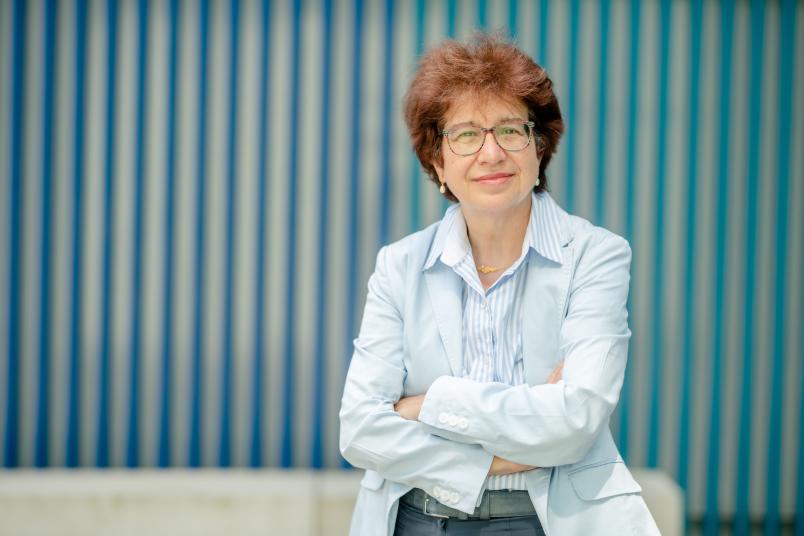
Martina Havenith heads the Chair of Physical Chemistry II at Ruhr University Bochum. Since 2012, she is also spokesperson for the RESOLV Cluster of Excellence.
With these methods, you can examine hydrogen bonds, among other things. What are these bonds, exactly?
A hydrogen bond is weaker than a chemical bond. It can open and close at room temperature, and that’s what it does. In liquid water, this bond breaks and reforms once every millionth of a millionth of a second. I call this water’s terahertz dance, with terahertz referring to the frequency range in which the opening and closing of the bond happens.
Hydrogen bonds
Hydrogen bonds
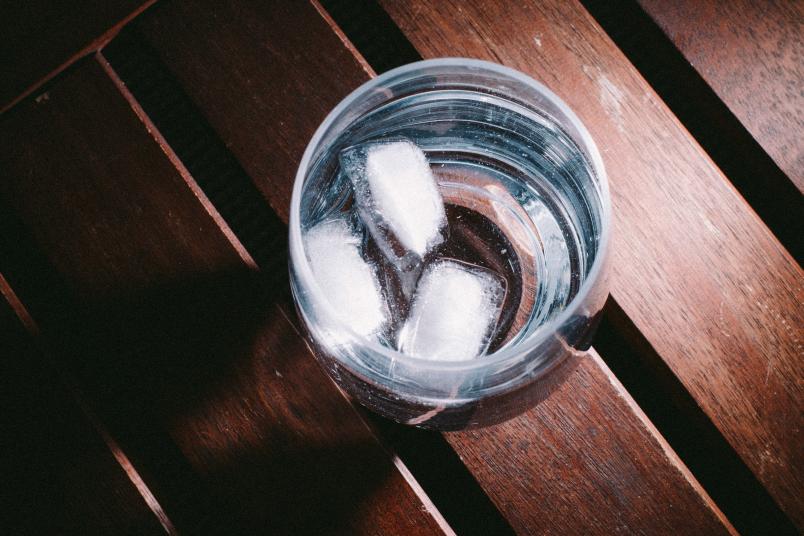
Solid materials normally have a higher density than their liquid states, but this is not the case with water: Ice is lighter than liquid water and floats.
A water molecule consists of one oxygen atom (depicted in red in the image below) connected to two hydrogen atoms (white). The oxygen atom contains two free pairs of electrons that can form a weak bond with hydrogen atoms of other molecules, creating a hydrogen bond. This is a directed bond that gives the water molecule an orientation. When frozen (right image), the hydrogen bonds give water a hexagonal lattice structure. Below freezing point, the hydrogen bonds remain closed; at room temperature, however, they open and close permanently, causing the hexagonal lattice to break up (left image). Individual water molecules can thus fill the hollow spaces in the lattice.
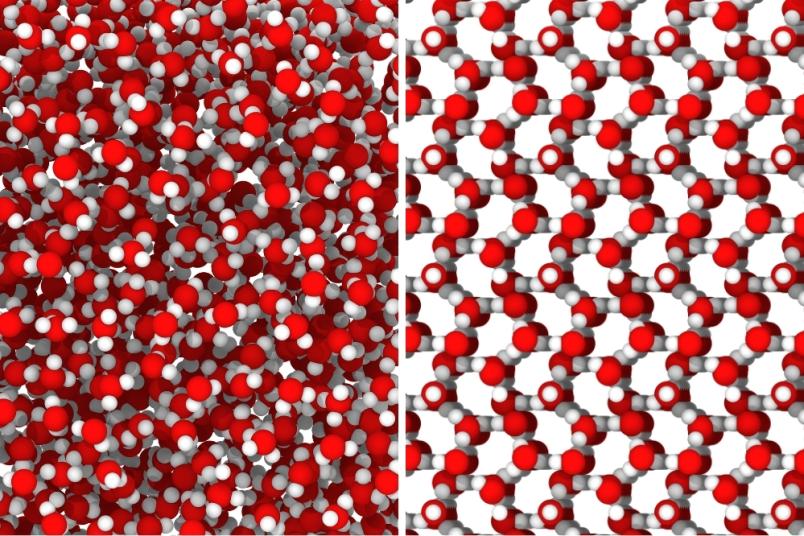
Illustration of the structures of liquid water (left) and ice (right)
What is your favorite research project in RESOLV that has to do with hydrogen bonds?
I immediately think of our project on supercritical water. When you heat up water and place it under high pressure, it reaches supercritical state. Normally, when you heat up water in a pot, you can clearly see the interface between liquid water and water vapor. With supercritical water, this transition is blurred and there is no longer a difference between liquid and gas, no water surface is visible. Water is incredibly aggressive in this state, attacking everything it comes into contact with.
What research question were you interested in for this topic?
We wanted to know whether water in its supercritical state still has hydrogen bonds, meaning a preferred orientation. The researchers were at odds about this.
How were you able to examine supercritical water if it is so aggressive?
Two of the few materials that supercritical water does not attack are gold and diamond. We had to ensure that the water in our testing cell did not come into contact with anything else. The doctoral candidate who conducted the experiment very slowly heated the water overnight via remote control in order to reach the proper state. If you’re unlucky, the water leaks out of the cell and it destroys anything it touches. That happened to us twice.

I wondered if the administrators would ask at some point why we’re always ordering gold and diamond and declaring them to be consumables.
I wondered if the administrators would ask at some point why we’re always ordering gold and diamond and declaring them to be consumables. But then the experiment worked on the third attempt.
What came out of the experiment?
On the timescale of our observations, we could no longer discern a preferred orientation of the water. It therefore no longer possessed hydrogen bonds.
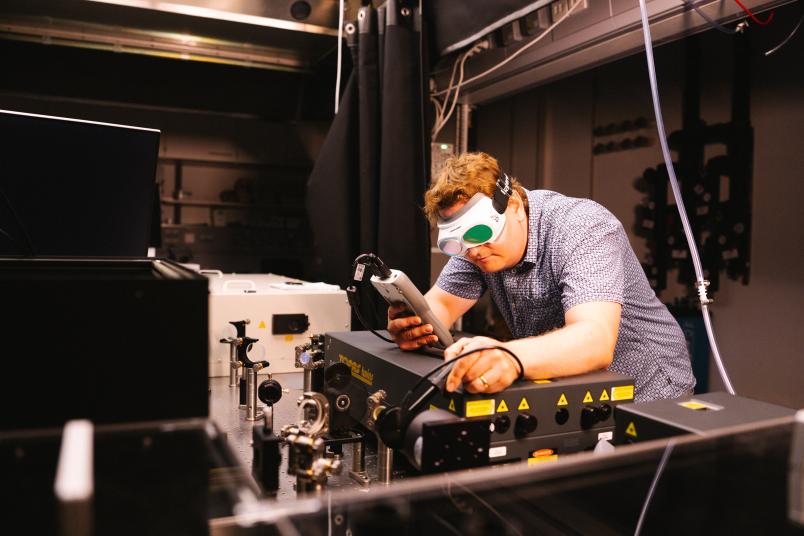
Claudius Hoberg measures the laser power of an ultrashort time spectrometer. This setup allows for the real-time observation of solvent processes that occur on timescales in the picosecond range.
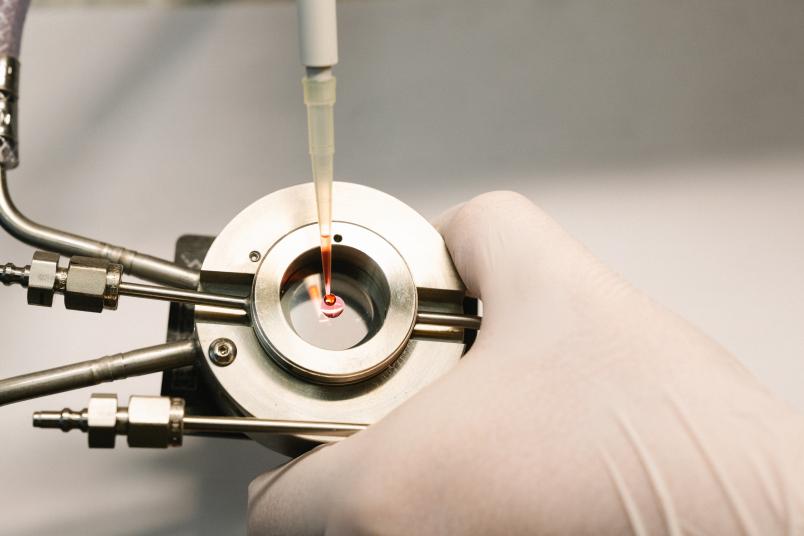
A transmission cell is filled with an aqueous sample solution. The solution is held between two synthetic diamond discs at a precisely defined distance. The temperature in the measurement cell can be fine-tuned, and the solution can be analyzed under extreme pressure. The experiment is conducted in the terahertz spectral range.
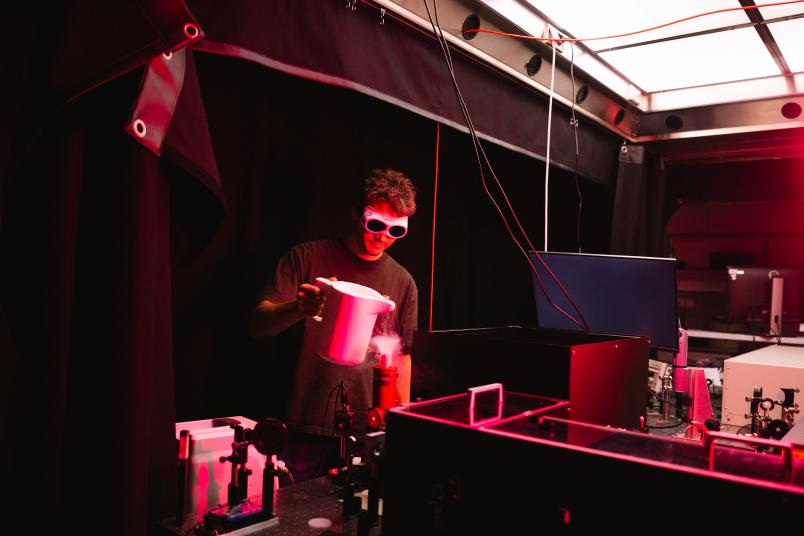
To detect terahertz radiation, special detectors are used that operate at very low temperatures. In the photo, Simon Schulke is filling an infrared detector with liquid nitrogen, which allows for temperatures as low as minus 196 degrees Celsius.
Are you investigating any other characteristics of water?
Among other things, we looked at how water forms hydrogen bonds with other molecules. For example, it prefers to form hydrogen bonds with sugar than with other water molecules. These are hydrophilic molecules, which means they are water-friendly. The opposite is hydrophobic molecules: Water is less likely to form a hydrogen bond with them than with other water molecules. As a consequence, water forms a two-dimensional layer around molecules known as the two-dimensional hydration shell. We have very closely examined the structure of this shell.
We were also able to demonstrate how this type of hydration shell influences chemical and biological functions. These interactions play a role in protein condensation, for instance, which can finally form neurotoxic fibrils in the brain.
What finding surprised you the most?
Many. My doctoral candidates often ask me before an experiment, “What are we expecting?” And I always say, “I’ll tell you afterward.”
I’m especially surprised that we can even see the effects so clearly.
I’m especially surprised that we can even see the effects so clearly, for example, that we can so distinctly differentiate between the hydrophobic and hydrophilic water layers. When I started my research career, we didn’t yet have the adequate methods to investigate this.
That was in 2012, when RESOLV received its first funding.
At the time I actually wanted to leave Ruhr University Bochum, because I felt like the research focus areas weren’t a fit for me. The rector of the university back then told me that if the structures don’t suit the people, it’s not necessary that you exchange the people. You can change the structures, too. He told me to define a new research focus area instead. I had already negotiated an offer from another university and would have received 3 million euros of start-up funding. In Bochum, I only had the chance to write a proposal. I went for the proposal because I’ve always been an optimist and a risk taker.
This proposal gave rise to the Excellence Cluster?
Our original intent was to apply for a research building. At the time – we were naive! – we said it’s not much more work to just apply for an Excellence Cluster on top of it. Of course, it was. Once we were actually working on it, the enthusiasm took hold more and more, and we just kept going. This is how my colleagues in Bochum, Dominik Marx and Wolfram Sander, and I got the idea for RESOLV – but it had a different name at first.
At first, the Excellence Cluster had the acronym “UNSOLV.” We said right away, we’ll never get funding with a name like that.
What was it called?
We had the subtitle “Understanding solvent-driven processes,” which gives the acronym “UNSOLV.” We said right away, we’ll never get funding with a name like that. We still need an R and an E! So, we thought about what words we could use for those two letters, and this is how we ended up with “Ruhr Explores Solvation.” It’s a perfect fit today, because for RESOLV Bochum and Dortmund are now both host universities, and we work with many partner institutions in the Ruhr area.
Looking into the proverbial crystal ball: Where do you see RESOLV after its third seven-year funding phase?
I do not make predictions. Experience tells me that many more utterly surprising and fascinating research results will follow with certainty. Other than that, I won’t tell you what I expect to see any more than I tell my doctoral candidates.
Ruhr Innovation Lab