
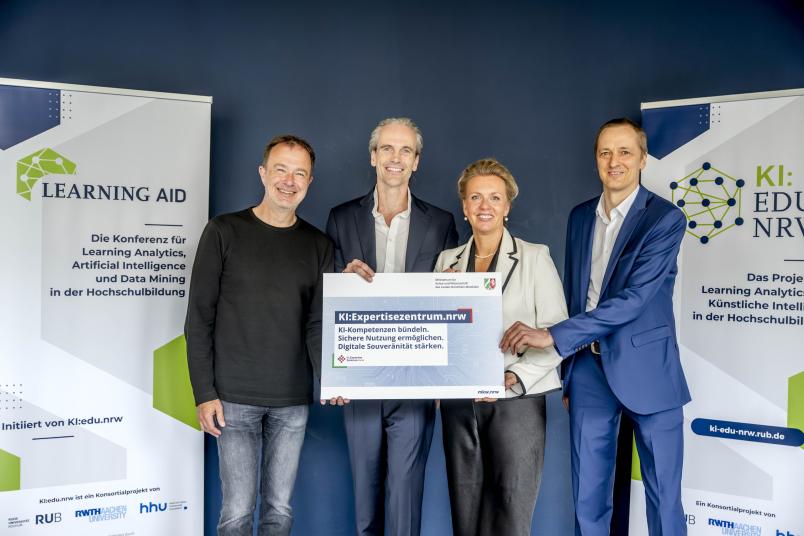
Minister Ina Brandes presented the funding decision to Dr. Peter Salden, Martin Bovermann, and Professor Malte Persike, the team leads for the KI:Expertisezentrum.nrw.
KI:Expertisezentrum.nrw
Working Together to Shape the Use of AI in Research and Instruction
The official launch of the KI:Expertisezentrum.nrw took place at the Learning AID event with the presentation of the funding notification by State Parliamentarian Ina Brandes, Minister of Science, North Rhine-Westphalia.
In recent years, artificial intelligence has reached every aspect of our lives much faster than many believed it would. Research and teaching are no exceptions, and they are faced with all of the benefits and disadvantages that come with this technological advancement. “We can only sustainably develop AI skills, applications, and hardware if we work together,” says Professor Kornelia Freitag during Learning AID – the conference for learning analytics, artificial intelligence, and data mining in higher education. This is precisely the goal of the KI:Expertisezentrum.nrw. On September 1, 2026, Minister of Science for North Rhine-Westphalia Ina Brandes presented the notification of funding to the project team during the conference.
“The challenges that AI entails in research and teaching are so great that we can only overcome them together, with all universities working jointly. With the Digitale Hochschule NRW and the KI:Expertisezentrum.nrw, our universities, art and music schools, and universities of applied sciences are in a strong position to leverage the incredible potential of artificial intelligence for research and instruction. The State of North Rhine-Westphalia is investing in major issues of the future, partially to counter states and large corporations that do not share our values,” said Brandes.
The KI:Expertisezentrum.nrw is seamlessly continuing the work of three successfully completed projects. Across three focus areas, the 40 individuals involved in the project are contributing their technical knowledge of skill development, apps, and hardware. The goal is to give university researchers, instructors, and administrators the ability to use AI responsibly and efficiently, involve the community in the development of applications, and establish a sovereign digital infrastructure.
Added value is already tangible
Although the project is in its initial stages, the added value for universities in NRW in all project areas is clear. A legal opinion aligned with the European Union’s revised AI Act will be published shortly, providing higher education institutions with guidance on the legal framework for the AI transformation. Various training offerings will be available in the winter semester, and new functions for the KI:connect portal are being developed; this portal allows university employees and students to utilize AI language models for everyday use. Several language models that are independent from commercial service providers are already available for use on the University of Cologne and RWTH Aachen servers. As of the 2026/27 winter semester, it will be possible to transcribe audio files, such as recordings of lectures, via the inference infrastructure in the KI:Expertisezentrum.nrw; the inverse, meaning synthesizing texts into audio files, is also in development. Multilingual models operated under university sovereignty are used for both tasks in order to cover the widest possible range of applications across studies, teaching, research, and administration.
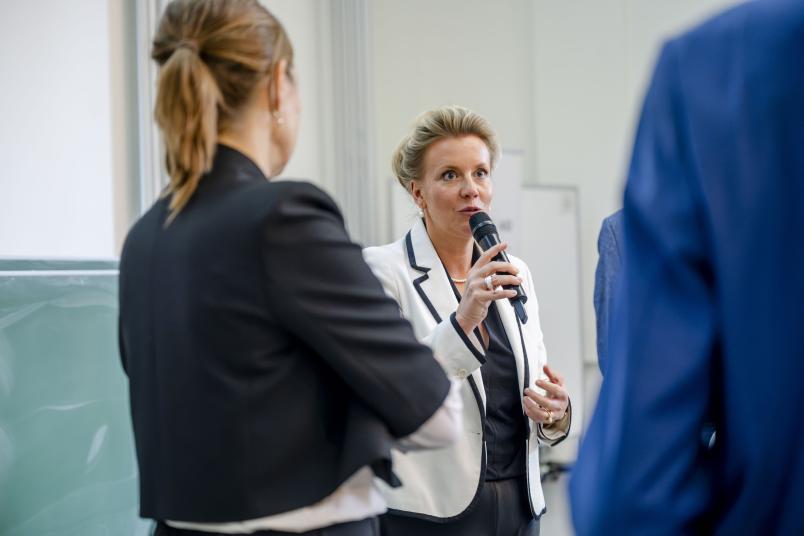
During a panel discussion, Minister Ina Brandes, Professor Susanne Menzel-Riedl (HRK Vice President for University Systems and Organization), and Professor Roger Erb (Chairman of the Stiftung Innovation in der Hochschullehre) discussed issues concerning the use of AI in university operations.
Minister Brandes expressed great satisfaction with the development and referred to a current paper from the German Science and Humanities Council, which commended the NRW state strategy for AI in higher education – developed by predecessor projects and currently being implemented – as “exemplary.” According to Brandes, deepening nationwide cooperation is now on the agenda, a process to which the Learning AID conference also contributes. This conference is considered an annual “summit” on AI in German-speaking institutions of higher education. 350 participants from every state in Germany attended the conference at Ruhr University Bochum on September 1 and 2, 2026.