
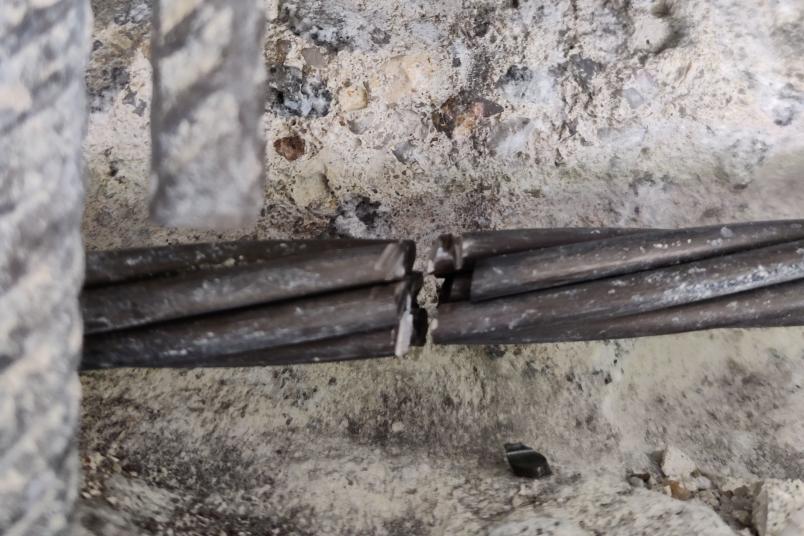
Strands like these are found inside prestressed concrete bridges. If they are damaged, you cannot see it from the outside.
Civil engineering
Transparent Bridges
Many bridges in Germany are at a critical age. If damage could be identified in a timely manner, a bridge’s service life could be safely optimized and reconstruction planned in time before the bridge has to be closed.
September 11, 2024: Out of the blue, the Carola Bridge in Dresden collapses into the Elbe just a few minutes after a tram passed over it. Nobody had noticed anything visibly amiss about the bridge, which was constructed in the 1970s. How could this happen? And how can we tell in time when bridges are about to fail?
“If you take a closer look, no bridge collapses without warning,” says Dr. Mark Alexander Ahrens from the Institute of Concrete Structures at Ruhr University Bochum. “There are always symptoms leading up to it.” They just have to be noticed in time.
However, this is not at all an easy task, especially with prestressed concrete bridges that make up the majority of road bridges in Germany. This material-conserving structural method was developed after the Second World War. Because concrete can bear a lot of pressure but not much tensile force, it has to be reinforced with steel. Yet, due to reparations owed to the victorious power, the available stock of steel in Germany after the war was severely limited. “It is possible to build more economically if bridges are reinforced with embedded steel strands, which are placed under strong tension from the outset so that the entire structure is prestressed,” explains Ahrens. Not only steel reinforcement bars but also empty conduits are embedded in the fresh concrete for this purpose. Multiple thinner steel strands are pulled through these conduits and tensioned at the ends. The remaining hollow space in the conduit is finally filled with mortar. The first standard for this method comes from 1953.

We view concrete as a sponge.
Once the conduits are filled, we can no longer see what is happening inside. Ideally, nothing at all should be happening: The strands are supposed to be protected against air and water. “However, we do not view concrete as a rock, but as a sponge,” says Ahrens. “It breathes all throughout its life, reacts to weather, and undergoes normal aging processes.”

Aeneas Paul and Noah Sträter (right) are researching how to detect in a timely manner whether a bridge has internal damage.
In addition, not everything goes optimally at construction sites, and some things were still unknown when the first prestressed concrete bridges were built. If the strands are left out in the open at the site due to delays, or if workers went home one day and continued with certain tasks the next day, water pockets and air bubbles could remain in the conduits. Corrosion can happen in these areas that is unseen from the outside and slowly progressed over many years. Because the strands are permanently under strong tension, cracks form in the affected areas. Individual strands inside the bridge tear without anybody noticing. Then, one day, the bridge can no longer bear its loads and seems to suddenly fail. Experts refer to this phenomenon, which caused the Carola Bridge collapse, as “hydrogen-induced stress corrosion cracking.”
Four types of steel are particularly susceptible
The first instances of such damage were discovered on Prinzenallee in Düsseldorf in the 1980s. Numerous findings regarding this have since been incorporated in the respective standards. Four types of steel that were frequently used for bridge building are particularly susceptible to hydrogen-induced corrosion stress cracking. Use of such steel ceased in West Germany after this discovery, but continued in East Germany until the mid-‘90s. “There is often documentation about old bridges that tell you what kind of steel was used for the prestressing,” explains Ahrens. “This helps to better assess the risk. But sometimes the information is inaccurate or not available.“ Furthermore, tension strands can also fail due to material fatigue from recurring road traffic. Coupling joints, where the concreting sections of a structure are connected to each other, are particularly at risk. As a result, they are used in bridge sections that are presumably subjected to less stress, which works well in some cases and less so in others.
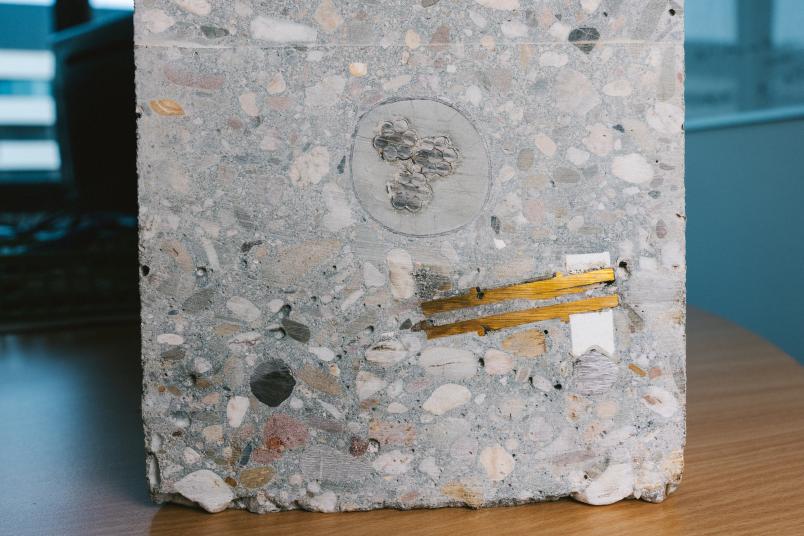
In the cross-section, the steel strands are visible at the top; they are incorporated into the bridge and enclosed in an airtight casing. At the bottom right, an ultrasound sensor embedded in the bridge has been cut through.
When faced with the known risks, what can be done to notice in time when a bridge is weakening? The researchers at the Institute of Concrete Structures have developed two methods to do just this. Noah Sträter employs ultrasound. “We equip the bridges with a network of ultrasound emitters and receivers, one about every five and a half yards,” he explains. The sensors are placed inside bore holes, which are then refilled. The ultrasonic waves pass through the bridge and generate a characteristic pattern. By repeating the measurement later and comparing the patterns, researchers can tell whether and where a change has occurred inside the structure, as changes in the concrete affect the propagation of the ultrasonic waves.
How ultrasonic waves propagate
“Of course, we cannot tell with the retrofitted sensors whether the bridge has changed compared to its condition when it was erected,” explains Sträter. “But we do see changes between ongoing measurements and can estimate whether damage processes are progressing unseen inside the structure.” If this is the case, measurements can be taken at short intervals to safely maximize the bridge’s service life and detect in good time if the structure is at risk of failure. “The worse the damage is, the faster it progresses,” says Sträter. “In this way, we can determine in a timely manner whether there is a risk of danger and strengthen the bridge, or close it if necessary.”
Optical fiber detects strain
Aeneas Paul has developed another method: His approach is based on distributed fiber-optic sensors made of glass fiber which are bonded in place across lengths of up to over 160 feet and can be distributed along the entire length of the bridge, even if it is miles long. The optical fiber is highly sensitive to strain. By transmitting a laser pulse through the fiber and analyzing it, the changes in the structure’s strain can be determined with a resolution of up to one millimeter based on the characteristic fingerprint of the optical fiber. Repeating the measurement and comparing the values makes it possible to precisely determine whether and at which locations the bridge has expanded or contracted. “If prestressing strands inside the bridge fail, this manifests on the surface as strain effects that cannot be detected with the naked eye,” explains Paul. The optical fiber detects these minute changes. According to Paul, this allows the monitoring of a structure and the identification of symptoms of a possible failure in a timely manner.
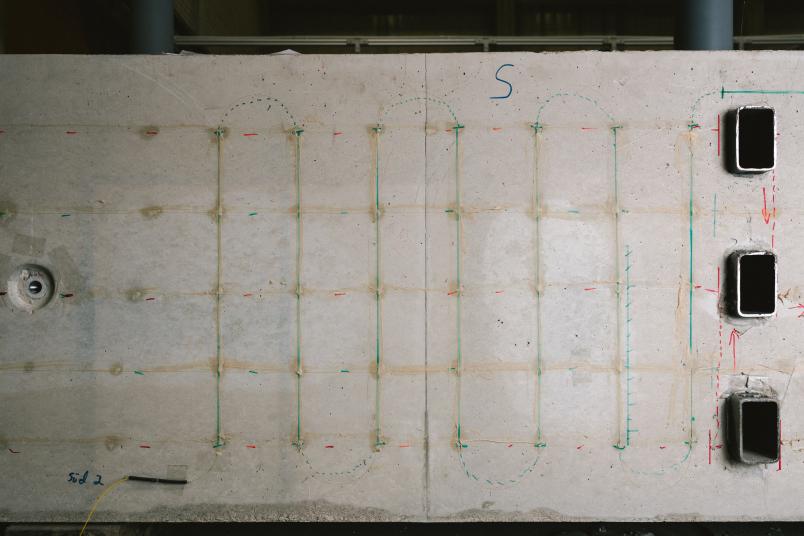
Changes within the bridge structure can be detected using fiber-optic cables attached to it.
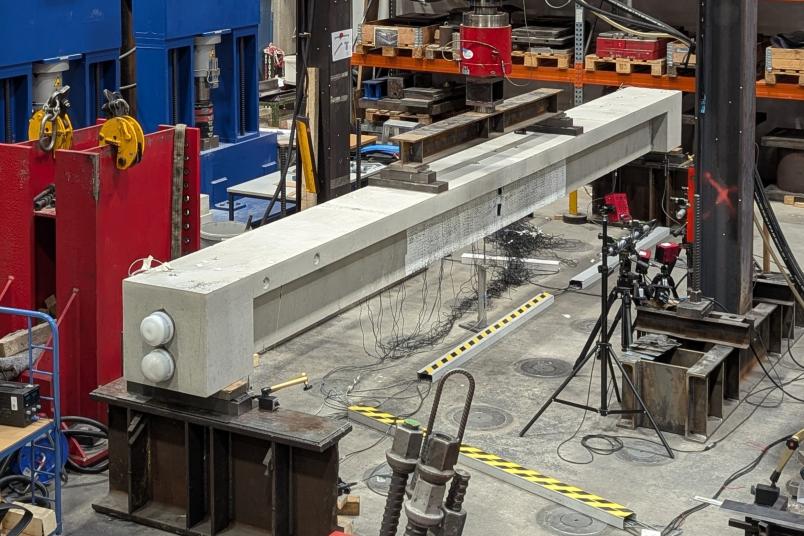
In the test facility, the researchers conducted experiments with concrete components that they could press using a die.
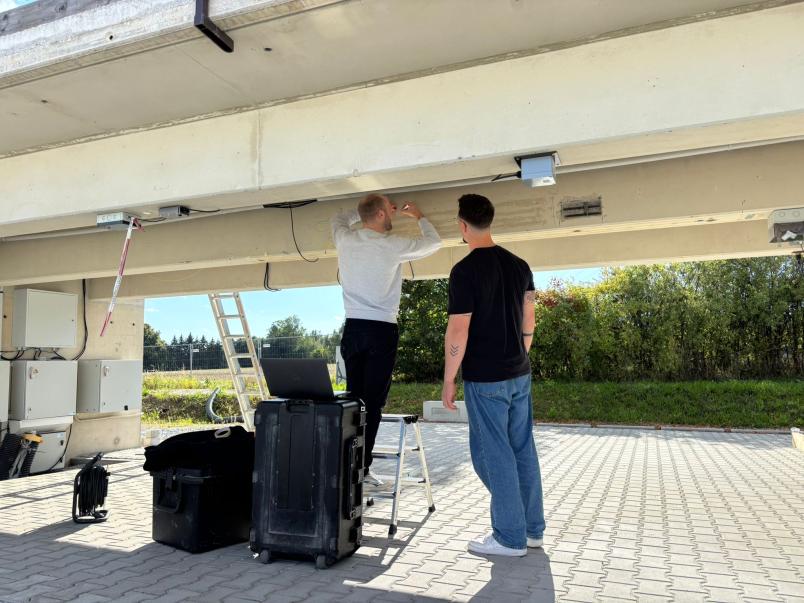
The researchers also tested their methods on actual bridges. In this process, fiber-optic cables are attached to the underside of a bridge.
There are advantages and disadvantages to both methods: The ultrasound measurement requires relatively little effort, but also provides a lower resolution. The optical fiber is high-resolution, but the measurement requires enormous quantities of data. Gluing it onto the bridge is also a demanding task. If the fiber breaks, the entire sensor fails. Both methods of measurement function while the bridge is in use; events such as a heavy truck driving over it or an accident happening can be factored out.
“Each bridge requires a special monitoring concept based on one’s prior knowledge of it,” says Ahrens. Monitoring would make it possible to plan a new construction – in time, years in advance of the possible failure – that can replace the bridge later without the roads having to be blocked for years. In light of approximately 40,000 long-distance road bridges, largely built from the 1960s to the 1980s, the need is immense.