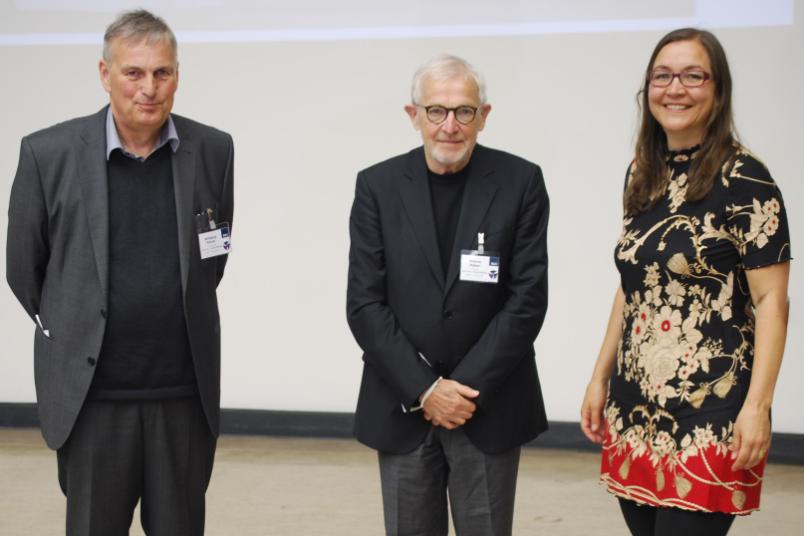
During the honorary doctorate ceremony in 2022 (from left): Wolfgang Rhode, Francis Halzen, and Julia Tjus
Nobel Prize for Francis Halzen
The Success Story of the IceCube Neutrino Observatory
In the antarctic ice, the pioneer of neutrino astronomy opened a new window to the universe. He has held an honorary doctorate from Ruhr University Bochum since 2022.
The 2026 Nobel Prize in Physics was awarded to Professor Francis Halzen. The Belgian-American physicist was honored for his “decisive contributions to the IceCube Neutrino Observatory and the discovery of high-energy neutrinos of astrophysical origin”. For Ruhr University Bochum and TU Dortmund University, this honor is also a special occasion: Halzen received an honorary doctorate from Ruhr University in 2022 and has been closely associated with research at both universities for more than 20 years.
Halzen is considered one of the founders of neutrino astronomy. His central idea was to install light detectors deep within the Antarctic ice to detect neutrinos from space. These elementary particles are extremely difficult to detect because they barely interact with matter. That is precisely why they are so valuable to astronomy: they can reach us virtually undisturbed from regions of the universe that remain hidden from other observational methods – for example, from the vicinity of black holes or from exploding stars.
A telescope deep within the Antarctic ice
In 2011, researchers completed the IceCube Observatory. The deep ice at the South Pole is used as a giant detection chamber: More than 5,000 highly sensitive light sensors are installed within a volume of approximately one cubic kilometer of glacial ice. They detect faint flashes of light produced by particle collisions within the ice.
However, the search is challenging: IceCube detects about 100,000 neutrinos each year that are produced in Earth’s atmosphere. In contrast, only about 100 neutrinos per year come from outer space. Filtering these rare events out of the vast amount of data is one of the central tasks of the IceCube collaboration.
The scientific breakthrough came in 2013: the IceCube collaboration, led by Francis Halzen, detected high-energy neutrinos originating from outside our solar system for the first time. This made neutrino astronomy a completely new tool for investigating extreme phenomena in the universe.
The collaboration reached another important milestone in 2023: For the first time, neutrinos were identified that originated from our Milky Way. This discovery was led by TU Dortmund University with the participation of researchers from Ruhr University Bochum. Modern machine learning methods – developed in Dortmund – played a central role in this achievement. They help identify patterns in the IceCube data that would not have been accessible using traditional methods.
Bochum and Dortmund: long-standing partners in the IceCube consortium
A group from Ruhr University Bochum, led by Professor Dr. Julia Tjus, has been a member of the IceCube collaboration since 2009, working closely with the group led by Professor Wolfgang Rhode at the TU Dortmund University. The two locations complement each other in a unique way: Bochum contributes expertise in the theoretical modeling of astrophysical neutrinos and their sources, while Dortmund specializes in data-driven analysis, particularly the use of machine learning.
The connection to Francis Halzen goes back a long way. He was a co-advisor on Julia Tjus’s doctoral dissertation at TU Dortmund University and has been collaborating with researchers from Bochum and Dortmund for more than 20 years. In 2022, Ruhr University Bochum awarded him an honorary doctorate.
“Francis Halzen paved the way for an entire research community,” says Julia Tjus. “As a particle theorist in the 1980s, he started with the crazy idea of convincing people that it was worth lowering detectors on long cables into the Antarctic ice. It is only because of his great foresight and his unwavering persistence in bringing this idea to fruition that we can now see the cosmos in the light of neutrinos.”
Wolfgang Rhode also emphasizes the importance of modern analysis methods for the recent successes: “Using these methods, we were able to achieve a result that would have required 70 more years of measurement time using traditional methods. So we’d still be waiting for that major breakthrough!”
Inspiration for tomorrow’s research
Halzen’s Nobel Prize recognizes an outstanding scientific achievement and, at the same time, the power of international collaboration. IceCube brings together particle physics, astrophysics, engineering, data analysis, and theory. For Bochum and Dortmund, the award is both a validation and an incentive.
The combination of theoretical modeling, experimental expertise, and AI-based analytical methods will continue to grow in importance in the future. Neutrinos can provide insights into cosmic regions that remain hidden from other observational methods, thereby significantly expanding our understanding of the universe.
“The era of neutrino astronomy has only just begun,” says Julia Tjus. “Together with TU Dortmund University, we have just launched a project to use machine learning to search for neutrinos from the proximity of supermassive black holes. Exciting times are ahead and the Nobel Prize is a motivation to take the next steps together.”
Ruhr University Bochum and TU Dortmund University will continue to work together to further open this new window into the universe.
Ruhr Innovation Lab
Francis Halzen has been a long-standing partner of Ruhr University Bochum and TU Dortmund University in the field of neutrino research, for example as part of the “Ruhr Astro, Particle, and Plasma Physics Center,” or RAPP Center for short. The center is part of the “Matter in Terrestrial & Cosmic Laboratories” research focal area at the Ruhr Innovation Lab, which will be funded as Bochum-Dortmund Consortium of Excellence starting in 2027.