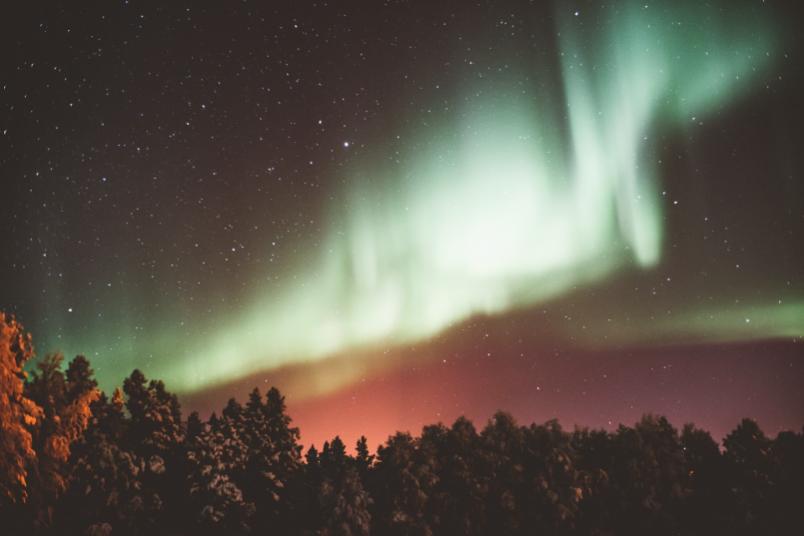
Auroras can be regularly observed in Northern Europe; in Germany the phenomen only rarely occurs.
Physics
Bridging the Scales of the Universe
Auroras are beautiful. At the same time, they demonstrate that the behavior of tiny particles affects processes that unfold in space on immense scales.
In May of 2024, many people in Germany witnessed a rare celestial event. Even in the south of the country, colorful auroras danced across the evening sky. The aurora is only visible at these latitudes during particularly high levels of solar activity. Behind this spectacle is the solar wind, which continuously transports charged particles to Earth. The colorful phenomena occur as a result of processes taking place on tiny scales, specifically the interaction of energetic particles in Earth’s atmosphere. However, the phenomenon is driven by a large-scale process known as solar wind, which extends across millions of kilometers through space. This is where Professor Maria Elena Innocenti comes in.
Innocenti, who leads the Computational Plasma Physics Group at Ruhr University Bochum, develops computer simulations that bridge the gap between the different scales. “Processes on the vast scale and the tiny scale are connected,” she explains. “If you really want to understand physics, you can’t ignore either of them. Some very small-scale processes play a critical role in the broader system. So, we have to incorporate as much information as possible into our computer models.”

Even as a child, Maria Elena Innocenti wanted to be involved with space. Today, the professor at Ruhr University Bochum is exploring the interaction between small- and large-scale processes in the universe.
In a world where computing power did not matter, it would be possible to simulate all particles moving between the Sun and Earth and thereby create a precise depiction of the actual processes. In reality, however, such detailed simulations are only possible for small sections of the entire system. Anything more would push even the most powerful supercomputer to its limits.
Connecting small and large scales in simulations
For this reason, Innocenti and her team have devised some methods for connecting small- and large-scale aspects of a system in simulations. “For example, we work with multiple hierarchically arranged models,” says the researcher. One model that represents a small-scale process can be embedded into a model that simulates processes on other scales.
To stick with the aurora: A model that simulates large-scale processes can be used, for instance, to try to predict when the Sun will be particularly active and when processes will occur that could lead to auroras. “This is not only interesting because auroras are pretty to watch,” says Innocenti. “It’s also because events triggered by solar activity can disrupt communication systems, like satellites.” In a project supported by the German Aerospace Center, the researchers from Bochum are currently contributing their expertise to improve the simulation of space weather events in the terrestrial magnetosphere, i.e., in the region around Earth where the terrestrial magnetic field dominates particles dynamics.
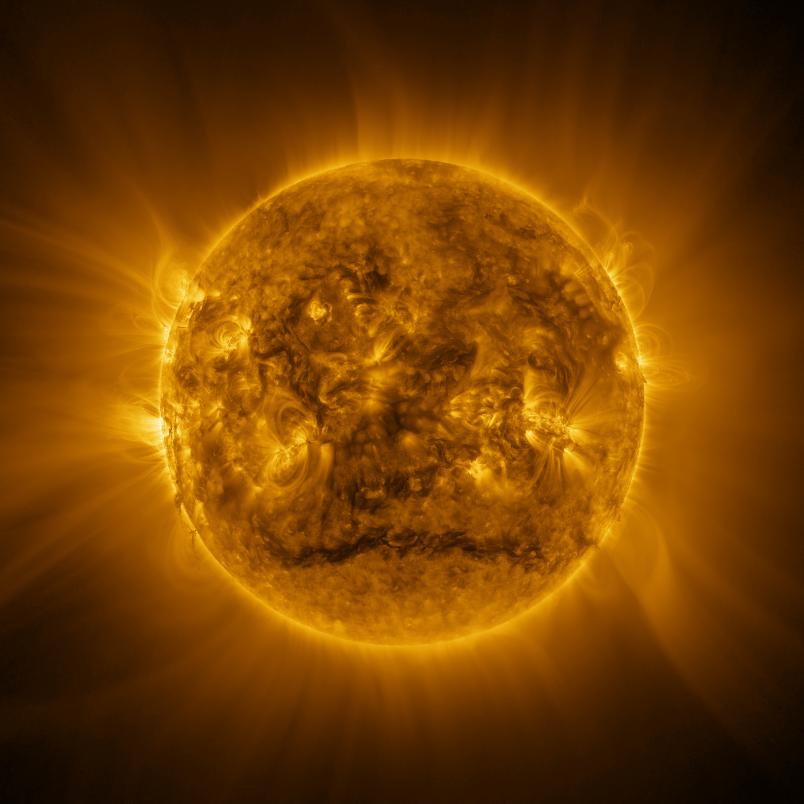
This image was taken during the Solar Orbiter space mission. It depicts the atmosphere of the Sun in ultraviolet light. Where the glowing loops are visible, the Sun is particularly active. Data from Solar Orbiter are intended, among other things, to help understand what accelerates the solar wind moving through space at hundreds of kilometers per second.
When it comes to processes that shape the terrestrial magnetosphere, Innocenti is particularly fascinated by magnetic reconnection, one of the most important energy conversion processes in space: Magnetic energy is converted into kinetic energy, meaning that particles are heated up and accelerated.
Where magnetic fields collide
This physical process, which happens on both the dayside and the nightside of Earth, occurs when magnetic fields of different orientations are pressed against each other and merge. The solar wind, i.e. the stream of charged solar particles impinging on Earth, has its own magnetic field. If the magnetic field of the solar wind encounters that of Earth with a suitable orientation, magnetic reconnection occurs. “Indeed, magnetic reconnection is driven by large scale processes,” says Innocenti. “But it boils down to the trajectories of individual electrons and protons.”
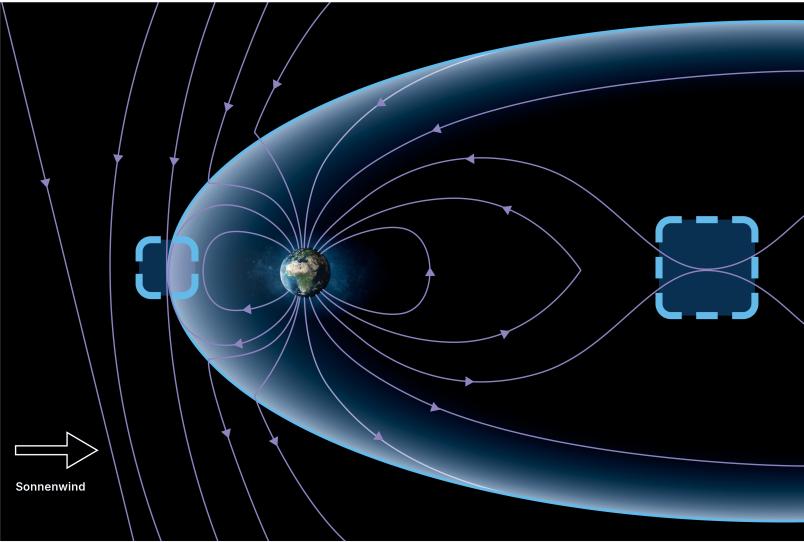
The solar wind interacts with the Earth’s magnetic field, causing the magnetic field lines on the dayside and nightside of the planet to have very different shapes. On both sides, magnetic reconnection occurs where magnetic fields of different orientations are pressed against each other (dashed rectangles).
In turn, these small-scale processes on the electron level in the dayside magnetosphere bring about a reorganization of Earth’s magnetic field on the larger scale: The solar wind blows these newly reconnected magnetic field lines towards the terrestrial nightside. There, the magnetic field lines are pushed together and meet again, once more leading to magnetic reconnection. The plasma here heats up, and particles are accelerated that move back toward Earth along the magnetic field lines. There, they hit the atmosphere and can cause auroras.
Simulations based on space mission data
Innocenti’s team replicated several aspects of this very process in a number of simulations that ran on supercomputers, in Garching and Jülich. These models show how specifically energy from the magnetic field is transferred into the heating and acceleration of particles. The researchers used first-principles simulations which reproduce how particles interact with electric and magnetic fields, without relying on any prior assumptions. In this way, the team from Bochum demonstrated how the processes at the particle level are connected to large-scale phenomena and ultimately determine the structure of Earth’s magnetic field.
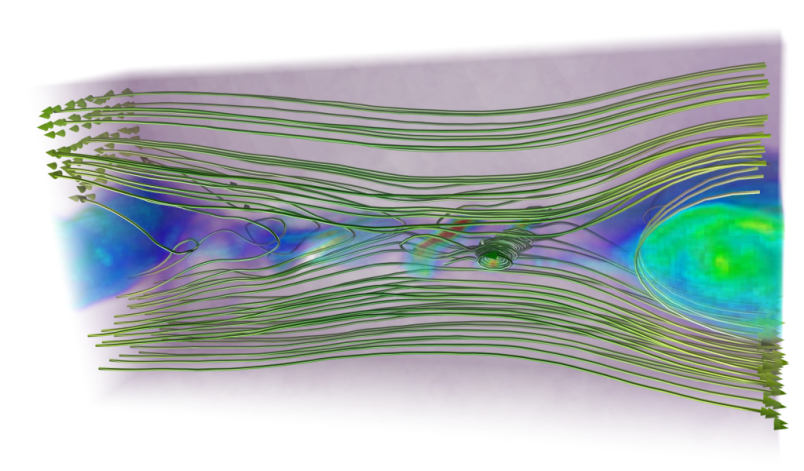
This image shows a simulation of magnetic reconnection on the nightside of the terrestrial magnetotail. The green lines symbolize magnetic field lines running in opposite directions on the top and bottom. Magnetic reconnection is taking place where the lines meet in the middle. The blobs on the left and right represent blobs of plasma that are accelerated and ejected. (Image from Schoeffler, K.M., Bacchini, F., Kormann, K. et al. 2025)
All the simulations run in the group are initialized from and benchmarked against data from space missions, such as the Magnetospheric Multiscale mission for magnetospheric simulations and Solar Orbiter or Parker Solar Probe for solar wind simulations. Parker Solar Probe ventured closer to the Sun than ever before.
Space missions
Space missions
Another interesting mission is already on the horizon: The European Space Agency is expected to officially confirm the Plasma Observatory mission in November 2026. This mission aims to use seven identical spacecrafts to explore Earth’s entire magnetosphere. It is specifically designed to bridge the gap between small and large scales. Maria Elena Innocenti is already excited to see the data, even more so than if she were to see the auroras over Germany again.
Ruhr Innovation Lab