
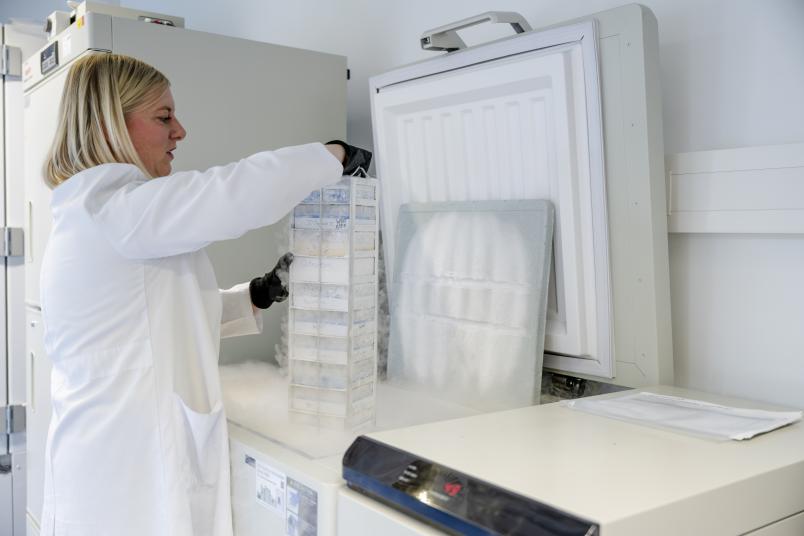
A treasure for cancer research: Britta Majchrzak-Stiller removes the frozen cells—from which organoids can grow—from cold storage.
Medicine
A Treasure in the Freezer
Organoids are the link that connect real tumors and lab experiments. They can be used to test the effectiveness of cancer medication.
White steam wafts out from the freezer from which Dr. Britta Majchrzak-Stille retrieves a transparent, rectangular container. It contains the results of years of preliminary work, a treasure for cancer research: At –150 degrees Celsius, the researchers store future organoids from pancreatic cancer cells.
This type of cancer is one of the most consequential, explains Dr. Philipp Höhn, who, like Majchrzak-Stiller, is a member of the Surgical Research Lab at St. Josef Hospital, Ruhr University Bochum. Only about six percent of patients survive five years after diagnosis. “There are a number of reasons for this,” says Höhn. “The cancer does not induce any symptoms for a long time, so it almost always remains undetected until very late. In addition, it often grows aggressively and quickly spreads in its environment.”
Tumors are as diverse as people themselves
The only thing the tumors have in common is their origin in the ducts of the pancreas. “There are also a lot of frequent mutations. That aside, every tumor is as unique as the patient is,” says Majchrzak-Stiller. This makes chemotherapy very difficult. It is difficult to predict whether a tumor will respond to a particular drug or not. Because the medications lead to severe side effects, there are reservations about simply trying them out.
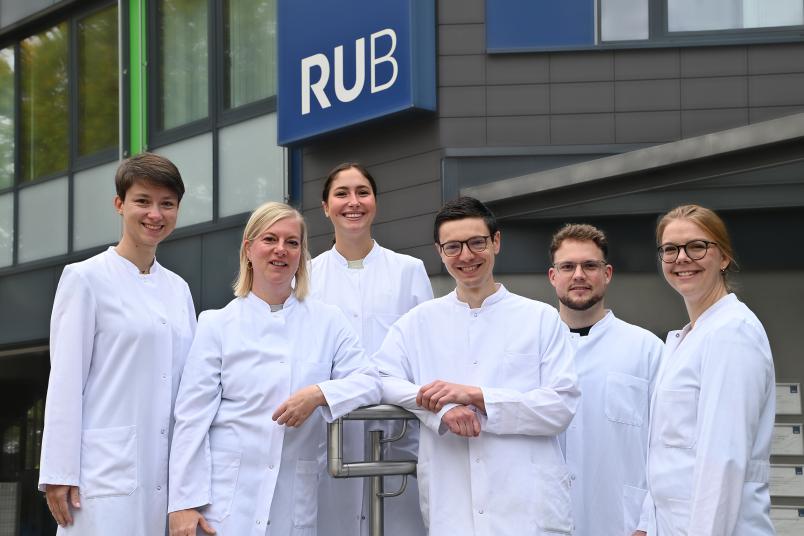
The team from the surgical research lab (from left to right): Lea Skrzypczyk, Britta Majchrzak-Stiller, Lisa Trzebiatowski, Philipp Höhn, David Wiedemann, Johanna Strotmann
This is where organoids enter the picture. A small, three-dimensional tumor made from the patient’s own material behaves in many aspects the same way as the tumor within the body does. The effectiveness of various cancer medications can be tested on it in advance, and the patient can receive the most promising substance. The researchers in Bochum are developing and testing this concept as part of the Germany-wide study UNITEPANC, financed by German Cancer Aid (Deutsche Krebshilfe). “We are not yet at the point where we can offer this to all patients,” Höhn adds. However, the team has spent about four years putting together the respective workflows, and the biobank of organoid cells has been in development since early 2025.
Everything has to run like clockwork
“We can only do that because we are one of the largest pancreatic medicine centers in Germany,” says Höhn. Approximately 250 patients with pancreatic cancer receive operations here every year, but not all of them are eligible sources for organoids. For example, the tumor has to be of a certain size, and the patient cannot have received any chemotherapy before the operation. About 60 cases per year meet all the requirements.
Everything must run like clockwork for the operation: Because the pancreatic tissue is extremely sensitive and rapidly starts to deteriorate due to the aggressive digestive secretions produced in the gland, someone must have an ice box at hand in the operating room during the procedure. The surgeons must examine and release the removed tissue as quickly as possible so that it can be transported by taxi to the pathology department, where staff are at the ready to receive it. Here, the tissue is cut and processed before being reduced to small pieces and embedded in Matrigel, a gel-like protein mixture. The entire procedure is over within two hours.

An organoid can only regrow from a cell that has already learned how to become an organoid.
This is where things get exciting: Organoids do not grow in all cases. “When it works, the organoids grow within the gel for three to four weeks,” explains technical assistant Lea Skrzypczyk. They grow spherically at different rates and reach sizes of up to 200 micrometers. “We do not let them grow any larger because at some point they become necrotic on the inside, meaning the tissue dies off, because there is no blood supply.” The matrix is then dissolved, the cells are dissociated and washed, and then deep-frozen. “An organoid can only regrow from a cell that has already learned how to become an organoid,” says doctoral candidate Lisa Trzebiatowski.
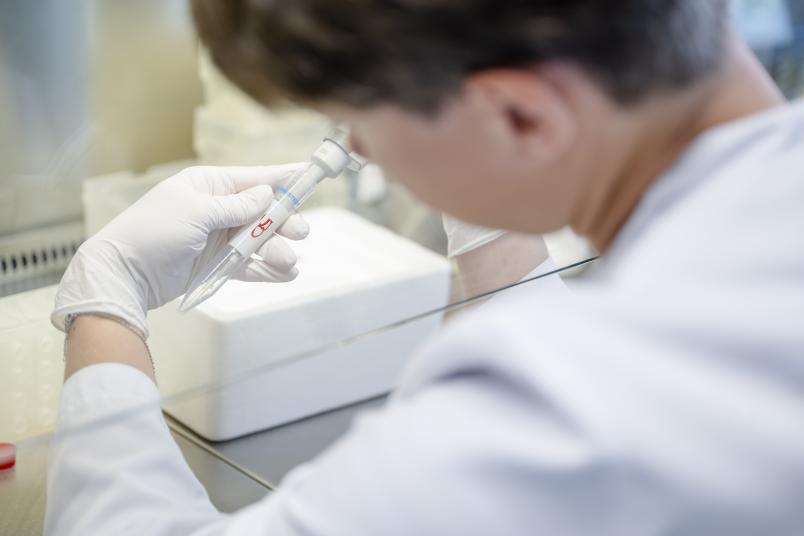
The cells have to be assessed every day. Lea Skrzypczyk tends to the cultures.
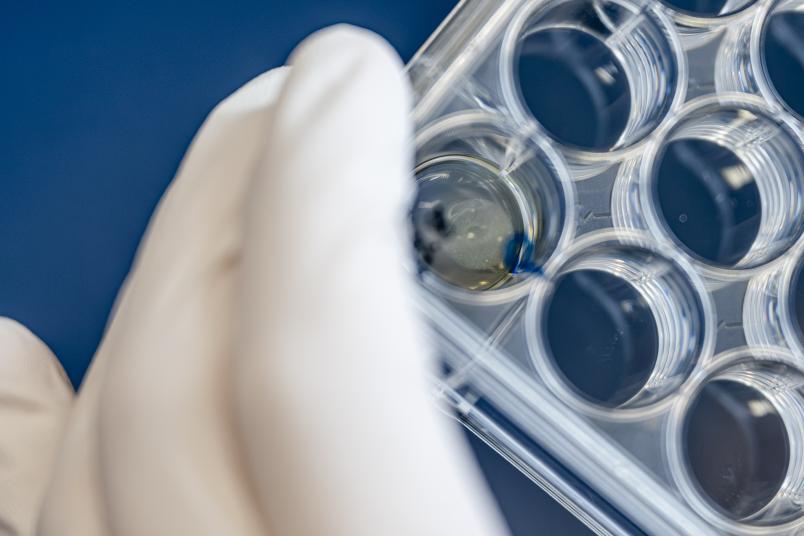
The organoids reach up to 200 micrometers in size. If they grew any larger, they would become necrotic on the inside because they have no blood supply.
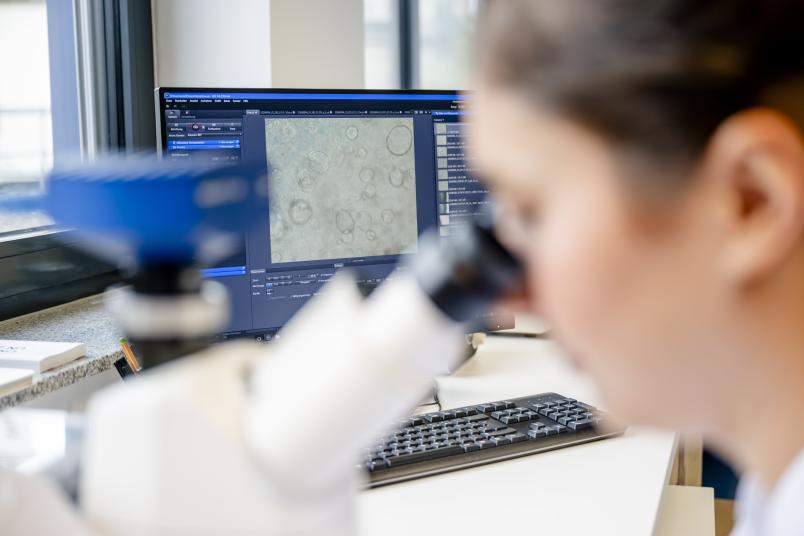
Lisa Trzebiatowski assesses the growth of the organoids. They grow spherically within the gel matrix and can be seen with a microscope.
Like the tumor material, the organoid cells are collected in a biobank. Each of them adds on to the treasure stored in the freezer. Since January 2025, the team has been able to freeze 15 cell lines, while about five others are currently in culture. The more the team collects, the better it will be possible in the future to rapidly test various anti-cancer agents and compare their efficacy in collaboration with pharmaceutical companies.
Organoids replace many experiments on animals
Compared to purchased cell lines, the organoids have the major benefit of growing from patients’ own material and reflecting the genetic diversity of the tumors. Because of their three-dimensional growth, they act similarly to the tumor in the patient’s body. “For example, if I have a two-dimensional cell culture and administer a drug to it, the substance easily spreads everywhere and reaches every single cell,” Höhn explains. “But this does not reflect the reality: Organoids are much better in this regard.”
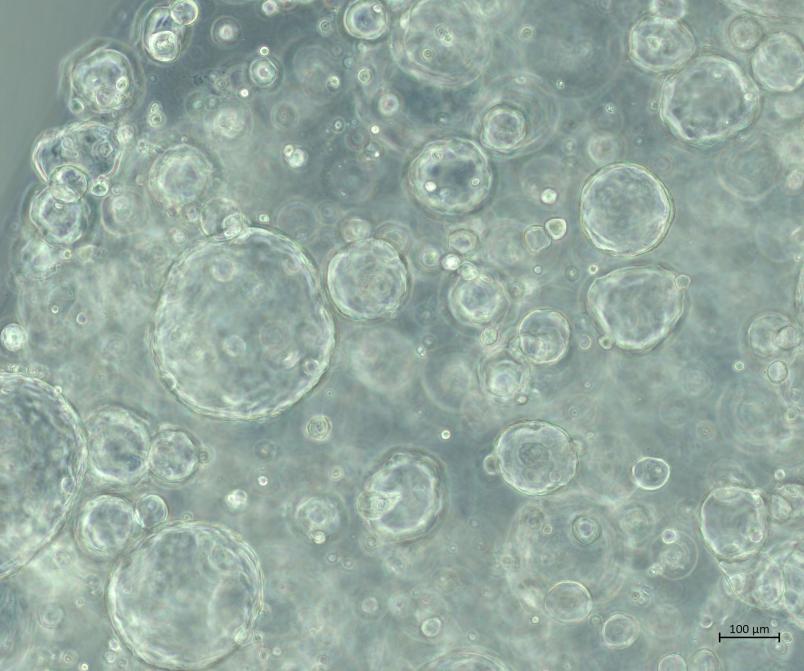
The organoids grow spherically in the gel matrix and reach various sizes.
If a medication proves effective in testing with an organoid, the next step is animal experimentation—usually a mouse. These tests are required by law. “With the organoids, you can rule out many substances in advance and require much fewer animals as a result,” says Höhn.
A Patch for the Pancreas