
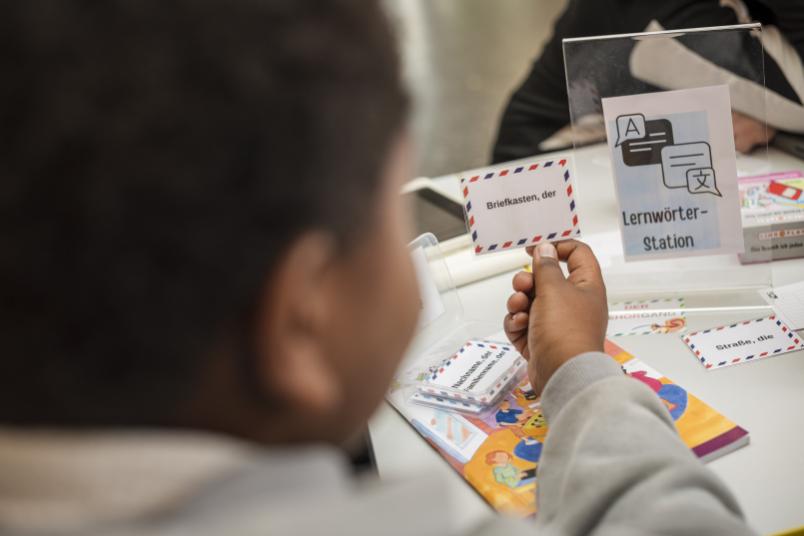
The project “Digitale Wege. GeHen (Gemeinsam Herkunftssprachen nutzen)” encourages the use of multilingualism in the classroom.
Language Pedagogy
Having a Voice in Multiple Languages
Using multiple languages in school is equivalent to pedagogical magic. However, there is a lack of concrete instructional materials. Researchers in Bochum hope to bring this method into the classroom.
It is 9 o’clock on a Monday morning. A teacher in a fourth-grade primary school German class asks her students, “Nehmt bitte das Heft heraus! (Please take your notebooks out!)” Elif looks at Narin questioningly, who whispers back in Turkish, “Defter. Defter.” It is common for multilingual children and adolescents to help each other out in their communities’ languages at school so that they can follow along with a class conducted in German. “Multilingualism can be a good bridge and a useful resource for simplifying learning processes, treating other language cultures with respect, and improving one’s own German proficiency,” says Professor Björn Rothstein from the Department of German Language Education. “However, multilingualism is usually unutilized in school,” says his colleague Dr. Karin Yeşilada. Their joint instructional and learning project “Digitale Wege. GeHen (Gemeinsam Herkunftssprachen nutzen),” financed by the RAG Foundation, focuses on this exact issue. The researchers want to explore the ability to flexibly use multiple languages in the classroom context, and bring about a change in how this is viewed.
Breaking down the monolingual habitus
“In Germany, languages other than the foreign languages taught in school do not play a role. Ingrid Gogolin referred to this as the monolingual habitus,” explains Rothstein. Breaking this habit, he adds, is difficult. “It means engaging with the mindsets of everyone involved—teachers, homes, students—and literally encouraging them to not only use German,” says Rothstein. This is a challenge because all the educational certificates are in German. “It’s deeply rooted, so it will remain that way for generations. A new encouragement strategy is needed.” The project “Digitale Wege. GeHen” seeks to do just this: Encourage translanguaging, or the ability to flexibly use multiple languages in the classroom. Researchers are also utilizing support from AI.
What is translanguaging?
What is translanguaging?
The project launched in January 2025, and the team ended its first school year in the summer of 2026. Karin Yeşilada spent an entire school year vising primary and secondary school classrooms. “Some schools house the project in their international classes, others integrate it into regular instruction. We orient ourselves on the basis of the participating schools’ structures and circumstances, and are entirely at their service,” she says. Leading up to the project, she held workshops for the teachers in which they learned about the concept of translanguaging and did away with the false assumption that they had to master multiple languages right away.

Translanguaging is actually a manual for language use, not an obligation to master a language.
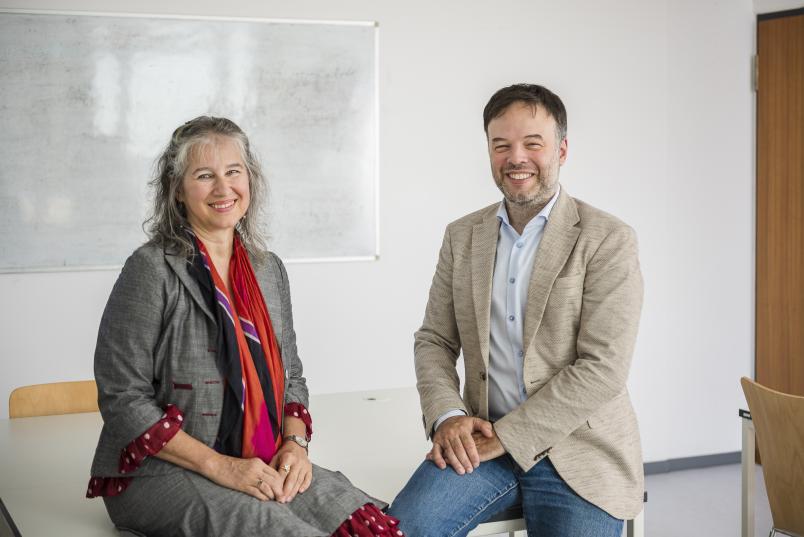
Karin Yeşilada (left) and Björn Rothstein are researchers at the Ruhr University Bochum Institute of German Studies.
“Translanguaging is actually a manual for language use, not an obligation to master a language,” Yeşilada explains.
Two classes per school always take part in the project, each with three to five students. These students are specifically selected in the preliminary discussions with the teachers, and of course with the parents’ consent. The process and support for the students throughout the project vary from one school to another, and are determined by the instructional formats and working methods. “Sometimes I switch from one student to another within one hour of class. Sometimes the independent work periods are suitable for more intensive work. Then multiple students can approach me simultaneously. And there are also times when teachers ask me to work for one day or even three weeks with a student in particular need of support,” says Yeşilada.
Overcoming hurdles
At the start of the partnership with the school, there are usually technical hurdles to overcome first. “It comes down to the available resources and devices, charging, Internet access, and installation of the free translation app,” says Yeşilada. “Then I explain how they can use it.“
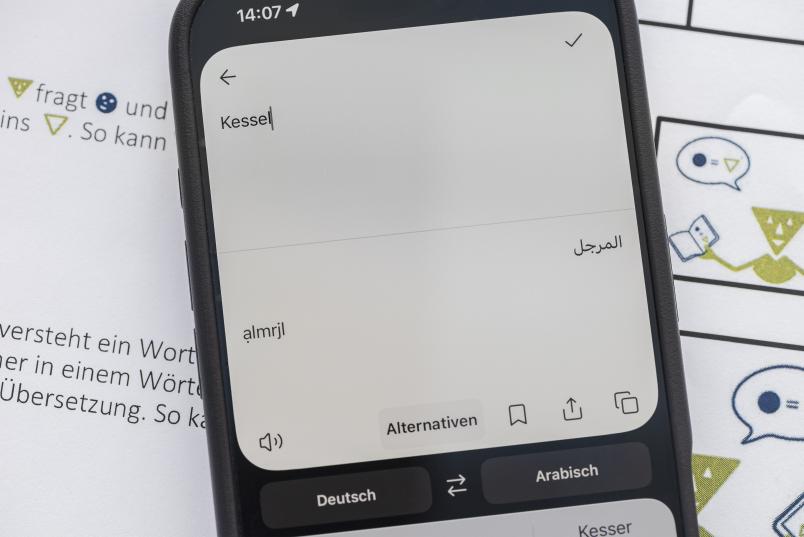
A translation app in the classroom can help children understand and learn new words.
First, the language of origin is selected, meaning the language into which the German word is to be translated. This is not so simple. “Not all languages, let alone language varieties, are listed in the app. Some of them are available under a different name. For example, we looked for Farsi, but the app has it listed as Persian. Similarly Zaza, Kurmanji, and Sorani are listed as Kurdish,“ Yeşilada explains. Some students are also only verbally proficient in the respective language but cannot write it. In such cases, they use the app’s audio function when it is available.
Word by word
Once these hurdles have been overcome, however, Yeşilada works through the material with the students, word by word. This works best with a worksheet. She spent much of the first year at the word level. “They can translate entire sentences, of course. But it was important to me that they understand the concept of translanguaging at the word level. They should learn that they can use a noun to find the right verb, like ‘publication’ and ‘publish.’ That’s how we gradually made our way forward,” explains Yeşilada.
Most participants said that they gain a lot from the support.
And to great success, according to the initial surveys among the participating students. “Most participants said that they gain a lot from the support,” says Yeşilada. “In many cases we achieved our goal of translating the German word into the respective language, thereby understanding the word better. I worked very intensively for three weeks with one student, and she quickly improved greatly through translanguaging.”
Motivation for students
Yeşilada says that many students were motivated by being able to use their own language at school. “I had a number of students who really put in the effort to better learn their own language, such as by learning its written form, as a result of the project,” she explains. This was confirmed by the teachers, who noticed that their students were much more motivated in class. “They engaged more deeply with their own heritage language and with languages in general, and in the process, experienced a sense of self-efficacy.”
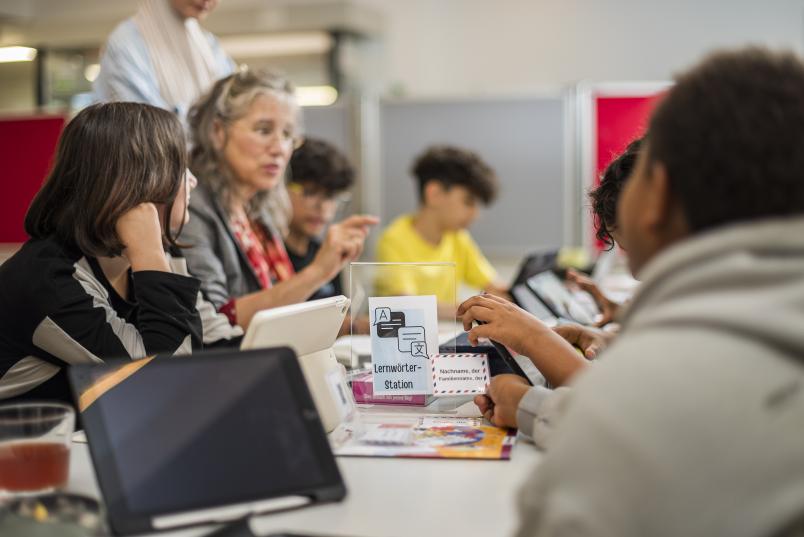
The research team in Bochum is working with a school in Herne that is experimenting with multilingual learning.
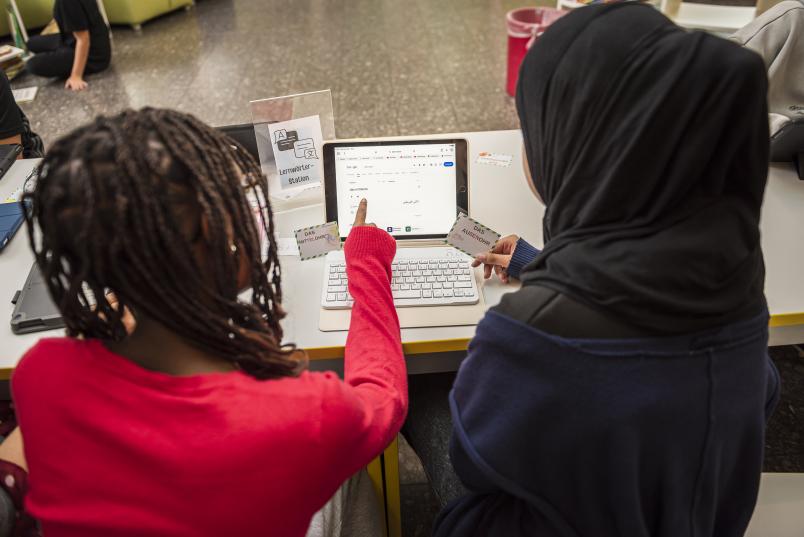
The children learn to figure out the meaning of various German terms on their own. The translation apps they use help them in this process.
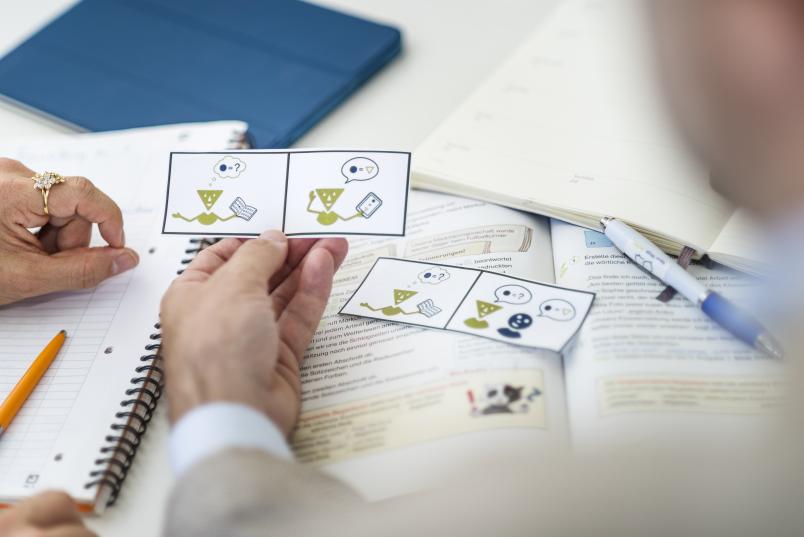
Flashcards provide an impetus for digital translation.
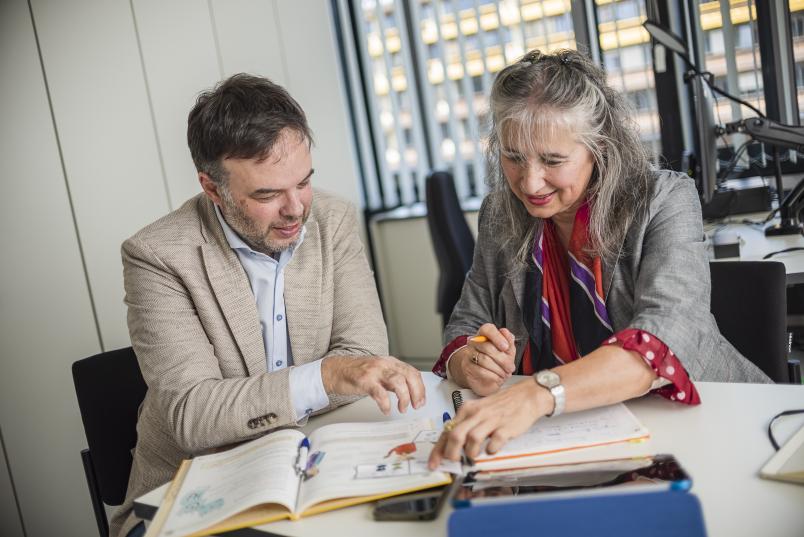
Björn Rothstein (left) and Karin Yeşilada want to promote multilingualism in schools.
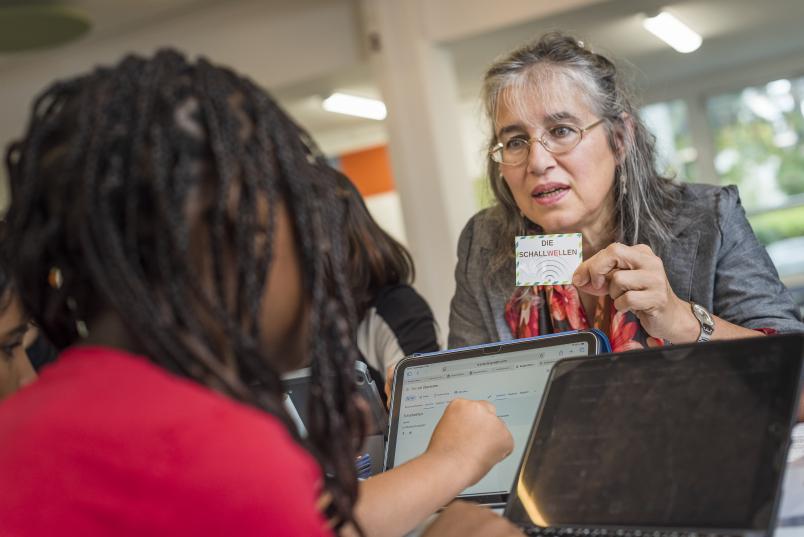
Karin Yeşilada provides personal support to the children as they learn.
Often, this also sparked the interest of their classmates. “The students I worked with frequently became catalysts for further engagement. Suddenly, discussions about words and their meanings would break out, involving half the class,” says Yeşilada. On one occasion, the focus was on the word “kettle;” on another, it was the terms “bread roll” and “publication.” “We looked for synonyms, tried to deduce the meaning of words based on context and our existing knowledge, and even used AI-powered image searches.”
Introducing the language of education
In this way, various learning processes have already been set in motion, and bridges have been built in many directions. This is also important to the project leaders. “After all, even students who grow up monolingual and speaking only German ultimately need to acquire AI literacy and become multilingual. They must master different registers of the German language, one of which is the language of formal education. AI can help expand their vocabulary and introduce them to this academic register,” says Rothstein.
Developing effective teaching materials
Following the initial year and a half, the team now intends to expand the project’s reach. “For one thing, we’re launching a new recruitment phase, aiming to bring more schools and students into the project. At the same time, we’re offering professional development sessions and workshops for teachers,” says Rothstein. The goal, he explains, is to provide practical, effective teaching materials, offer actionable recommendations, and encourage reflection on the use of AI tools.
Translanguaging is considered a kind of pedagogical magic, yet if you search for materials within the field of translanguaging pedagogy or didactics, you find nothing at all.
“Translanguaging is considered a kind of pedagogical magic, yet if you search for materials within the field of translanguaging pedagogy or didactics, you find nothing at all. However, we need concrete methods and strategies for different subjects so that we aren’t leaving teachers to their own devices, and so that we can fill this gap in the research,” Rothstein adds.
The researchers still have a long road ahead of them. “Breaking the monolingual habitus takes time. Technology cannot do this alone. Teachers have to be sensitized and trained, and the students have to be continuously encouraged to utilize their multilingualism,” says Rothstein.
To a significant extent, democracies function through language.
Rothstein and Yeşilada are quite aware that the project will not immediately do away with the systemic hurdles that make the translanguaging approach more difficult. For example, the immigrant languages most frequently spoken in North Rhine-Westphalia are not, or are barely, integrated into schools as languages of instruction. “This, too, must be systematically addressed within the context of multilingual pedagogy, though it is a particularly daunting challenge,” says Rothstein. Language, understanding, and dialogue are fundamental for our democratic coexistence, he adds. “To a significant extent, democracies function through language.”
Enabling participation
Translanguaging could be an approach to enabling participation and building bridges. Elif and Narin would not have to whisper to each other in class anymore. Instead, they would have a strategy right in front of them to remind them, “You are multilingual. Use that!”