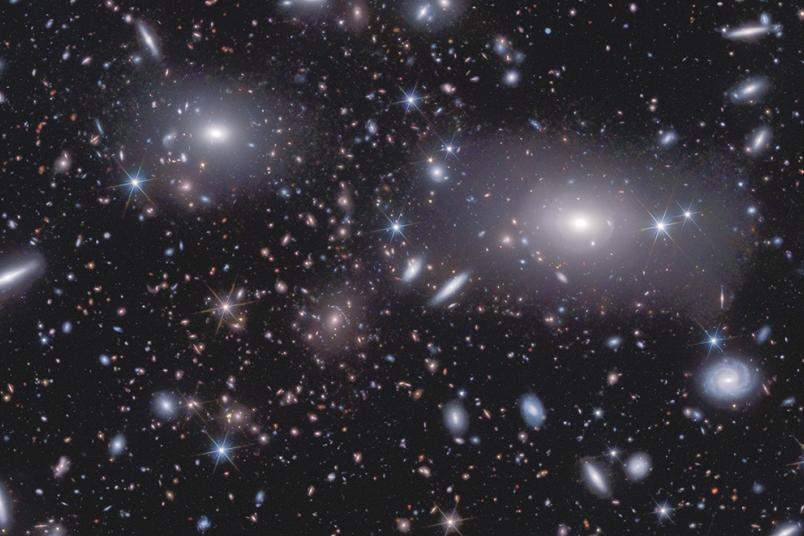
As part of the DR1-Foundation data release Euclid observed Abell 3128, a cluster of hundreds of galaxies lying around 800 million light-years away from us.
Space telescope
Euclid lays the foundation for its best-ever 3D map of the Universe
The new dataset from the Euclid space telescope contains images of 900 million galaxies. That means plenty of work for Bochum-based cosmologist Hendrik Hildebrandt, who is involved in analyzing the data.
The European Space Agency’s Euclid mission has released its first major batch of data on November 12, 2026. With this release, which captures the light of more than a billion objects and covers an area of sky as big as 9,500 full Moons, Euclid lays the foundation for its largest-ever 3D map of the cosmos. Hendrik Hildebrandt, cosmologist at Ruhr University Bochum, is part of the Euclid team and will work with this data set.
The new data release, named DR1-Foundation, comprises around 13 months of observations, and marks the first major release of mission data since the space telescope’s launch in mid-2023. For the first time, it gives scientists the puzzle pieces they need to begin constructing a detailed 3D map of the cosmos – crucial to solve the many mysteries of the dark Universe, including dark energy, dark matter, and the cosmic web.
Reconstructing structures of matter in the universe
Hendrik Hildebrandt is an expert in the analysis of the so-called weak gravitational lensing effect. “Using this effect, we aim to reconstruct the structures of matter and their statistical properties across the entire region of the sky observed by DR1,” he says. “I am convinced that the Euclid dataset will enable groundbreaking cosmological measurements.”
Facts and Figures
Facts and Figures
Ruhr Innovation Lab
Hendrik Hildebrandt’s research is part of the Ruhr Innovation Lab’s Focal Area “Matter in Terrestrial and Cosmic Laboratories”. The consortium comprising Ruhr University Bochum and TU Dortmund University will receive funding as a Consortium of Excellence beginning January 1, 2027. In the Euclid project, Hendrik Hildebrandt leads the Key Project on the cosmological analysis of the so-called two-point statistics of cosmic shear, which is one of the two central measurements for which Euclid was built.