
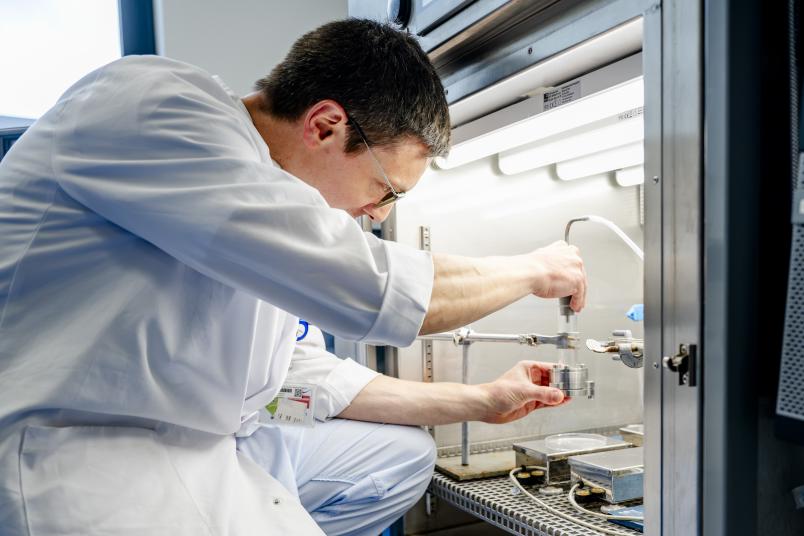
Philipp Höhn has developed a simulator that makes it possible to test the impermeability of membranes to body fluids.
Surgery
A Patch for the Pancreas
A simulator bridges the gap between materials engineering and clinical testing.
Pancreatic surgeries are a delicate undertaking. The small, sensitive organ produces digestive secretions that are normally only activated in the duodenum and are extremely aggressive. “This is the fluid that breaks down a poorly chewed steak,” explains Dr. Philipp Höhn, a senior physician in the Department of General and Visceral Surgery at St. Josef Hospital, Ruhr University Bochum.
Removing part of the pancreas creates an opening from which the secretion can enter into the abdominal cavity, which is highly dangerous for the patient. Specialists refer to this as a fistula. Surgeons prevent this fluid from leaking out by suturing a section of the small intestine over the opening as tightly as possible. However, this is not always sufficient. In such cases, a patch is needed to seal the fistula. “The problem is that there aren’t any that work,” says Höhn. The materials available on the market either cannot withstand the secretion or they do not adhere reliably to the opening. Various manufacturers are searching intently for a functioning wound-sealing solution, because the economic potential is substantial.
A leak test simulator
Philipp Höhn has developed a simulator to test possible materials. In this setup, the potential patching material can be clamped into a flask. Several millimeters of the pancreatic secretion donated to the researchers by patients are then poured over it. Höhn secures the flask in a warming cabinet at body temperature. Pressurized air places mechanical strain on the patch material to simulate conditions within the body. A highly sensitive scale is located beneath the flask to precisely register whether and how much fluid penetrates and drips through the patching material. This experiment can take several hours. A graph displays how long the material remained leak-proof.

We would like to cooperate with specialized materials engineers.
Experiments with adhesives on biomembranes, such as porcine diaphragm (a slaughterhouse by-product) or artificial casing, have shown that a seal cannot be achieved with them. “We would like to cooperate with specializes materials engineers so that we can develop customized patching materials,“ says Höhn.
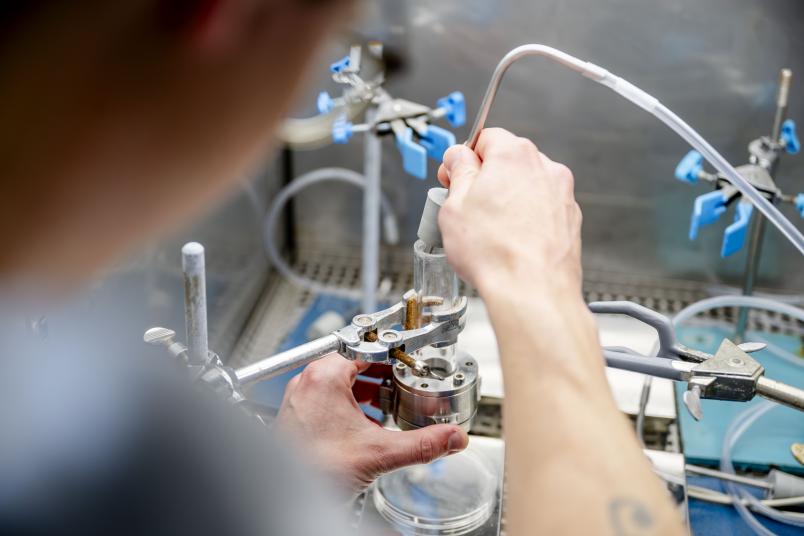
The bodily secretion is inserted into the flask above the material being tested. Compressed air and temperature create conditions simulating those of the body. A sensitive scale positioned beneath the flask records every drop that passes through the membrane.
The Clinical Research Group has also launched a new project in which doctoral candidate David Wiedemann grows organoids from healthy pancreatic cells. He hopes to discover why some patients experience difficulties due to secretion leaks after an operation while others do not: Perhaps the composition or activation of the secretion differs between individuals. “If we could understand which factors lead to these problems, we could influence them and possibly inhibit certain factors for the healing phase,” says Höhn.
A Treasure in the Freezer