
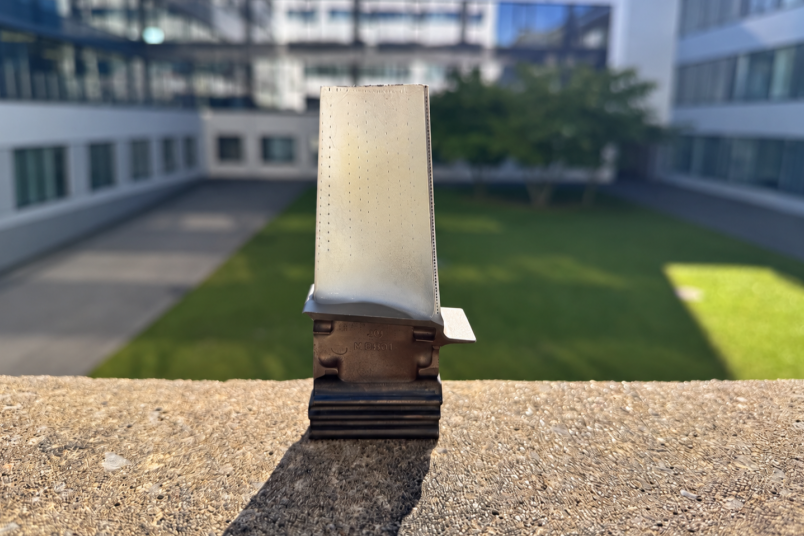
Aircraft turbine blades have to withstand extreme loads, and are thus often replaced. A new procedure seeks to restore them.
Materials Research
A Second Life for Aircraft Turbine Blades
Restoring instead of renewing: A pressure-assisted heat treatment is intended to make turbine blades for aircraft as good as new.
Years of use in temperatures exceeding 1800 degrees Fahrenheit (1000 degrees Celsius) and extreme mechanical loads leave marks on aircraft turbines and the blades therein. Their microstructure changes during use, and local defects such as pores form in the material. First-stage turbine blades are thus generally replaced after about 5,000 flight missions, which corresponds to three to six years of service. A research team in Bochum, Germany, is examining whether the blades can be restored and reused instead. This would save on energy and raw materials, in particular critical elements. Professor Sebastian Weber and Dr. Louis Becker from the Chair of Materials Technology at Ruhr University Bochum are leading the research team as part of the joint project “Second_Life”. Since August 2026, the project has been receiving funding for a three-year period under the “LuFo Klima VII-1” aviation research program of the Federal Ministry for Economic Affairs and Energy.
Restoring the microstructure to its original condition
Because of the great stress (or “load spectrum”) they are exposed to, first-stage turbine blades are made from single-crystal, nickel-based superalloys. The atoms in their interior are arranged in a continuous crystal lattice, meaning there are no grain boundaries that would otherwise act as weak points at high temperatures. However, the blades become damaged over time. “When the turbines are operating at high temperatures, the blades are subjected to tensile stress caused by centrifugal forces resulting from rotation, and they sustain damage through creep fatigue,” explains Weber. The resulting microstructural damage limits the blades’ service life.
The research team wants to restore these components. “We aim to restore the microstructure and mechanical characteristics through hot isostatic pressing, or HIP,” says Becker, head of the research group. In this process, the blades are heated under isostatic gas pressure and then rapidly cooled. In this way, damage such as creep pores is expected to heal, while the single-crystal nature of the material is preserved. “The objective is to restore the parts to their original condition so that the blades can be reused after they have been given a thermally insulating protective coating (thermal barrier coating, TBC).”
Sustainability in aviation
At the German Aerospace Center, defined creep-fatigue damage is first generated under high-temperature conditions that simulate operational environments. Suitable HIP process parameters are then developed and changes to the microstructure are examined at the Ruhr University Bochum. The researchers want to mechanically re-test successfully treated samples in order to verify whether both the microstructure and the mechanical performance can be restored. “By extending the service life of turbine blades, we can reduce both the need for newly manufactured components as well as the use of energy and raw materials used to produce them,” says Weber.