
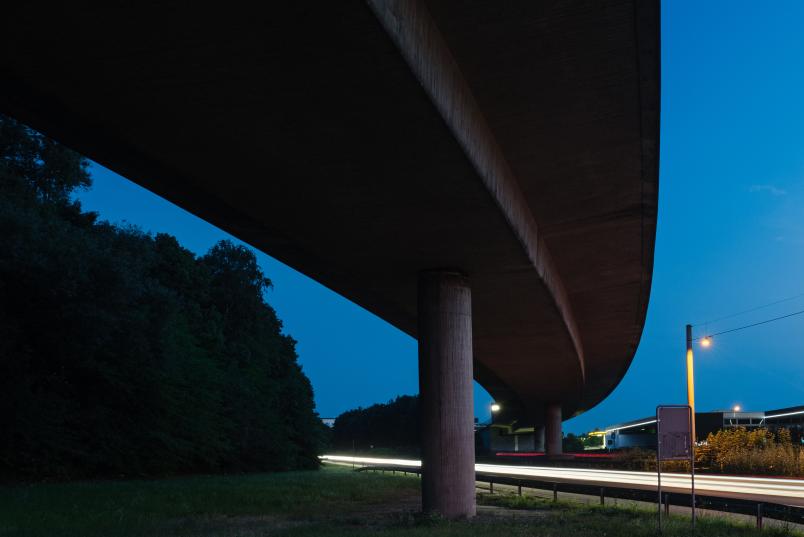
Many bridges in Germany are slowly reaching the end of their planned service life. This makes it all the more important to regularly inspect them.
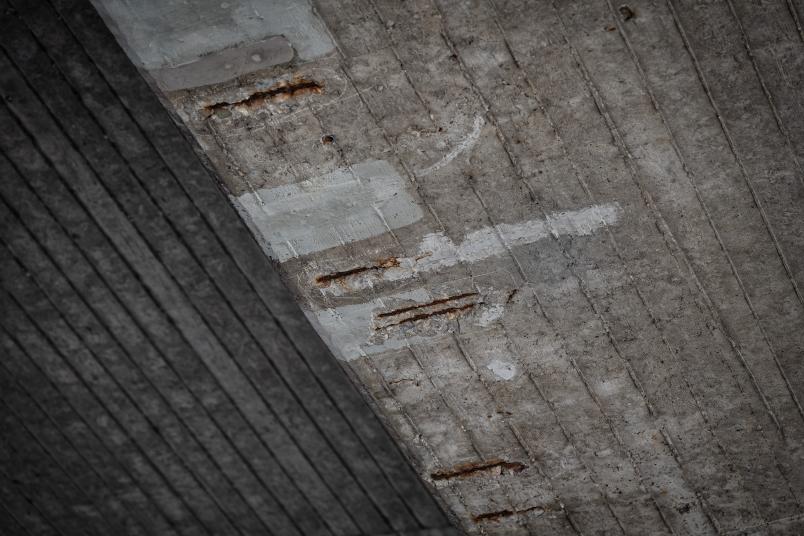
Cracks in concrete bridges are a serious warning sign. For example, moisture can enter into the cracks and cause the steel reinforcement to rust, which can lead to instability.
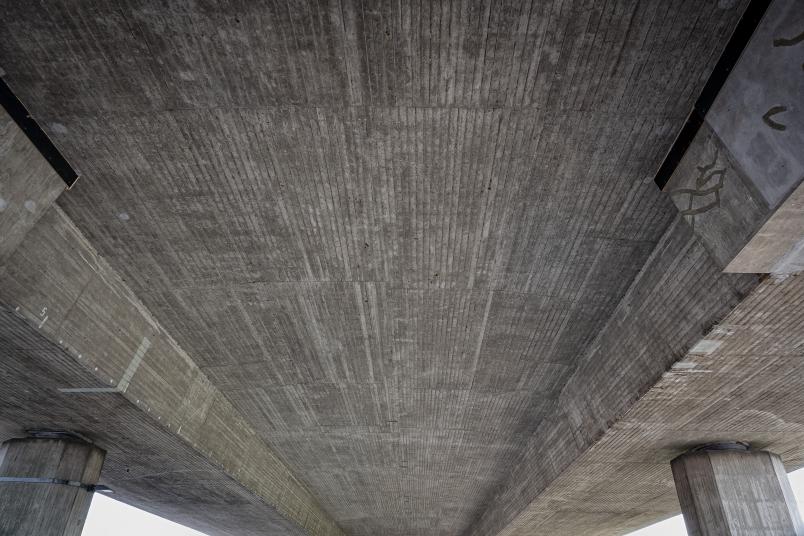
Concrete bridges contain box girders. These provide a look inside the interior of the structure. The drones are supposed to fly into these girders to look for cracks in the concrete.
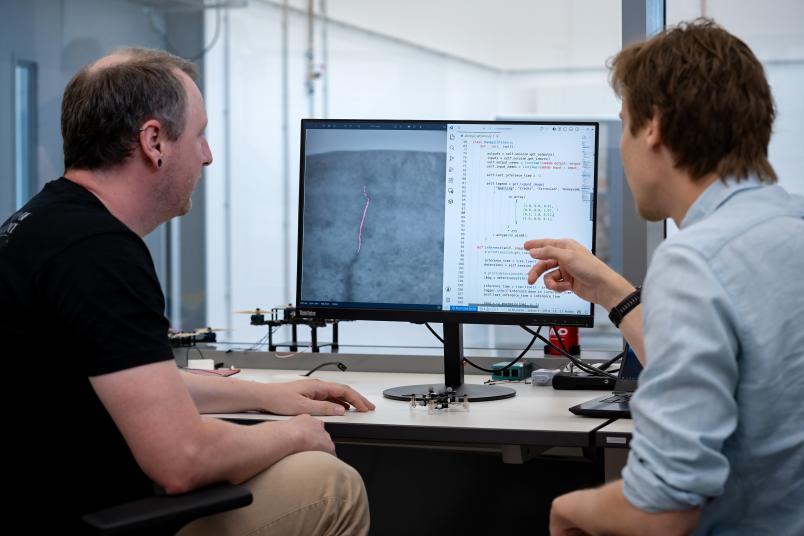
Marcel Neuhausen and Patrick Herbers evaluate the data from a drone flight in their in-house flight lab (ZESS).
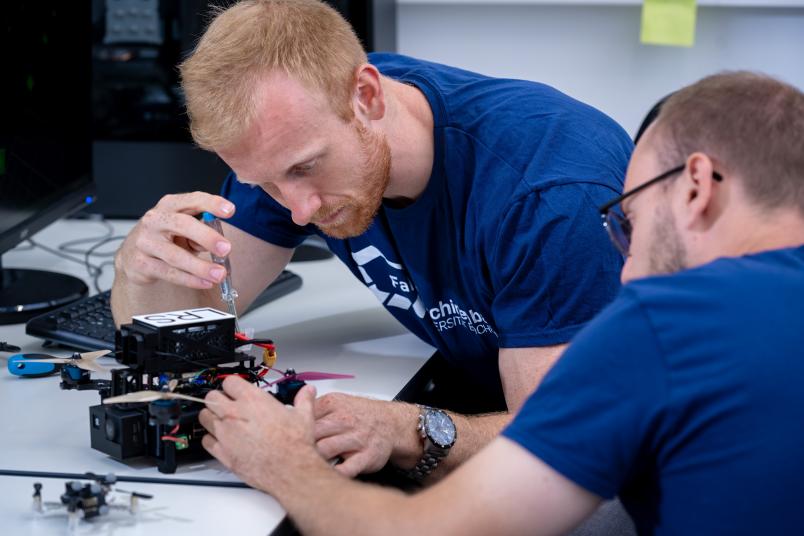
There are many aspects to the project: Here, David Müller and Raphael Dyrska are fine-tuning the drone prototype.
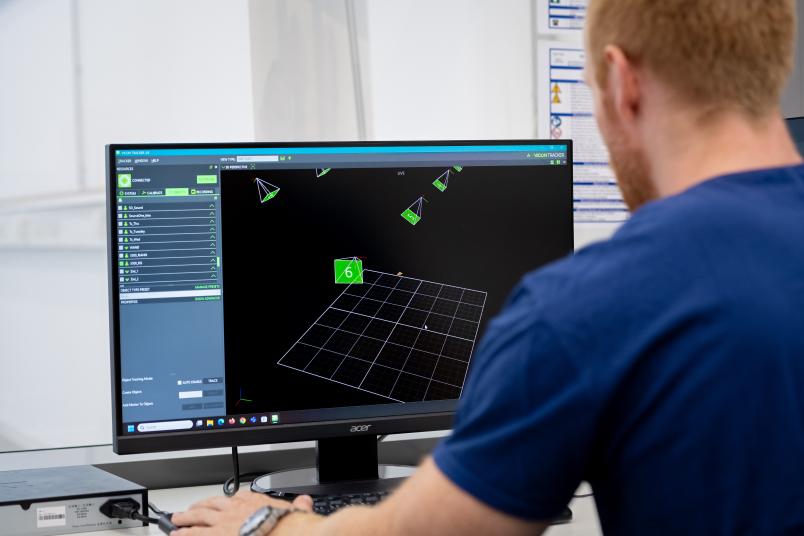
The researchers in Bochum hope to simplify bridge inspection through digitalization and automation.
Bridges
How a Mini-Drone Detects Cracks in Concrete
Bridge inspections are costly and work-intensive. An autonomous drone could make this work easier for inspectors in the future, and discover cracks that cannot otherwise be seen.
Thousands of bridges in Germany have to be tested every year. Many of these were constructed between the 1960s and the 1980s, when the post-war construction boom reached its peak. Problems come with age, however: Heat, frost, environmental factors, and especially an increase in traffic volume (especially from heavy trucks) put strain on the structures. “The critical phase begins now,” says Patrick Herbers from the Chair of Computing in Engineering at Ruhr University Bochum. “Many of these bridges are slowly reaching the end of their planned service life, and the country has to ensure that they don’t suddenly collapse.”
Digitalized testing has been rudimentary so far
The regular tests are costly and take a lot of effort. Up to this point, testers have been working on site with a clipboard and camera, taking photos and notes to examine everything at the office later. This can lead to errors, and the inspection also comes with roadblocks, cranes, or extensive climbing. To make matters more complicated, cracks in concrete are often hair-thin. “It gets critical after 0.2 to 0.3 millimeters,“ Herbers explains. “But they are almost invisible to the naked eye from a couple yards away.”
A new drone is supposed to revolutionize bridge inspections from the inside. It was developed by a team working under David Müller and Dr. Raphael Dyrska from the Chair of Automatic Control and Systems Theory, as well as Dr. Marcel Neuhausen from the Chair of Artificial Intelligence and Formal Methods.
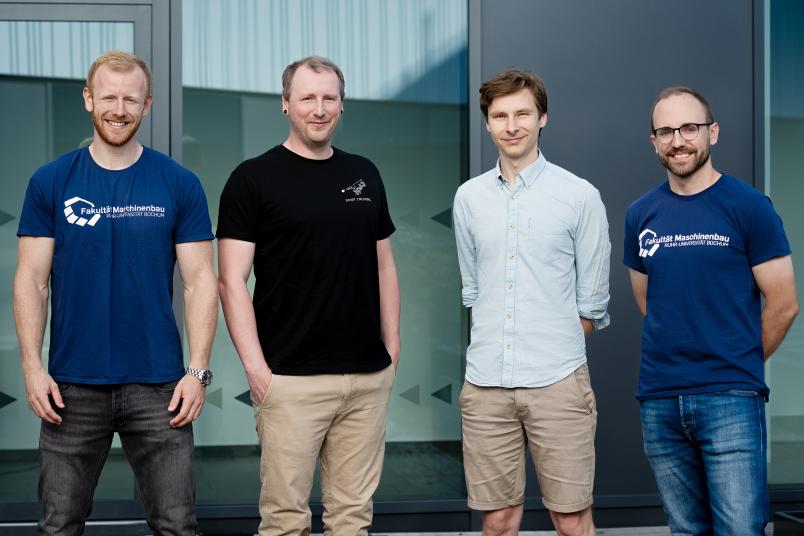
From left: David Müller, Marcel Neuhausen, Patrick Herbers, and Raphael Dyrska are working together on the project “Autonomous Bridge Inspection with Drones.”
The project is a true Bochum-wide partnership: While Müller and Dyrska are working on the flight controls and hardware, Neuhausen and Herbers are in charge of the artificial intelligence that is supposed to detect cracks. “We asked ourselves how we can digitalize structural inspection while making it safer and more efficient,” Müller explains.
The idea is not new, as large drones are already being used to inspect bridges from the outside. Yet the narrow box girders found in many bridges are off-limits to these flying giants. “No drone larger than a soccer ball will fit in there,” says Müller. “Even if they did, many of the sensors would stop working because of all the obstacles in that environment.”
As a result, the researchers scaled the problem down and built a drone that is small enough to fly into these girders. “We started out with a ready-made drone that we modified,” Müller explains. “But it quickly became clear that this won’t be enough. So, we built a drone of our own from scratch.”
The first prototype was extremely small, with a diameter of eight centimeters. It was quite agile as a result, but this made it difficult to equip it with a sufficient battery and other important components. The researchers thus developed a somewhat larger drone that meets all the requirements for practical use.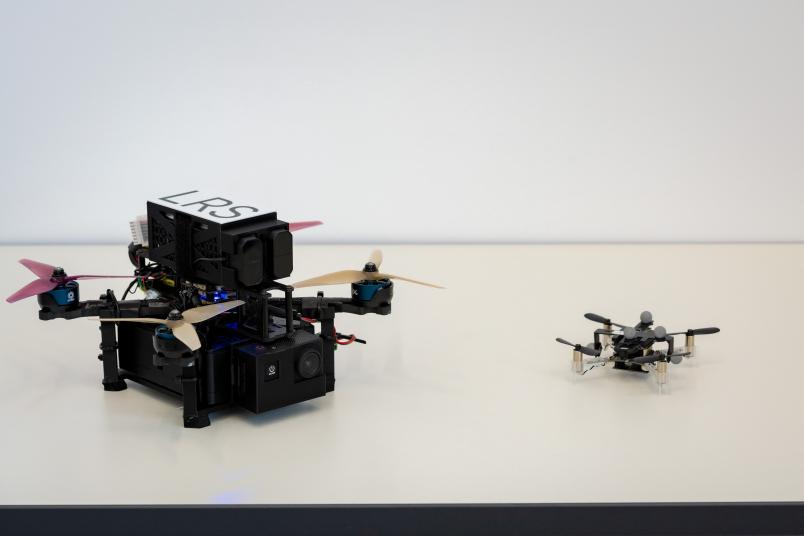
The prototype of the drone was tiny, measuring just eight centimeters in diameter. This allowed it to fit into any box girder. “Yet the little drone had a big problem: It needed a constant connection to a computer to stream the images and detect the cracks,” says Müller. “And the flying time? About five to six minutes.”
The drone plans its own route
This is when the team took it a step further and built a larger version with a diameter of 23 centimeters. This drone flies entirely on its own. It plans its own route, scans the walls for cracks with AI, and saves the results directly on an SD card. No cords, no PC, no interruptions.
But how does the drone find its way in the dark, winding girders? “GPS doesn’t work there,” says Herbers. “We use SLAM, or Simultaneous Localization and Mapping.” This is an algorithm that maps the environment and determines the position of the drone, similar to a modern lawnmower robot. “Imagine you are entering a dark room and are feeling your way forward while blindfolded,” says Müller. “Every step gives you new information about the environment, and at the same time you know where you are. This is what SLAM does.”
Not every dark spot is a crack
Yet the challenges are immense. “There is almost no room in the girders, but the drone still has to be equipped with a lot of sensors and hardware,” says Müller. “The hardware also has to be lightweight and use little power, while being efficient enough to detect cracks.” The AI that identifies the cracks operates on the drone itself. It analyses each image pixel by pixel and not only says whether a crack is present, but also how certain it is. “Not every dark spot is a crack,” explains Neuhausen. “Some are just blotches of paint or pores in the concrete. Spider webs also look like cracks in the concrete, but they’re harmless.”
The team has developed a clever solution to minimize these uncertainties: The drone can approach uncertain areas from various angles to improve its detection. “The drone decides on its own whether it has to take a closer look at a certain area,” says Herbers.
It’s like an orchestra in which each musician has their own instrument, and they all have to harmonize.
As small as the drone is, it still has its limits. “The battery life is one of the biggest problems,” Müller concedes. “We don’t get far with five to six minutes of flying time. We had to make some compromises with the larger version.” The integration of all modules on the drone is another challenge. “Each module—flight controls, AI, and sensors—functions on its own,” explains Herbers. “But getting them all to run simultaneously on one device flying around in the air? It’s like an orchestra in which each musician has their own instrument, and they all have to harmonize.”
The researchers test how the drone acts under various conditions in the flight lab.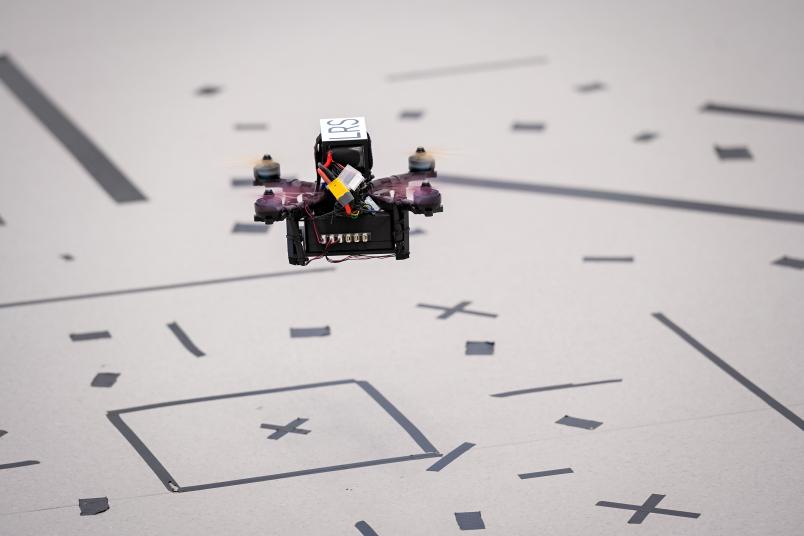
The team is currently testing the drones at Ruhr University Bochum’s Zentrum für das Engineering Smarter Produkt-Service Systeme (ZESS), where the Chair of Automatic Control and Systems Theory operates an indoor flight lab. “There, we simulate the conditions in a box girder,” says Herbers. “Using a motion capture system normally used in the film industry for special effects, we can localize the drone down to the millimeter, allowing us to test whether our algorithms are working,” Müller explains.
The next step is already planned out: use in a real bridge. “We want to show that our drone doesn’t just work in a lab, but also in practice,” says Neuhausen. “And we want to work with real bridge inspectors to see how we can make their job easier.”
The drone is supposed to support inspectors, not replace them
One thing is clear: The drone is not supposed to replace human inspectors, but support them. “Ultimately, a human has to check the data,” Herbers emphasizes. “But our drone can take care of the bothersome data collection, and draw attention to critical areas.”
Ideally, the end product will be a digital twin of the bridge: a 3D model with all of the cracks and damage indicated. “Imagine an inspector receives a tablet with a map of the bridge,” says Herbers. “All of the points that the drone has deemed critical are marked, including the degree of uncertainty. The inspector would then just have to manually check these points and can focus on the evaluation.”
Outlook: from theory to practice
The researchers in Bochum are hopeful that their drone can revolutionize bridge inspection. “There are still a lot of unanswered questions,” says Dyrska. “How do different construction styles impact the usability of the drone? How can we measure crack width more accurately? And how do we integrate all of this into the existing inspection procedures?”
Despite all the questions, the digitalization of structural inspection is inevitable. “The number of bridge inspectors is decreasing, the demands are growing, and the bridges aren’t getting any younger,” says Neuhausen. “With our drone, we can make inspections safer, faster, and more affordable. This is a huge step forward.”