
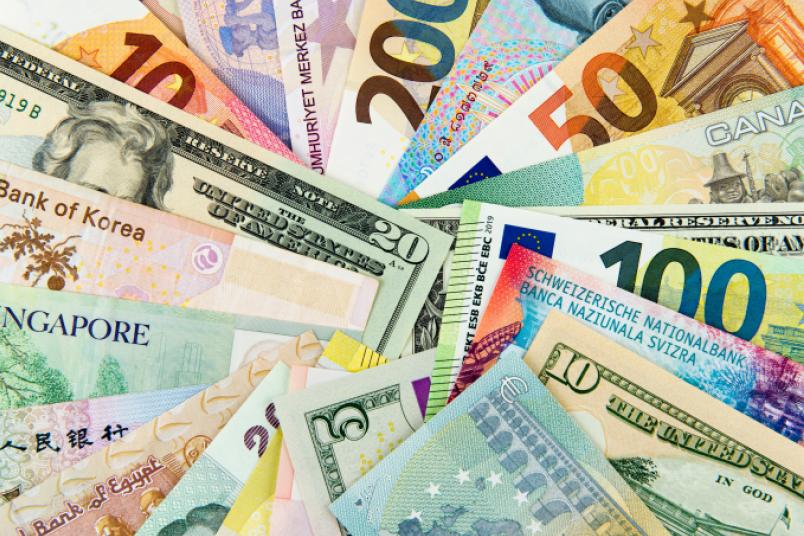
Exchange rates always play a role in global trade. Today, the US dollar is the world’s most important anchor currency.
Economics
The Invisible Bridges of Globalization
Interrelations among nations form economic bridges. Goods and capital flow along them—as well as political shocks.
Exchange rates determine the value of a Mexican peso, the cost of a German car in the USA, and whether an Argentinian farmer can repay his debts. Although they seem highly abstract at first, they can have very real ramifications.
Professor Jantke de Boer is quite familiar with the mechanisms underlying all this. Since April 2024, she has served as Junior Professor of International Monetary Macroeconomics at Ruhr University Bochum. She has now spent eight years researching her specialty field of exchange rates. “These rates connect the real economy with the financial markets. In Europe we have the euro, but once you cross over the currency union, the exchange rate always plays a role,” the economist explains.

Financial markets do not wait for a political decision to be implemented.
In her two most recent studies, de Boer and her coauthors explored how expectations of future US trade policy influence the currencies in other countries. “Specifically, our question is: What happens with a currency when it suddenly becomes more likely that the USA will pursue a more protectionist trade policy, such as by increasingly imposing tariffs on imports?” says de Boer.
Exchange rates already react when tariffs have not even been implemented yet. “Financial markets do not wait for a political decision to be implemented. They try to anticipate future developments. If it seems more likely that the USA will impose higher tariffs in the future, the expectations of future trade flows shift. This can immediately be reflected in the exchange rates,” says de Boer.
US presidential debates in focus
Measuring this in a scientifically rigorous way is not exactly trivial. Jantke de Boer and her team took advantage of a special event occurring in the USA: the presidential debates, which always air on American television between 9:00 and 10:30 p.m. (East Coast Time). “We looked at how markets react during these live broadcasts when a candidate announces protectionist measures,” says de Boer. “We benefit by knowing exactly when this new information reaches the market. Within a very short time window, we can effectively rule out other influences, as other news relevant to exchange rates is generally absent—given that major stock exchanges are closed and no macroeconomic news is released at that time of day.”
Compared to the stock market, the foreign exchange market has one crucial difference. “It is not centralized like the stock market, but rather an over-the-counter or OTC market,” explains de Boer. This means that a currency is traded on demand. Large banks constantly offer exchange rates and traders worldwide react immediately to new information. The foreign exchange market is open 24 hours per day because banks are always active somewhere in the world.
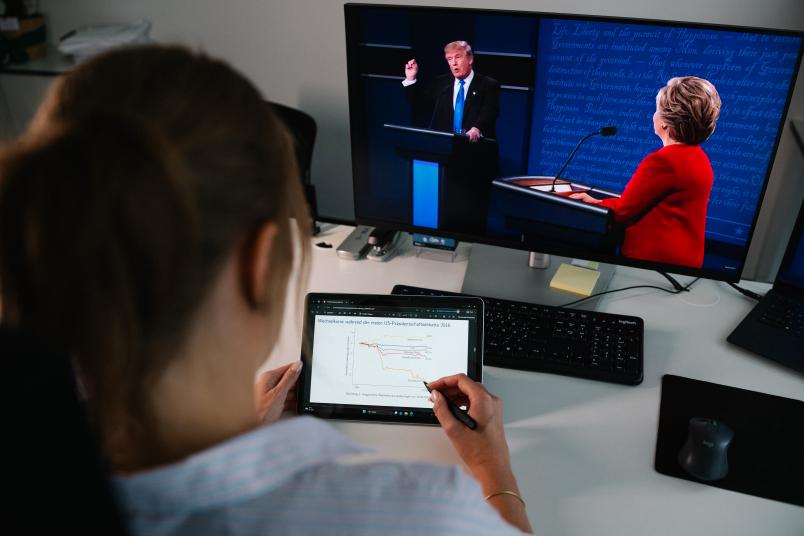
For their study, the researchers viewed all US presidential debates from 1996 to 2016 and identified how political developments in one country are carried over to other countries via financial markets.
For their analyses, the researchers used the presidential debates from various election cycles—23 debates from six cycles between 1996 and 2016, to be exact. To coincide with the respective debates, they analyzed data from prediction markets, where people can bet on the outcome of the presidential election. “We can use the betting odds to measure in real time whether a candidate’s chances of winning improve or worsen during a debate,” de Boer explains.
“By correlating information from the prediction markets with high-frequency exchange rate data, we observed how exchange rates react to changes in the probability of future US policy within a very short amount of time,” says de Boer.
The researchers did not determine which candidate is more protectionist based on their own feeling, and instead made use of the Manifesto Project. There, campaign agendas are systematically evaluated and political positions are coded, including the extent to which parties advocate for protectionism or free trade.
The more a country exports to the USA, the stronger the country’s currency reacts.
The statements made by the more protectionist candidates in the televised debates create what are known as exogenous shocks for exchange rates. The rates react, but not all to the same extent. “Our core result is that the more a country exports to the USA, the stronger the country’s currency reacts. Economic ties to the USA thus help determine how heavily a political shock from the USA transfers to another country. For countries with very close trade relations with the USA, we see economically relevant exchange rate shifts within just a few hours,” says de Boer.
To provide one concrete example of such a reaction: “Mexico is heavily dependent on exports to the USA. If the USA imposes tariffs, the Mexican goods become more expensive. The demand for Mexican pesos falls, and the peso loses value.” Such shifts have real consequences. “If the peso drops in value, imports from the USA rise in price, such as machinery or technology that Mexico needs for its industry,” de Boer explains.
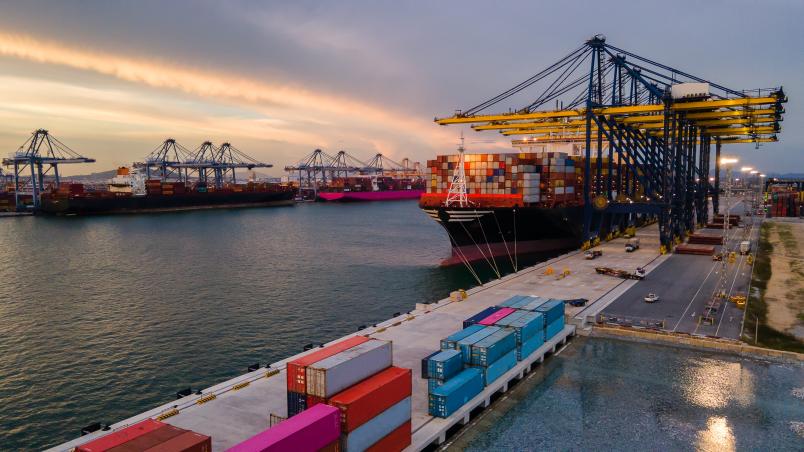
Many countries depend on exports to other nations. If the importing country imposes tariffs, the imported goods become more expensive and demand is highly likely to decrease. This causes the value of the exporter’s currency to depreciate.
However, these effects often only last for a short time. “The financial markets process new information every day,” says de Boer. “Even by the next day, other events like a new poll, an economic report, or a statement by a politician can redirect the exchange rates.” The study thus only presents a picture from one moment in time: the markets’ reaction to expectations during and shortly following the televised debates.
While the economists jointly observed many industrial and emerging countries in their first study, the subsequent study focused on the exchange rates in emerging nations. “In our first study, we saw that emerging countries react particularly strongly. This made us wonder why some of them are particularly vulnerable and others are much more durable,” de Boer explains. “For instance, emerging nations differ widely with regard to their financial markets, currency reserves, foreign debt, or the instruments that national banks can use to stabilize exchange rates. These are the differences we examined in our second study.”
Large and more segmented financial markets offer protection
It became clear that countries like India or Brazil, which have a large and more segmented financial market, are less impacted. “A large financial market means more liquidity. The country is better equipped to absorb shocks,” says de Boer. “Brazil, for example, has one of the largest financial markets in Latin America. If investors withdraw their money, these capital flows can be cushioned by a liquid, national financial market.” Many emerging countries also hold large reserves of foreign currencies—primarily US dollars—in order to intervene in times of crisis. “If the National central bank sells dollar reserves, it can brace the value of its own currency,” says de Boer.

Jantke de Boer has been studying exchange rates for many years. She has been a Junior Professor of International Monetary Macroeconomics at Ruhr University Bochum since 2024.
The researchers also discovered indications that interventions in the foreign exchange market and active management of international capital flows can soften the impacts of political shocks from the USA. In addition, countries with higher net foreign assets react less strongly than debtor nations.
And what is there to be said about the Donald Trump administration?
De Boer also has an answer to the question of what her research means with regard to modern trade policy under President Donald Trump. “Our study does not examine current US trade policy, as our data end in 2016. Still, the mechanism that we identify is of course highly relevant today. Our results show that financial markets can already react strongly to expectations of future trade policy. If the estimation of how protectionist the USA will be in the future changes, this can already affect other currencies.”
Her research demonstrates how closely economics and policy are intertwined, and how quickly local decisions can have a global impact. “If a country takes protectionist measures, this may strengthen its own economy in the short term, but eventually lead to higher prices for consumers as well as trade conflicts,” she warns.