
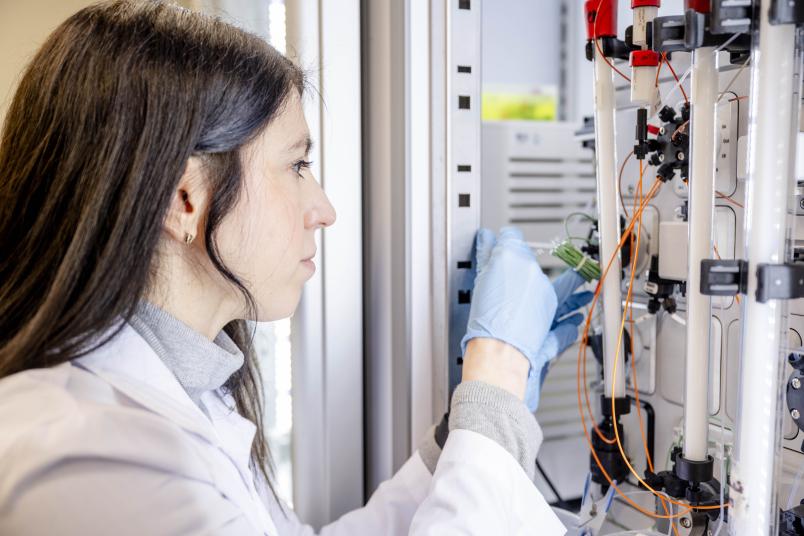
Georgina Herrera is the lead author of the paper.

Verian Bader, Georgina Herrera, Lena Kühn, and Konstanze Winklhofer (from left) are working together to study processes in cells.
Molecular cell biology
Insights into the Logistics of Cellular Waste Disposal
The details of the removal of harmful cell components explain why gene mutations lead to neurodegenerative diseases.
Protein aggregates, damaged organelles, and invading bacteria are identified and removed in healthy cells. An international research team led by Professor Konstanze F. Winklhofer from the Institute of Biochemistry and Pathobiochemistry at Ruhr University Bochum, Germany, has deciphered a critical mechanism underlying these processes, focusing on the protein optineurin. Malfunctions in this protein can lead to neurodegenerative diseases like amyotrophic lateral sclerosis or frontotemporal dementia. The researchers hope that their insights will lead to new approaches to treatment in the future. The study was published in the scientific magazine Advanced Science from December 17, 2025.
Marking and removing harmful substances
All living cells have to constantly monitor their own components and dispose of those that are potentially harmful, such as misfolded proteins or invading microbes, when necessary. This process is known as selective autophagy. To ensure that only the correct cellular components are eliminated, they are marked with chains of ubiquitin molecules. These chains interact with selective autophagy receptors that also bind with the autophagy mechanisms.
“One core protein in these cellular logistics is optineurin,” explains Winklhofer. “It specifically identifies misfolded proteins, damaged mitochondria, and invading bacteria, and signals to the autophagy system that these disruptive factors have to be removed.” It was previously unclear how this identification and organization process works in detail.
How the connection to the break-down machinery is formed
The research team in Bochum has shown that, after binding to ubiquitin chains, optineurin forms condensates that facilitate the efficient connection to the autophagy machinery. Condensates are reaction spaces in cells that form through phase separation. The formation of optineurin-ubiquitin condensates requires phosphorylation of optineurin by the protein TBK1 (tank-binding kinase 1), as phosphorylated optineurin can bind better to ubiquitin chains.
The LC3 protein, which plays an important role in the autophagy process, is also enriched in the condensates. Through the binding of optineurin to LC3, the components to be broken down are precisely directed to membranes where they are packed into autophagosomes and can then be digested in lysosomal organelles.
Proteins lose their function through mutations
“Interestingly, mutations in the optineurin and TBK1 genes are associated with familial forms of neurodegenerative diseases,” says Dr. Georgina Herrera, first author of the publication. These disease-causing mutations lead to a loss of function in optineurin and TBK1. Protein aggregates can then accumulate in nerve cells.
“The current study provides mechanistic insight into these processes,” says Winklhofer. “A detailed understanding of the break-down and clearance of harmful cellular components could inform new treatment approaches in the future, especially for neurodegenerative diseases.”