

Anna Meichsner is investigating the role of mitochondria.
Biochemistry
Mitochondria as Control Centers of Cell Communication
Mitochondria do not only provide energy, but also have a wide range of functions within cells.
The structural and functional characteristics of mitochondria shape their role as signaling organelles, with far-reaching effects regarding immune responses, inflammatory processes, and diseases. A research team led by Professor Konstanze F. Winklhofer at the Institute of Biochemistry and Pathobiochemistry at Ruhr University Bochum, Germany, provides an overview of the many functions of mitochondria in intracellular signaling. The researchers report their findings in the journal Molecular Cell from January 28, 2026.
Target and source of cellular signals
“Mitochondria function as signaling platforms within cells,” explains Winklhofer. “They link metabolic states with inflammatory or stress responses, thereby influencing the cell’s fundamental decisions.”
Thus, mitochondria are both target for external signals as well as source of signaling components themselves. Metabolic changes, disruptions to protein quality control, or damage to mitochondrial DNA trigger specific stress responses that reach the cell nucleus, where they modify gene expression patterns. Examples of this include the integrated stress response and mitochondrial unfolded protein response, both of which help recreate the cellular equilibrium.
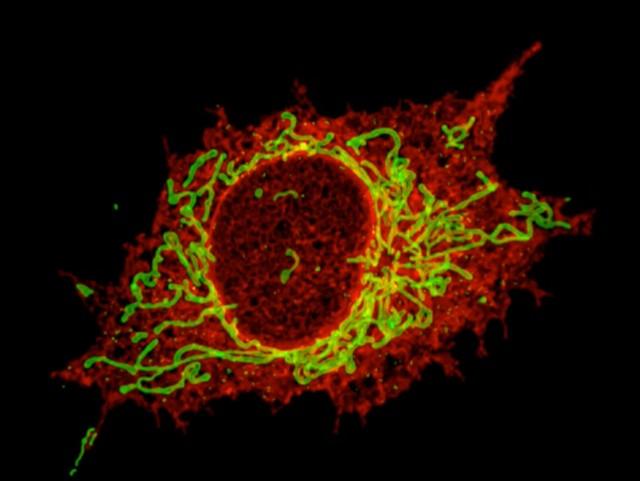
Microscopic image of a mitochondrion: The endoplasmic reticulum is shown in red, the mitochondria in green. The image was taken using super-resolution microscopy.
At the same time, mitochondria can emit their own signals by releasing molecules such as reactive oxygen species, metabolites, or nucleic acids. These signals influence fundamental cellular decisions, from adaptive responses to programmed cell death.
Mitochondria and the immune system
The article places special emphasis on the role of mitochondria in innate immune signaling. Because of their evolutionary origin they contain bacterial-like molecular signatures which if released, the cell can identify as danger signals. When these signals are emitted in the event of stress or damage, they activate immune and inflammatory signal pathways.
“Mitochondria can specifically enhance immune responses, but also fuel chronic inflammation if these processes are not properly regulated,” says Anna Meichsner, first author of the review. They can thus be both helpful and harmful. “This makes them an important interface between cellular stress, immune responses, and disease development.” Persistent or misdirected signals of chronic inflammations are connected with metabolic, neurodegenerative, or inflammatory diseases.
“Better understanding of the regulatory mechanisms of mitochondrial signal pathways is crucial for comprehending their role in health and disease,” explains Winklhofer. “In the long term, this could provide a basis for targeted intervention in pathological signaling processes.”