
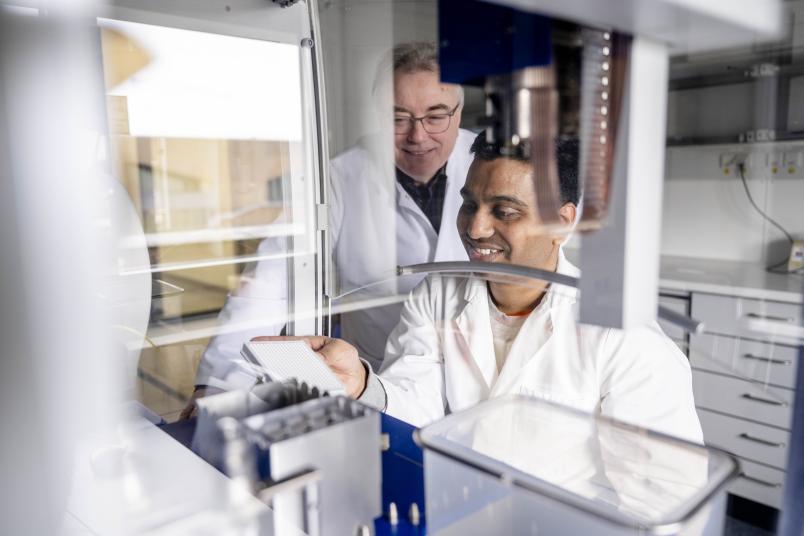
Ralf Erdmann (left) and Chethan Krishna are dedicated to researching trypanosomes. These pathogens cause various diseases that are common worldwide.
Pathobiochemistry
A Highly Precise Target for Medications against Tropical Diseases
The pathogens that cause tropical diseases rely on an essential protein that is absent from all other organism. This discovery opens the possibility for targeted treatment.
Researchers working with Professor Ralf Erdmann at Ruhr University Bochum, Germany, have discovered a critical vulnerability shared by the pathogens that cause African sleeping sickness, Chagas disease, and leishmaniasis. The PEX38 protein plays a crucial role in the formation of certain organelles of the trypanosomes that are essential for their energy supply. Because humans do not require this protein, it represents a promising target for new treatments against tropical diseases that affect over one billion people worldwide every year. Current treatments are often limited by high toxicity and increasing drug resistance. The team led by Ralf Erdmann reports its findings in the journal Proceedings of the National Academy of Sciences (PNAS) from February 26, 2026.
Unique metabolic architecture
Cells have to break down sugar to produce energy. In most organisms, this process of glycolysis takes place in the cytosol. This is not the case with trypanosomes. These possess specialized organelles called glycosomes where glycolysis takes place. “Because the parasites rely fundamentally on these organelles for energy production, any disruption of glycosome biogenesis is lethal to them,” says Erdmann. “This makes glycosomes a potential Achilles’ heel new developed drugs could target.”
In collaboration with the teams led by Professors Bettina Warscheid (University of Würzburg) and Michael Sattler (Helmholtz Center Munich), Erdmann and his colleagues Dr. Chethan Krishna and Dr. Vishal Kalel from the Faculty of Medicine at Ruhr University Bochum discovered that the PEX38 protein plays a critical role in glycosomal biogenesis.
Mechanism of evolutionary repurposing
The membrane of glycosomes consists of lipids and proteins. These proteins are formed in the cytosol must then be transported to the glycosomes, where they are inserted into the membranes. This process requires special assistance: Transport proteins guide newly formed membrane components to their destination, while chaperone proteins shield the hydrophobic membrane proteins against the surrounding aqueous cytosol.
The entire process of glycosomal biogenesis is facilitated by a group of proteins known as peroxins (PEX proteins), discovered by Ralf Erdmann in 1991. While most organisms rely on a conserved set of peroxins, the team in Bochum discovered PEX38 as a trypanosome-specific component. “PEX38 functions as a sort of adapter that connects both chaperones and import receptors,” Erdmann explains. Without PEX38, chaperones could no longer be recruited – newly formed membrane proteins become damaged, and glycosomes cannot be assembled.
PEX38 is the first peroxin to be identified outside of yeast and mammals in over 35 years, marking an important milestone in the study of organelle biogenesis and parasite biology.
PEX38 also represents a striking example of evolutionary repurposing. In most organisms, an ancestral form of PEX38 is part of a transport pathway that delivers proteins to the endoplasmic reticulum. This pathway was lost in trypanosomes throughout their evolutionary course. However, PEX38 itself was not eliminated, but rather repurposed: In these parasites, it transports membrane proteins to the glycosomes.
A species-specific target for global health
The therapeutic potential of this work is substantial. Because PEX38 is essential for parasite viability, but this interaction does not occur within the human body, its interaction with other peroxins represents a highly precise molecular target for drug development. Using state-of-the-art proteomics and high-resolution NMR structural modeling, the researchers demonstrated that PEX38 contains distinct domains that bind both chaperones and the PEX19 import receptor. “Disrupting this interaction could provide a way to selectively eliminate the pathogen without harming human cells,” says Erdmann.