
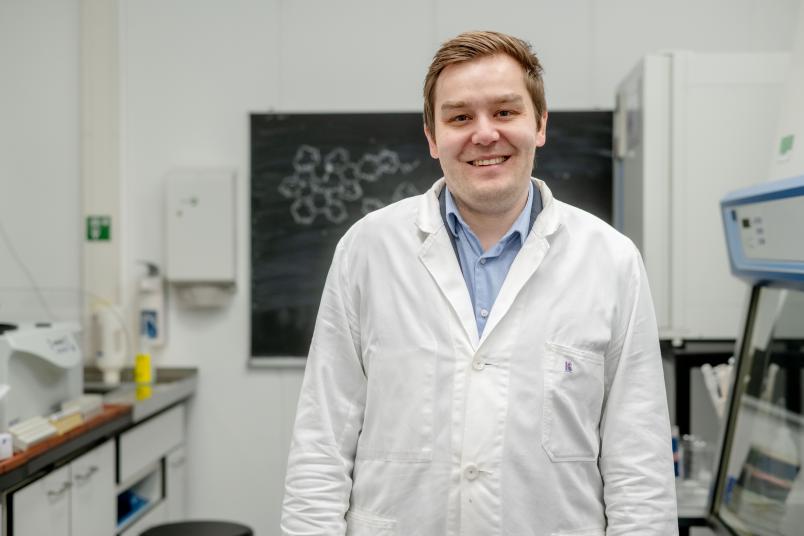
Johannes Karges is researching compounds that kill tumor cells.
Chemotherapy
Copper Overload Kills Cancer Cells
A copper-based agent complex kills cancer cells in a novel way. It receives its activation signal through light. It could help where existing chemotherapy treatments reach their limits.
Cuproptosis was discovered in 2022. It was a previously unknown type of cell death caused by an excess of copper. The research group led by Professor Johannes Karges at Ruhr University Bochum, Germany, used this mechanism to develop a new, copper-based agent complex that kills cells 100 times more effectively than existing chemotherapy treatments. The copper complex is embedded in polymeric nanoparticles that selectively accumulate in tumor tissue. Only through activation via light do the particles dissolve and release the active ingredient, specifically killing tumor cells and preserving healthy tissue. The researchers report their findings in the journal Advanced Functional Materials from March 25, 2026.
Cancer cells take in more copper than healthy cells
Cuproptosis is fundamentally different from all previously known mechanisms of cell death: The deciding trigger is an excess of copper in the cell. It binds to certain proteins in the mitochondria that are normally responsible for energy production. These proteins clump together as a result, the cell undergoes extreme stress, and then it dies. “What makes this type of cell death so unique is its specificity in targeting the cell’s energy production,” explains Karges. “Cancer cells often have an altered, particularly intense metabolism and take in more copper than healthy tissue does.”
Karges’ team has successfully developed a copper complex that selectively induces cuproptosis. It is approximately 100 times more effective than existing platinum derivatives currently used clinically. “However, the substance was not selective at first and was fatal to healthy cells as well,” says Karges. “We were able to solve this issue by integrating the ingredient in light-activated nanoparticles.”
Packaging with dual benefits
The actual agent complex is embedded in polymeric nanoparticles. Due to the increased metabolism of cancer cells, these particles accumulate in tumors. The agent is thus selectively transported to where it is supposed to take effect. In addition, the polymer coating prevents the copper complex from being prematurely and uncontrollably released.
A light stimulus is required to release the agent on site. “The release principle is based on a photo-responsive bond within the basic polymer framework,” says Karges. “Light radiation selectively severs this specific bond, whereupon the nanoparticles dissolve and the copper complex is released locally.” This allows highly precise and selective treatment of cancer cells. “We were also able to show that this method is effective in treatment-resistant cancer cells, where conventional chemotherapy treatments hit their limits.”
However, much research must still be done before the method can be used clinically. “So far, we have shown this on resistant cancer cells in the lab, not in a human body,” Karges emphasizes. “A lot still has to be done before an actual treatment can be performed.”