
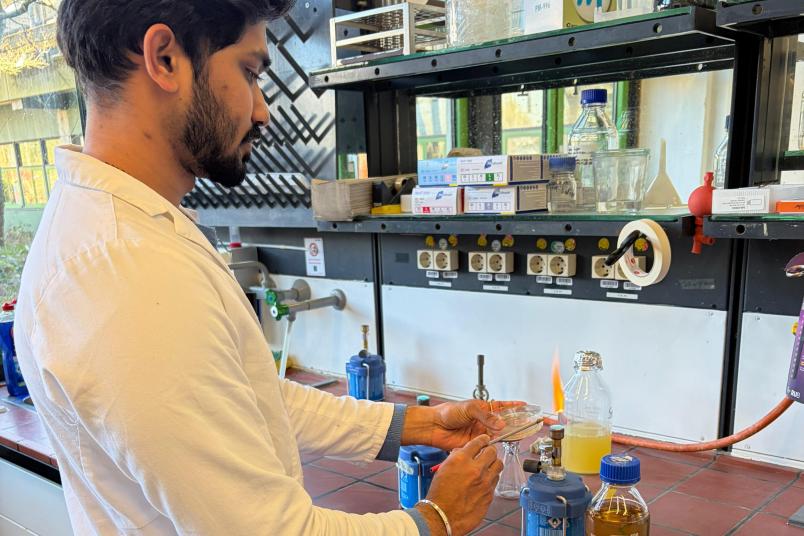
Inoculation of Rhodococcus by Selvapravin Kumaran
Biotechnology
Soil bacteria break down toxic chemicals in the environment
These masters of adaptation offer a wide range of potential metabolic pathways for a vast array of environmental conditions.
Many aromatic compounds, such as phenols, cresols and styrenes, are toxic to organisms and harmful to the environment. They can accumulate as a result of industrial processes and harm ecosystems. Soil bacteria can help to break them down. For one of these, Rhodococcus opacus 1CP, the team from the Microbial Biotechnology Research Group at Ruhr University Bochum, Germany, led by Professor Dirk Tischler, has analyzed the genome and identified many potential metabolic pathways that the bacterium can employ to act as a ‘clean-up specialist’ under a wide variety of environmental conditions. They report their findings in the journal Applied and Environmental Microbiology on March 27, 2026.
A large genome with many redundancies
“Our ‘pet’ Rhodococcus opacus 1CP is characterized by a particularly large genome, which encodes a large number of enzymes, some of which are redundant,” explains Dirk Tischler. These enzymes enable substrates to be converted and often work in a specific sequence, thereby forming a metabolic pathway. If an aromatic compound, such as styrene, is supplied to the bacterium, it is activated and metabolized, ultimately producing CO2. “In the course of this metabolism, the bacterium has gained energy and cleaned the environment for us: a central element of environmental biotechnology,” says Tischler. “Understanding these processes is very important to us because it not only helps us understand how to remove pollutants from the environment, but also how to support ecosystems in doing this themselves, so to speak.”
The redundancies in the genome of soil bacteria are a great advantage here: the various enzymes of the same class are produced under different environmental conditions, for example depending on oxygen concentration, temperature or nutrient availability. This allows bacteria to adapt quickly to changing environmental conditions. In the context of climate change, this is a vital ability.
Switching off one enzyme opens up a new metabolic pathway
To find out which enzymes contribute to the breakdown of aromatic compounds, Dirk Tischler’s team analyzed the genome of Rhodococcus opacus 1CP. “We were able to show that when certain enzymes are knocked-out, others step in, thereby even new metabolic pathways become active,” reports Tischler. In all cases, it became clear that two or three enzymes of the same class are often actively involved in the initial activation or subsequent conversion. This is also the case with phenol and cresol: here, the strain has three enzymes that normally activate phenol or cresol and form catechols. If these are switched off, other enzymes are suddenly recruited, allowing the breakdown of aromatic compounds via alternative routes. “There is still a lot we can learn here,” says Dirk Tischler enthusiastically.