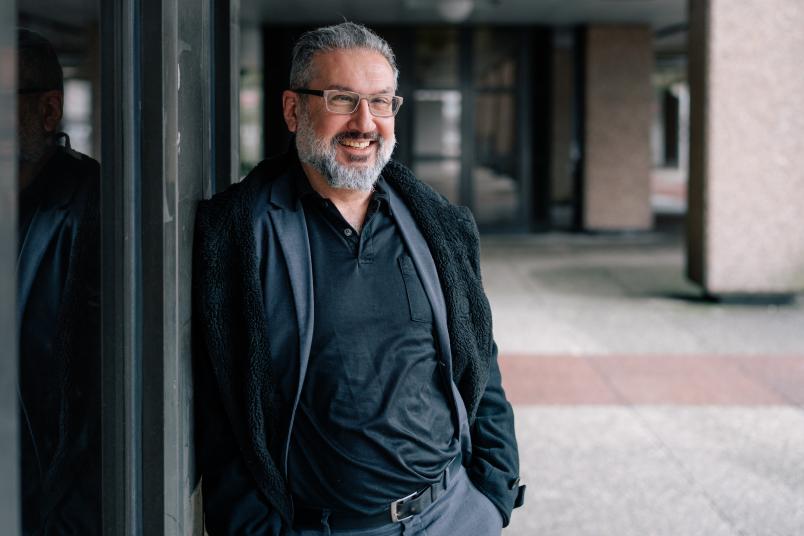
Ekrem Dere is Professor at the Research and Treatment Center for Mental Health at Ruhr University Bochum.
New theory
Why Some People Mentally Travel into the Future More Often than Others
A researcher in Bochum theorizes that mental time travel can activate the reward system of the brain. The behavior thus reinforces itself.
In order to predict the potential consequences of actions, it helps to envision yourself in the future and imagine the coming scenario. Some people do this more often than others. Professor Ekrem Dere of Ruhr University Bochum, Germany, and Sorbonne Université in Paris has developed a theory for why. He believes that mental time travel activates the reward system in the brain, thereby reinforcing one’s behavior. Dere describes his approach in the journal Psychological Review, published online on April 6, 2026.
“The benefit of future-oriented mental time travel is clear,” says Dere, from the Research and Treatment Center for Mental Health at Ruhr University Bochum. “It allows us to be more successful and less stressed in our day-to-day, as the future becomes more predictable and thus easier to plan.” However, he adds, one may ask why people invest time in this challenging cognitive task that does not provide any immediate rewards and has no guarantee of success.
Mental time travel follows a universal learning principle
In response to this, Dere formulated the self-reinforcement hypothesis of future-oriented mental time travel. He postulates that this process follows a universal learning principle known as operant conditioning, which states that behavior that is rewarded or punished will occur in the future either more or less frequently, respectively.
Dere theorizes that if future-oriented mental time travel seems like a promising solution to a social or professional problem, the reward system in the brain is activated. This makes it easier to remember the plan of action until it is realized, and it reinforces the behavior, causing it to occur more frequently in the future.
According to Dere, this theory can be tested with functional magnetic resonance imaging: People who mentally travel to the future more frequently should have a more reactive reward system, i.e., a more responsive mesolimbic dopamine system.
Mental time travel can have a disease-preserving effect
“In a pathopsychological context, the cognitive function of mental time travel can also be hijacked by disease-preserving processes,” says Dere. This can cause one to ruminate on negative past experiences and project them into the future. Such catastrophizing projections bring forth negative emotions, foster a bad self-image, and trigger maladaptive safety and avoidance behavior. A mental disorder can then become chronic. “For this reason, it would be important to psychotherapeutically train constructive and adaptive future-oriented mental time travel, and to recognize and halt catastrophizing future projections.”