
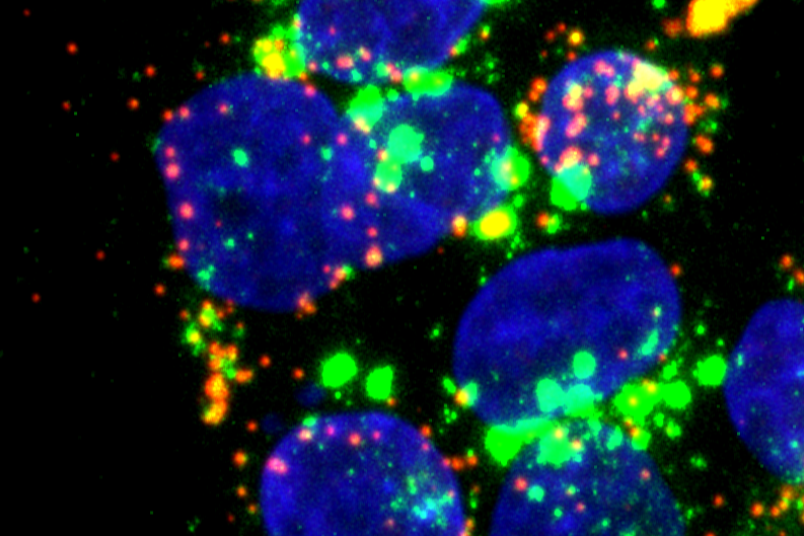
Immunofluorescence images of HEV entry: Hepatitis E virus RNA (red), endolysosomal compartments (green), and cell nuclei (blue).
Virology
New cellular target prevents hepatitis E infection
Instead of directly attacking the virus, the compound acts on the host cell and prevents infection.
An international team of researchers has identified a promising new approach for treating infections with the Hepatitis E virus (HEV). At the center of the study is the drug Apilimod, which specifically blocks the entry of the virus into human liver cells, thereby preventing infection at an early stage. The compound targets a mechanism of the host cell, reducing the likelihood that the virus will develop resistance. Apilimod has already been clinically evaluated, which could accelerate its development into a drug against hepatitis E. The study, lead by the Department of Molecular and Medical Virology at Ruhr University Bochum, Germany, was published in the journal eGastroenterology on March 31, 2026.
An essential enzyme
To replicate, a virus must first enter a host cell. This is precisely where the study begins: the researchers specifically investigated host cell processes required for successful HEV infection. In doing so, they identified the enzyme PIKfyve as a crucial factor for viral entry.
PIKfyve plays a central role in intracellular transport processes, particularly in the endolysosomal system - a network of cellular compartments used by many viruses as an entry route. In their experiments, the researchers identified the PIKfyve inhibitor Apilimod as particularly effective. The compound efficiently prevented the virus from entering cells. Unlike classical antiviral agents, Apilimod does not directly target the virus but instead blocks a cellular mechanism exploited by the virus.
“This is a key advantage,” says co-author Sarah Schlienkamp. “By targeting a host factor, the likelihood of the virus developing resistance is lower,” adds co-author Julian Ring.
A safe and well-tolerated compound
The effectiveness of Apilimod was confirmed in various model systems, including cell cultures, primary human liver cells, and an animal model using infected rats. In all experiments, viral load was significantly reduced.
“What is particularly interesting is that Apilimod has already been clinically tested and has a known safety profile,” emphasizes co-author Maria Darido. “This could significantly accelerate its further development for the treatment of hepatitis E.”
Moreover, the results show that inhibition of PIKfyve specifically blocks viral entry without significantly impairing essential cellular functions. This suggests good tolerability - an important factor for future clinical applications.
Overall, the findings highlight the potential of therapies targeting host factors. Instead of attacking the virus itself, these strategies focus on cellular processes essential for viral infection, which may also remain effective against emerging viral variants.
Future studies will need to determine to what extent these promising results can be translated into clinical applications.
Hepatitis E