
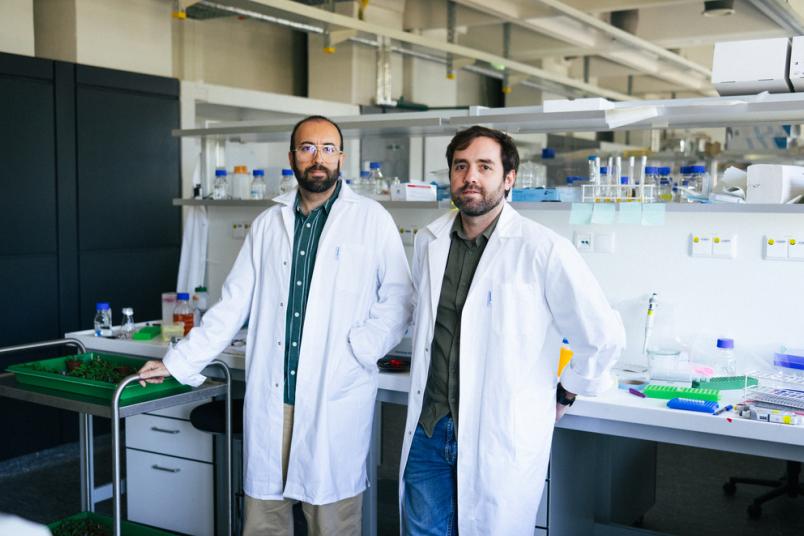
Suayb Üstün and Manuel González-Fuente (right) want to learn more about the immune system of plants.
Biology
How Bacteria Circumvent Plants’ Immune System
Bacteria deactivate the protein synthesis of host cells to hamper immune reactions. This insight could aid in the development of more resistant plants.
How are bacterial pathogens able to effectively overcome plants defense mechanisms? Researchers working with Professor Şuayb Üstün at Ruhr University Bochum, Germany, have found a surprising answer to this question: The pathogens seize tiny compartments in plant cells, known as processing bodies or P-bodies, to selectively deactivate protein production when the plant needs it the most. The researchers describe this previously unknown strategy of the plant pathogen Pseudomonas syringae in the journal Science Advances from April 24, 2026.
A stealth attack on cellular protein production
In order to defend themselves, plants have to quickly produce proteins that detect and combat infiltrating microbes. The research team discovered that Pseudomonas syringae disrupts this process by triggering the formation of P-bodies – small, droplet-like structures in the cell that store and regulate RNA molecules. “Many RNAs are practically taken out of circulation when these droplets form,” explains Manuel González-Fuente, first and co-corresponding author of the study. “This means that the plant can no longer produce the proteins that it urgently needs to defend itself.” The bacterium achieves this with two specialized proteins known as effectors, which jointly reorganize the host cell. This results in an strong reduction in protein production, thereby weakening the plant’s immune response.
Reprogramming the cell from the inside
Beyond this immediate effect, the study also addressed a deeper level of manipulation. First, the bacteria suppress a central cellular stress response linked with the endoplasmic reticulum, an important hub of protein production and quality control. Only then can P-bodies be formed efficiently. “This shows that pathogens work in a highly coordinated manner,” says Üstün, last author of the study. “They reprogram fundamental processes in the cell in order to take control, instead of just blocking one signal pathway.”
An unexpected role of cellular recycling
The researchers also noticed that autophagy, through which cells break down and recycle unwanted components, is involved in the regulation of P-bodies. This adds another layer: Bacteria not only influence protein production, but also the mechanisms by which cells maintain their internal equilibrium.
Why this is important
P-bodies and similar structures are found in many organisms, including humans. The results of the study could thus be relevant far beyond the realm of plant biology and provide insight into how pathogens manipulate their host cells in general. “This discovery provides new insights into infection biology,” says González-Fuente. “It indicates that controlling these cellular droplets could be crucial in improving resistance.”
On the way to more resilient crops
“Our work shows the extent to which pathogens can influence fundamental cell functions,” says Üstün. “At the same time, it shows us ways in which we can selectively steer these processes.” Understanding how pathogens reduce protein synthesis could aid in the development of plants that are better protected against diseases. If bacteria can be prevented from commandeering P-bodies, plants’ defense mechanisms could remain active when they are most needed.