
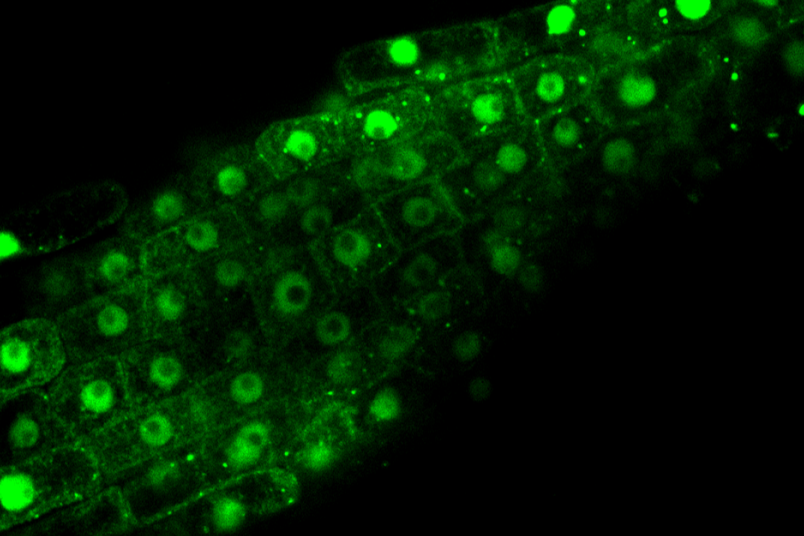
Confocal microscopy of Arabidopsis plants expressing NAC53 fused to GFP.
Biology
How Plants Rebalance Their Energy under Stress
When under stress, plants cut back on energy production to focus on breaking down damaged proteins.
Plants are under constant stress due to pathogens, heat, or other environmental factors. Proteins can become damaged as a result and cell function is thrown off balance. Researchers at Ruhr University Bochum working with Professor Şuayb Üstün have discovered how plant cells respond to this protein stress and selectively adjust their internal processes. The researchers show that cells under stress prioritize the breaking down of damaged proteins over energy production through photosynthesis. Their findings could help make plants more robust. The study is published in the journal Molecular Cell from April 30, 2026.
When proteins become unbalanced
Thousands of proteins have to be correctly produced, folded, and regulated in each cell. Under stress conditions, this balance (known as proteostasis) becomes unstable. Misfolded or damaged proteins accumulate and can harm the cell. In order to counteract this, cells use a sort of molecular recycling system called proteasome to break down the defective proteins. However, it was previously unclear how cells adapt this activity to different stress situations within the cell.
A control center in the endoplasmic reticulum
The researchers demonstrated that two central regulators control this adjustment: transcription factors NAC53 and NAC78. These are found in the endoplasmic reticulum (ER), an important hub of protein production. “We discovered that these factors act like a control panel,” explains Gautier Langin, first author of the study. “They integrate stress signals from different areas of the cell and decide how the cell will respond.” Under normal conditions, NAC53 and NAC78 are quickly broken down. When the cell is under stress, however, they are activated, migrate to the nucleus, and activate genes that strengthen the breakdown of proteins.
A new mechanism: ERAS
A key breakthrough in the work is the discovery of a new regulation mechanism known as ER-associated sorting (ERAS). This process determines whether NAC53 or NAC78 will be broken down or activated. “This is a fundamental mechanism of cell regulation,” says Üstün, last author of the study. “The cell uses a single control point to decide between breaking down or activating these factors.”
Surprisingly, the study showed that NAC53 and NAC78 not only activate the breakdown of proteins, but simultaneously suppress photosynthesis – the process plants use to produce energy. This highlights a central conflict of aims: Under stress, the cell pulls back on growth and energy production to ensure its own stability.
“When damaged proteins accumulate, the cell specifically reduces energy-intensive processes like photosynthesis,” explains Langin. “This helps prevent further harm.”
Communication within the cell
The results also show that this mechanism connects various cell compartments together, in particular the nucleus and the chloroplasts, where photosynthesis occurs. This facilitates a coordinated stress response throughout the entire cell.
Possibilities for more robust plants
The study provides a new understanding of how cells maintain their equilibrium under stress. Because similar mechanisms also exist in other organisms, the results could be relevant beyond the field of plant biology. “This type of regulation is probably evolutionarily conserved,” says Üstün. “It opens up perspectives of how cells interlink protein control and metabolism.” Better understanding of these processes could aid in making crops more durable against environmental stress like heat, drought, or pathogens. “If we can understand these correlations, we can take a targeted approach and make plants more robust,” says Üstün.