
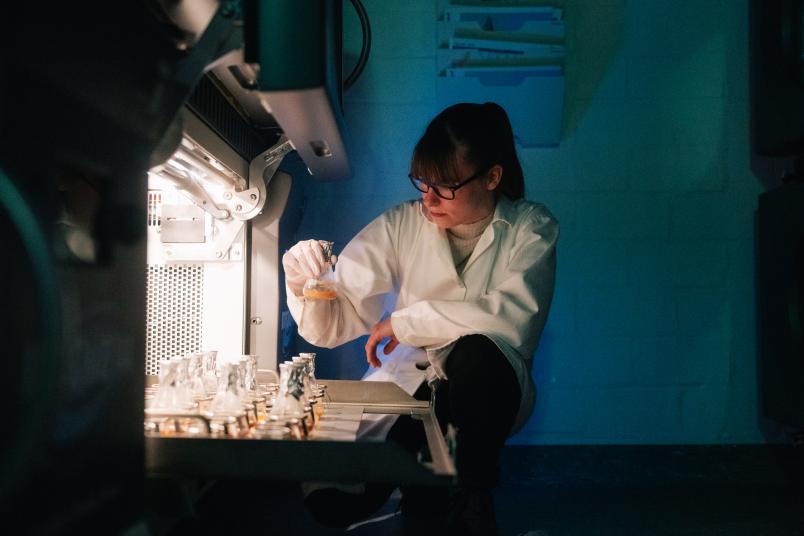
Lara Marson, a doctoral student in the Department of Applied Microbiology, is investigating which natural derivatives of calcimycin are produced by wild-type and mutant strains under different cultivation conditions.
Microbiology
Piracy among Microbes
Bacteria require iron to grow. If they cannot secure enough on their own, they steal from their neighbors.
Competition rules life in the soil. Bacteria and fungi constantly battle over resources. The fighting is fierce, especially when nutrients are scarce or hard to come by. Professor Julia Bandow and her team are taking a close look at the methods these tiniest of lifeforms use against each other. The researchers’ ultimate goal is to discover new substances that can be used as antibiotics for medical applications. They can learn a great deal from the competition for micronutrients. This is reported by Rubin, the science magazine of Ruhr University Bochum.
“Iron is an element that is abundant everywhere,” says Bandow. “But it usually occurs in a form that is not readily water-soluble, which makes it difficult for organisms to access.” Not surprisingly, bacteria have developed a range of methods to access iron.
Catecholates are the gold standard when it comes to iron availability. “The soil bacterium Bacillus subtilis is a real specialist here,” says Bandow. “It is capable of forming catecholate siderophores that surpass other methods of iron aquisition.” This particular bacterium collects iron and stores it within itself so that it has a sufficient supply to support growth.
One of its competitors, Streptomyces chartreusis, relies on a different tactic: In cases of iron deficiency, when only catecholates can help, it steals from its neighbors. “It has an uptake system for foreign siderophores,” explains Bandow. “This siderophore piracy is quite common among bacteria, and it can also be found in bacteria that colonize the human body.”
Detailed article in science magazine Rubin