
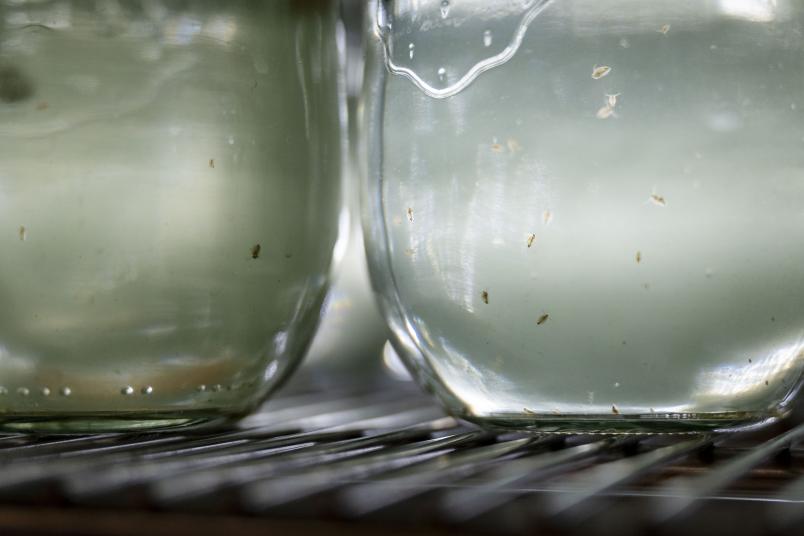
Water fleas are bred in jars like these in Bochum.
Biology
How Water Fleas Detect Their Predators
When water fleas grow up in the vicinity of predators, they change their body shape. Crowns of thorns or large heads make them more difficult to eat. Researchers in Bochum provide insight into the underlying mechanisms.
Daphnia, also known as water fleas, are artists of defense: When their predators live nearby, the water fleas change their body structure to make themselves more difficult to eat. “The predators emit chemical signals that the Daphnia can detect,” explains Professor Linda Weiss from Ruhr University Bochum, Germany. She and her team have identified a chemoreceptor gene family that encodes the corresponding receptors, and is thus involved in detecting predators’ signals. A research group with Dr. Annette Graeve, Joshua Huster, and Professor Linda Weiss describes their findings in the journal Proceedings of the Royal Society B, published online on May 6, 2026.
Different types of defenses against different predators
The researchers worked with three Daphnia species that are not only threatened by different predators, but whose predators emit different chemical signals, thereby triggering various defense responses. Daphnia magna becomes round like a balloon in the presence of the crustacean Triops; Daphnia longicephala enlarges its head, making it harder for backswimmers to grab; and Daphnia lumholtzi grows extended head and tail spines to defend against sticklebacks.
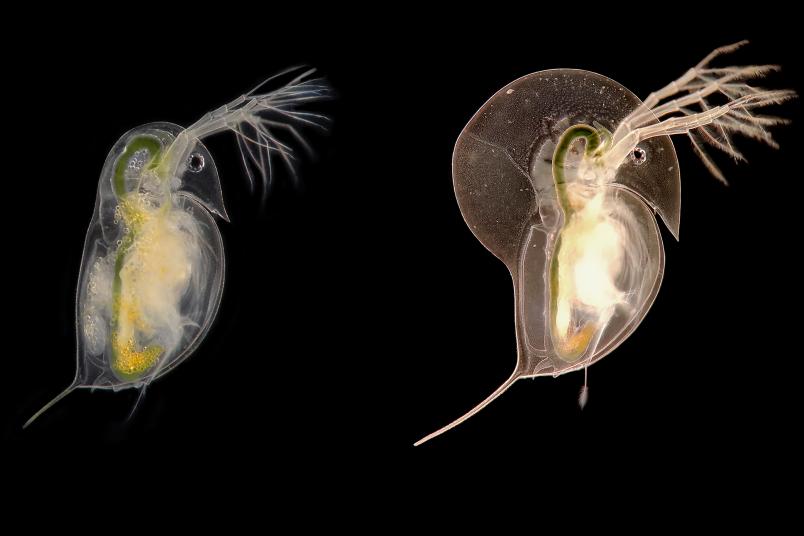
The researchers examined three Daphnia species: The images in this gallery show the animals without a defense on the left, and with a defense on the right. This image depicts Daphnia longicephala which enlarges its head in the presence of predators.
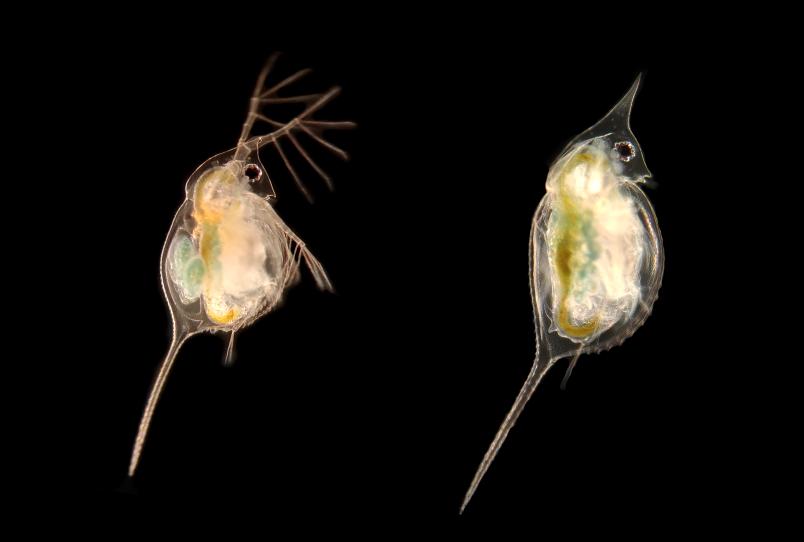
Daphnia lumholtzi forms barbs (right).
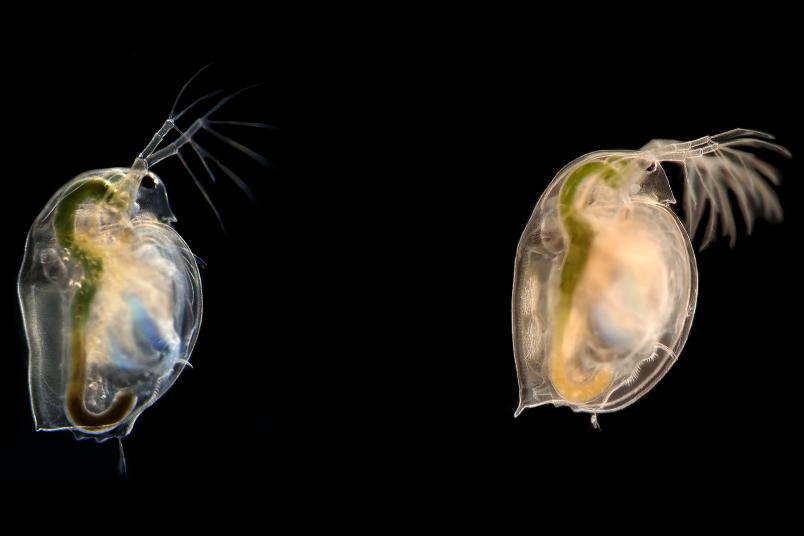
The stomach of Daphnia magna enlarges in the presence of predators (right).
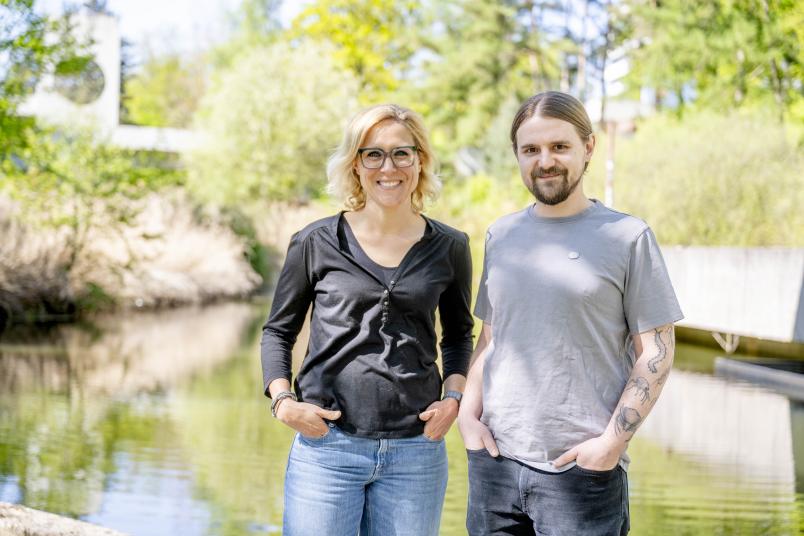
Part of the research team in Bochum: Linda Weiss and Joshua Huster
It was already known that the predators emit chemical signals known as kairomones. However, it was unclear which receptors Daphnia use to detect the kairomones. The researchers in Bochum suspected ionotropic receptors in which an ion channel opens upon the binding of a molecule.
In Daphnia as well as other organisms, these ionotropic receptors are scaffolds of co-receptors that anchor the overall receptor complex in the membrane and functionally interlink with select sub-units. The biologists in Bochum were interested in the role that these co-receptors, specifically sub-types IR25a and IR93a, play. They selectively prevented the expression of the two genes so that the Daphnia could no longer produce these co-receptors.
Receptor production suppressed
Normally, receptor proteins are formed when the corresponding genes are transcribed in the cell nucleus and exported to the cytoplasm as messenger RNA. Here, the messenger RNA is translated and further processed into a receptor protein, which is ultimately incorporated into the cell membrane – primarily in the chemosensory antennae of Daphnia.
The team disrupted this process with RNA interference: The researchers injected RNA fragments into the Daphnia. These fragments bind to the messenger RNA, thereby preventing its translation into a receptor protein.
No defenses without co-receptors
Daphnia that cannot produce the co-receptors IR25a and IR93a due to RNA interference did not form defense mechanisms when raised in the presence of their predators. The outer appearance of the animals without co-receptors looked identical to that of the control animals that were not raised alongside predators. This effect was consistent across all three species that were examined. The two suppressed co-receptors must thus play a role in the perception of the chemical signals emitted by the predators.
“We are interested in understanding the chemical interplay between predator and prey because we believe that climate change will influence such relationships, as e.g. invasive species may introduce new chemical signals into the local system that cannot be interpreted,” says Weiss. “If chemical communication is disrupted, this could reduce the effectiveness of defense reactions with consequences for feeding rates and population dynamics, and thus ultimately for the stability of entire freshwater food webs.”