
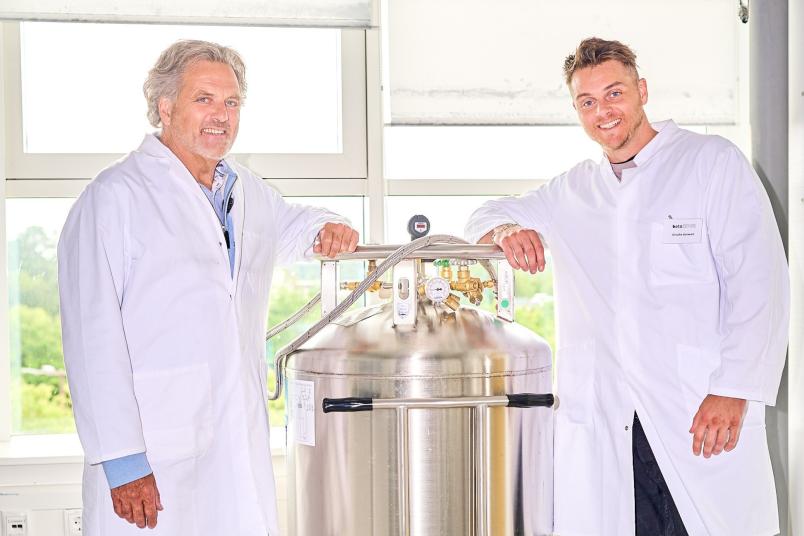
Klaus Gerwert and Grischa Gerwert in a betaSENSE laboratory
Early detection
Immuno-infrared Sensor Detects Alzheimer’s and Parkinson’s in Blood
An early start to treatment is crucial to successful therapy. A new sensor is helping with early detection.
For the first time, therapeutically effective medications are now available for Alzheimer’s disease. Effective symptomatic therapies also exist for Parkinson’s disease. However, a prerequisite for successful treatment is early diagnosis – ideally through a simple blood test conducted as part of a preventive screening, even before clinical symptoms appear. A research team led by Professor Klaus Gerwert from Ruhr University Bochum, Germany, has developed just such a blood test. It is based on the immuno-infrared sensor, a novel platform technology to which the Journal of Physical Chemistry B dedicates its cover story in its issue from April 24, 2026.
In our aging society, cases of Alzheimer’s and Parkison’s disease are rising dramatically. This is not only immensely challenging for patients and their families, but it is also putting increasing strain on our healthcare systems.
Modern diagnoses are largely symptom-oriented, and thus are usually made too late. The brain is already massively and irreversibly damaged by the time symptoms start to appear. “Because of this, there is a broad consensus in the scientific community that therapy needs to begin much sooner,” says Klaus Gerwert, “even before the typical insoluble protein deposits form in the brain – these being amyloid plaques in the case of Alzheimer’s, or Lewy bodies in Parkinson’s.”
Analyzing biomarkers in complex body fluids
The sensor method developed by the research group is based on the concept of using specific antibodies to isolate misfolded biomarkers directly from body fluids – the amyloid beta protein (Aβ) for Alzheimer’s, alpha-synuclein (α-Syn) for Parkinson’s. The degree to which these biomarkers are misfolded is a very early indicator of neurodegenerative processes. This misfolding is detected with modern infrared spectroscopy, highly sensitive quantum cascade laser technology.
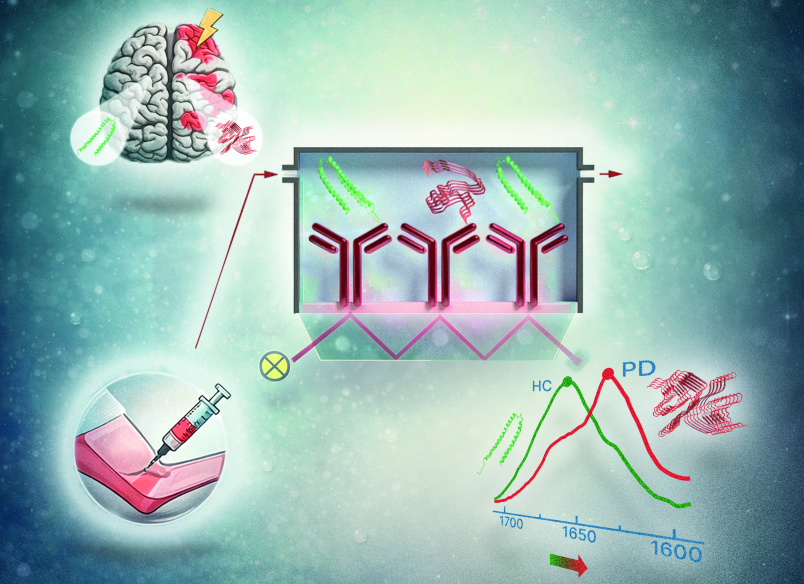
Misfolding of α-synuclein (α-syn) deposited in Lewy bodies in the brain is a hallmark of Parkinson’s disease. Such misfolded α-syn is also observed in blood and therefore allows a biological classification of Parkinson’s, an unmet medical need. The immuno-infrared sensor (iRS) measures the degree of α-syn misfolding and thereby addresses this need by a non-invasive and cost-effective blood test.
A newly developed and patented surface chemistry is used to immobilize the antibodies on the sensor, while a specially developed blocking layer prevents non-specific binding to the surface. This enables the secondary-structure-specific infrared spectrum of the biomarker to be directly isolated from complex body fluid background spectrum using difference spectroscopy.
“These unique measurements are possible because of the combination of molecular biology, biophysics, and laser spectroscopy,” says lead author Dr. Grischa Gerwert. Furthermore, this interdisciplinary technology possesses broad application potential for the analysis of a wide variety of biomolecules in complex solutions.
“One special advantage of quantum cascade laser technology lies in its high scalability through parallel measurements,” Grischa Gerwet adds. “Consequently, this method holds promise for broad clinical application and population-wide screening in the future.”
Working intensively to obtain approval
The immuno-infrared sensor is already being used in clinical studies by Gerwert’s company BetaSENSE. This company inspects new medications on behalf of the pharmaceutical industry, including a vaccine against Parkinson's disease, as part of contract research.
Approval according to the European IVDR Regulation is required for the blood test to be available as an early detection test for the general public. This entails considerably regulatory effort and financial expense. “At BetaSENSE, we are working hard to advance the approval process and make the test available to the public as soon as possible,” says Grischa Gerwert.