
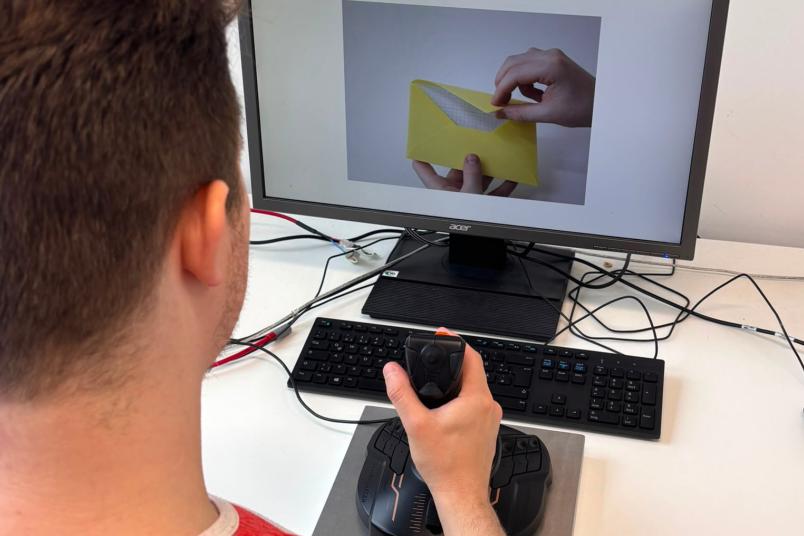
Using a joystick, the test subjects moved various images closer to them or pushed them away. In addition to the login screens of online platforms, neutral photos like this one were used as controls.
Psychology
When Online Content Exerts an Irresistible Pull
People with problematic Internet use are unconsciously drawn to certain types of online content. These findings could help researchers develop targeted training programs to support people with problematic Internet use.
Games, shopping, social media, pornography: The Internet offers many temptations. While most people use the Internet in moderation, some develop addictive behaviors. A multicenter study with over 1,000 participants with and without problematic Internet use found that all participant groups showed a tendency to approach internet-related cues. However, this automatic and unconscious pull was significantly stronger among individuals with problematic Internet use. “This indicates that certain training programs can be developed to help affected individuals distance themselves from such stimuli,” says Professor Martin Diers of the Ruhr University Bochum Clinic for Psychosomatic Medicine and Psychotherapy, Germany. The study was published in the Journal of Behavioral Addictions on May 12, 2026.
The research teams in Duisburg, Bamberg, Gießen, Hannover, Lübeck, Macau, Mainz, Siegen, and Bochum included a total of 1,015 individuals in their study. These subjects were divided into three groups following a diagnostic process. One group included individuals whose Internet use was non-problematic; the second group contained subjects with risky use; the third group was made up of individuals with pathological—i.e., problematic—Internet use. The subjects were categorized following a structured clinical interview based on the criteria of the Diagnostic and Statistical Manual of Mental Disorders (DSM-5) and additional aspects of the International Classification of Diseases (ICD-11).
Joystick task measures approach and avoidance tendencies
The groups were all given the same task: They were shown images on a computer screen that were either associated with internet-related content or were neutral. “The internet-related images included login screens from social media, gaming, shopping, or pornography websites,” explains Diers. The neutral images, for example, depicted hands using everyday items like scissors.
In multiple iterations, participants were instructed to use a joystick to pull the images toward themselves, or push them away. In two of four iterations, participants were instructed to pull internet-related images and push neutral images away. In the other two iterations, the instructions were reversed. The researchers recorded participants’ reaction times throughout the task.
Unconscious pull could help identify risk groups
“Overall, we observed a tendency to approach internet-related stimuli compared to neutral images,” says Diers. The rewarding nature of online activities draws many people in. “This tendency was much stronger in individuals with problematic Internet use, however.” This indicates that automatic and unconscious processes have a major impact on usage behavior.
“This insight could help us better identify risk groups based on this behavioral marker,” says Diers. The results could also provide starting points for therapy. “For example, training programs in which affected individuals repeatedly learn how to actively avoid addiction-related stimuli may prove useful.”
The research team also found evidence that avoidance tendencies may emerge in individuals with more severe forms of problematic Internet use. This could point toward conflicts between the desire to engage in online activities and negative experiences such as loss of control or feelings of guilt.