
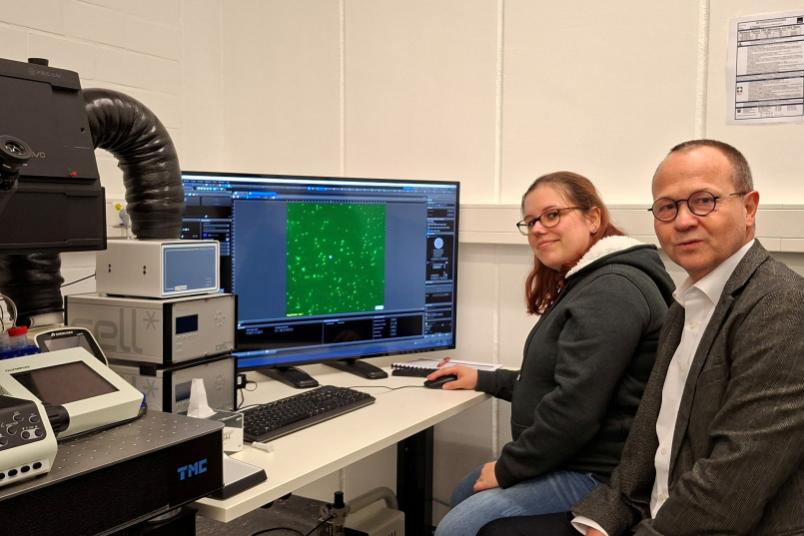
Sarina Veit (left) and Thomas Günther-Pomorski are observing individual proteins under a microscope.
Biochemistry
Individual Lipid Transporters under the Microscope
A new microscopy platform makes hidden differences between individual proteins visible and provides new insight into lipid transport across membranes.
Conventional methods generally analyze many proteins simultaneously. The specific traits of individual protein molecules are thus often unclear. A research team led by Dr. Sarina Veit and Professor Thomas Günther-Pomorski at Ruhr University Bochum, Germany, in collaboration with researchers from Weill Cornell Medicine in New York and the University of Toronto, Canada, has developed a new microscopy platform that overcomes this limitation. The method allows the simultaneous examination of hundreds of tiny membrane spheres each with a diameter of only about 200 nanometers. Each of these synthetic membrane spheres contains just one lipid transport protein. Using this method, the researchers can conduct measurements at the level of individual protein molecules. At the same time, the platform is flexible enough to be used to examine other proteins as well. The researchers report their results in the journal Nature Structural & Molecular Biology from June 15, 2026.
Lipid transport is essential to life
Every cell in our body is surrounded by a membrane – a thin, flexible shell mainly consisting of lipids. These lipids have to be transported through both sides of the membrane, a task performed by specialized lipid transport proteins. ”This transport is essential for many vital functions, including the formation and maintenance of cellular membranes, supplying mitochondria with lipids, and transmitting signals during programmed cell death,” explains Veit.
Previously, lipid transporters were mainly examined using ensemble measurements, in which millions of proteins are analyzed at the same time. However, such methods only provide average values and cannot distinguish between individual proteins; individual characteristics and behaviors remain unclear. The international research team was able to overcome this limitation. By using highly sensitive imaging technology as part of this high-throughput method, the researchers were able, for the first time, to precisely measure how quickly an individual protein transports the lipids through the membrane.
Not all proteins act in the same way
The new method was applied to the protein VDAC1. This protein plays a key role in supplying mitochondria with lipids and is only active when two protein molecules assemble into a dimer. “The tests have shown that the individual VDAC1 proteins do not behave identically at all,” says Günther-Pomorski. “While some dimers transported thousands of lipids per second, others were much slower or were even entirely inactive.” This previously unknown variability was not discovered in past ensemble experiments, but can be explained by differences in the manner by which VDAC1 proteins form pairs. Only specific spatial configurations offer a suitable surface for efficient lipid transport, as also confirmed by computer simulations.
Flexible method
The new platform is unique because it is not limited to this one protein and can be used flexibly. A range of proteins that are involved in various biological processes can be examined in the future. Furthermore, the method allows the selective analysis of how different factors influence transport activity. These include various lipid compositions of the membrane or cofactors like special ions.
“A deeper understanding of the functionality of lipid transporters could, in the long term, open up new paths in researching illnesses related to mitochondrial dysfunctions, blood diseases, or disrupted cell death processes,” explains Veit. “Perhaps lipid transporters could even serve as new drug targets.”