

Christopher Grefen and Khushbu Kumari are conducting laboratory research into how plants develop stomata.
Biology
New Paths for Developing Drought-resistant Crops
Researchers are discovering how plants form their stomata – and are thereby able to save water. This insight could open up new paths for more drought-resistant plants.
A research team at the Ruhr University Bochum Department of Molecular and Cellular Botany (Germany), led by Professor Christopher Grefen, has uncovered how plants form the tiny pores on their leaves responsible for gas exchange and water regulation. The scientists identified the two lipid-modifying enzymes GELP80 and GELP100 as deciding factors for the formation of functional stomata. The results were published in the journal The Plant Cell on May 26, 2026. They provide fresh insight into the mechanics of plant development and could, in the long term, help make crops more resistant to drought.
Enzyme becomes active early in development
Stomata are microscopic pores on the surface of the lead through which plants take in carbon dioxide and release water. Their function depends on two guard cells that open and close in response to environmental signals. The research team in Bochum discovered that GELP80 becomes activated in an early stage of development and selectively reshapes the cuticular lipid structure surrounding the created pores. This gives the guard cells their mechanical flexibility required for later regulation of the pore opening.
Unusual shape and stiffer guard cell walls
Plants lacking both GELP80 and GELP100 developed abnormally shaped stomata with structurally defective cuticular ledges and stiffer guard cell walls. As a result, the stomata were restricted in their mobility. At the same time, however, the plants continued to react normally to abscisic acid (ABA), confirming that the cause of the defects does not lie in disrupted signal transmission, but rather in altered mechanical characteristics of the cell wall and cuticle.
Limited mobility is an advantage
Surprisingly, the limited mobility of the stomata under drought-induced stress proved advantageous: The mutant plants lost less water and survived longer drought periods much more often than wild type plants. After 14 days without water, their survival rate was at about 80 percent, whereas nearly all of the comparison plants died.
The team also established a new model for stomata development in which GELP80 orchestrates early cuticle organization while the guard cells are in their early development. Later, the related enzyme OSP1 enables final pore opening, revealing a precisely timed sequence of lipid-remodeling events required for functional stomata formation.
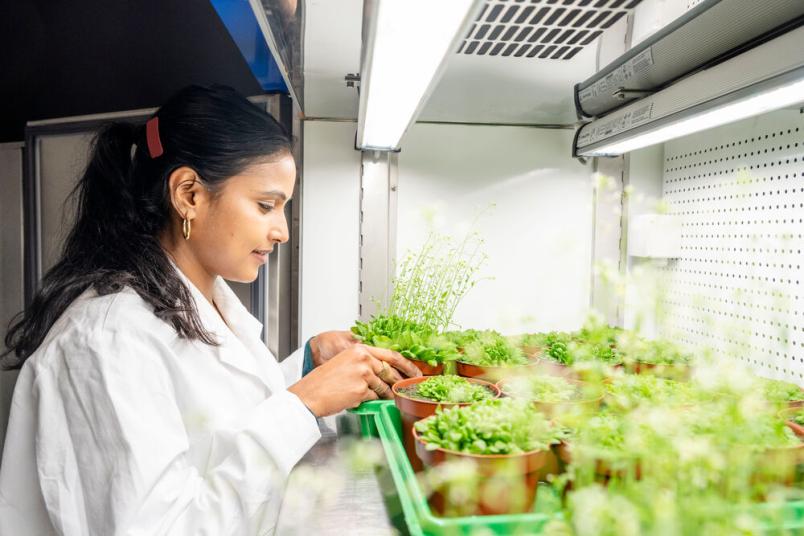
Khushbu Kumari works at the Chair of Molecular and Cellular Botany at Ruhr University Bochum.
“GELP80 acts like a molecular sculptor at the stomatal pore—it remodels the cuticular lipids early in guard cell development to give the stomata the precise mechanical flexibility they need to function,” says Dr. Khushbu Kumari, first author of the study. “When that sculpting is lost, the pore architecture becomes rigid and disorganized, and the plant simply cannot open and close its stomata efficiently.”
For the first time, the findings reveal a direct link between lipid metabolism, cell wall mechanics, and stomatal physiology. As we are faced with increasing drought and water scarcity, this insight could aid in optimizing crops for better water management and greater resilience to drought.