
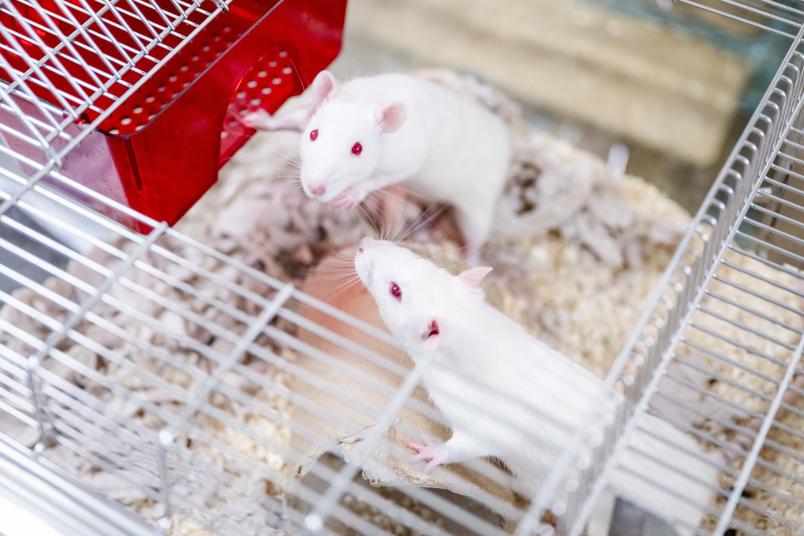
Rats are capable of empathy to a certain extent.
Philosophy
How Empathetic Rats Are
A rat first frees a cagemate rat and then shares food with it. Is this animal just as empathetic as humans?
In an American study from 2011, researchers observed that rats first freed their fellow rats from a cage and then shared food with them instead of leaving them in the cage and eating alone; this means they showed empathy. But do they have the same capacity for empathy as we humans, or do we differ in that regard? A research team working with Professor Albert Newen from the Ruhr University Bochum Institute for Philosophy II, Germany, set out to answer this question. They developed a model for more accurately describing empathy in various animals. Their answer: Yes, rats exhibit empathy, although it differs gradually from that of humans. The researchers report their findings in the journal Biological Review from June 28, 2026.
Empathy is the glue that holds our society together and makes our everyday lives personal and human. Is it not therefore a good candidate for a trait that separates humans from other animals? Are there any other animal species that show empathy? “Of course,” says the dog owner. “However, it is crucial to note that people ascribe human traits to their pets’ behaviors, and so they see empathy in their animals,” explains Newen. Rats, however, can transfer harmful diseases to humans. Do we thus immediately assume that they are not empathetic? How can we scientifically determine, without any prejudices if possible, whether animals can behave empathetically and which species have the capacity for this?
Testing behaviors
The researchers drew on behavioral observations to answer these questions. In one study published in the magazine Science in 2011, two rats lived in a large cage, belonged to the same group, and knew one another well. One of the two rats was locked in a small, narrow cage where it could barely move and that could only be opened from the outside. The other rat was hungry and was left to move around freely near the caged rat. It saw chocolate on one side and its fellow rat in the cage on the other. What did the free rat do? It first freed the rat from the cage and then shared the chocolate. “What more could one do to show that empathy is at play here?” asks co-author Maja Griem.
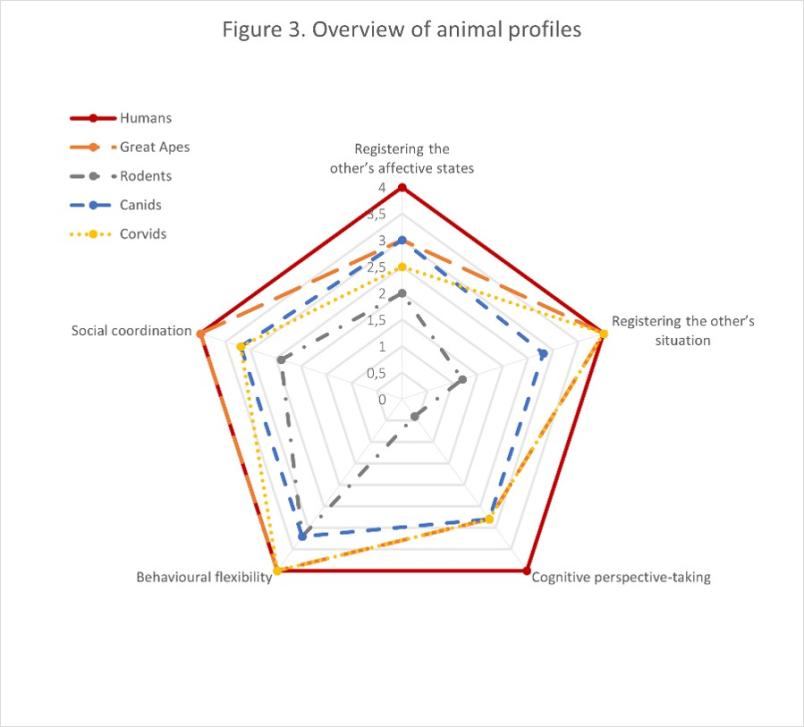
The forms of empathy that various animals are capable of.
While one group of animal researchers celebrated this finding as fully formed empathy, others remained skeptical and denied this, claiming that empathy is a deeply human emotion. Albert Newen’s team wanted to resolve this dilemma.
Creating multidimensional profiles of empathy
To do this, the researchers created multidimensional profiles of empathy. First, they ruled out that this was just an innate instinctual behavior: Rats only help rats that they are friends with, but not those they have never met before. When it comes to empathy, providing aid cannot occur randomly, but rather presupposes that sensing the other takes place in three dimensions, namely by registering the other’s emotion, situation, and (further) mental states. The behavior should also be based on this registering of information and occur flexibly, not instinctively. One should not help another for personal benefit, but because it is geared toward the other. “Overall, we have five dimensions of capabilities that are closely linked with empathy,” explains Newen. “Registering the other party’s emotions, situation, and mental state, as well as the two behavioral characteristics – namely, that the behavior is flexible and directed toward the other agent.”
Comparing different animal species
The research team examined these five dimensions more closely and determined how distinct they are among various animal species. They compared these using past behavioral studies of great apes, rats (and mice), dogs (and wolves), and corvids. “This allows us to compare these empathy profiles amongst each other and with us humans,” explains co-author and chimpanzee researcher Simone Pika from Osnabrück. The results: Rats possess the first two capabilities (registering emotion and situation) to a moderate degree, while there is almost no registration of mental states (other than the central emotion). The dimension of flexibility is strongly apparent in rats, but they are only moderately able to orient their behavior on the basis of others. “Put simply, one can say that rats’ remarkable helping behavior is a case of empathy,” says Newen, “but it is not the same type of empathy as seen in humans, especially because there is a lack of sensitivity to the other’s mental state beyond the registration of emotion.”
“We now no longer have to provide a yes/no response to the question of whether rats feel empathy. We can more precisely determine which type or profile of empathy they have in a gradual understanding,” says Newen.