
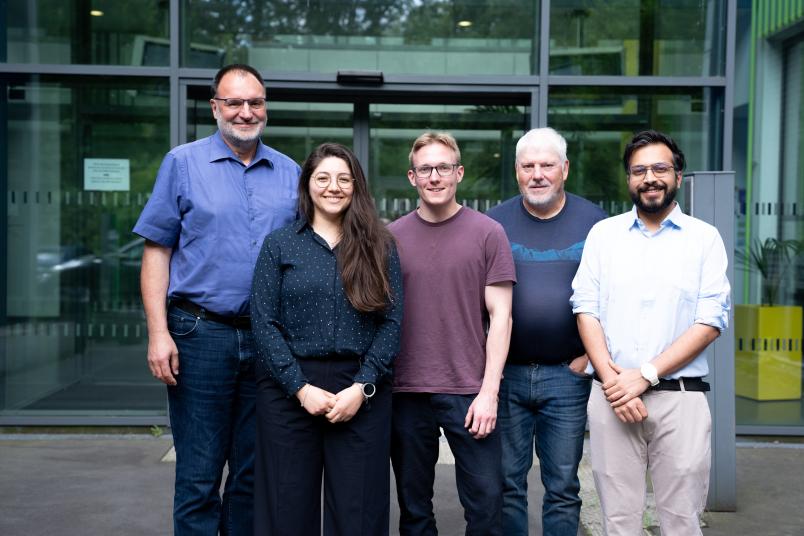
The authors of the current paper (from left): Martin Muhler, Catalina Leiva-Leroy, Julius Ponhöfer, Wolfgang Schuhmann und Adarsh Koul
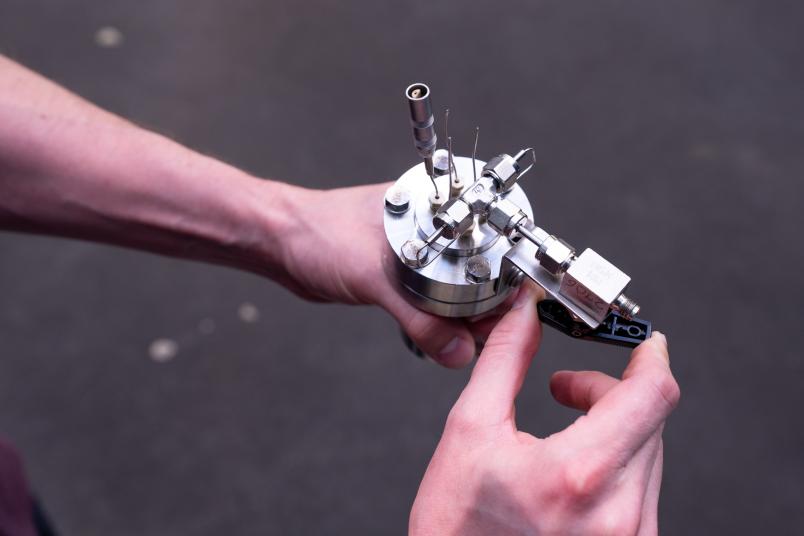
Electricity from sustainable sources serves as an additional driving force in alcohol oxidation.
Chemistry
More sustainable process for alcohol oxidation
By combining thermal and electrocatalytic methods, alcohol oxidation can be precisely controlled and made more energy-efficient.
Researchers at Ruhr University Bochum, Germany, have developed a new method that makes the oxidation of alcohols easier to control and more sustainable. Alcohol oxidation is important both for synthetic chemistry and for sustainable energy applications. Thermal processes are usually used for this purpose; in other words, the activation energy that must be overcome for the reaction is supplied in the form of heat, and oxidation takes place using oxygen under pressure. Together with the Max Planck Institute für Kohlenforschung in Mülheim, Germany, the Bochum team has now combined this approach with an electrocatalytic process that uses electricity from sustainable sources as an additional driving force. The group led by Prof. Dr. Martin Muhler, Prof. Dr. Ferdi Schüth and Prof. Dr. Wolfgang Schuhmann describes the method in the journal “Angewandte Chemie” on 18 June 2026.
“Coupling electrical with thermal energy while simultaneously increasing efficiency is a general principle that can be transferred to a wide range of processes,” says Wolfgang Schuhmann.
Combination of heat and electricity
The researchers investigated alcohol oxidation using ethylene glycol as an example; its oxidation has broad industrial relevance. Ethylene glycol is used, for example, as a precursor for PET and in fuel cells. The group used a specially synthesized cobalt oxide as the catalyst.
Electrocatalytic processes have the advantage that they can be precisely controlled and operated using electricity from renewable sources. Compared with thermal processes, however, electrocatalysis usually delivers lower production rates. The researchers combined heat and electricity as driving forces for alcohol oxidation and varied certain reaction parameters such as pressure and temperature.
The reaction proceeded with high selectivity: the desired products glycolate and formate were predominantly formed. As the temperature and oxygen pressure increased, their yield also rose. The study thus shows that electrocatalytic and thermal processes can be successfully combined.
Efficient use of electrical energy and heat
“Such electrothermal systems could be integrated into industrial environments where oxygen and low-temperature heat are available as by-products, enabling more efficient use of electrical and thermal energy,” write the authors of the study.