
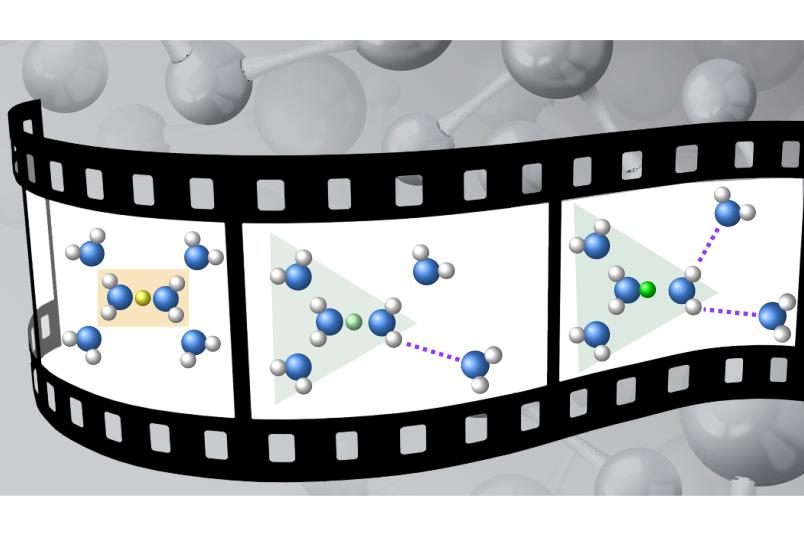
Hydrated proton (yellow/green) with six water molecules (blue/grey): Quantum simulations of an extended Zundel complex provide new insight into how protons move through water.
Complex Simulations
New Findings on Proton Transport in Water
International research team simulates motions of a hydrated proton in full quantum detail
Complex simulations – the most intricate of their kind to date – reveal how water governs the way protons move through it. They were carried out by an international research team led by scientists of Heidelberg University’s Institute for Physical Chemistry. Using their modeling, the researchers from Cambridge (UK), Bochum (Germany), Dijon (France) and Heidelberg (Germany) were able to trace in full quantum detail the movements of a proton shared among six water molecules. At its core, the work addresses how a proton moves through water: not as a single particle drifting along, but by “hopping” from one molecule to the next. The results were published in the journal “Nature Chemistry” from July 27, 2026.
This “hopping” motion has been known since the nineteenth century. When an acid dissolves in water, the released proton – a positively charged hydrogen ion – does not remain bound to a single water molecule. It is highly mobile and constantly jumps from one molecule to the next. This so-called Grotthuss mechanism, the basis of proton transport in water, is responsible, among other things, for the acidity of water and plays a crucial role in energy storage in batteries and in signal transmission in living cells. Because these ultrafast proton motions are so complex, they are notoriously hard to elucidate, and despite intensive research the fundamental dynamics of protons in water remain a matter of debate.
As Professor Oriol Vendrell of the Institute for Physical Chemistry at Heidelberg University explains, until now hydrated protons have been represented using two idealized structures – the Zundel cations and Eigen cations. They each assume a different number of water molecules to which the proton binds. In a Zundel structure, the proton is shared equally between two molecules; in an Eigen structure, it binds to a single molecule, forming a hydronium core that is in turn bonded to three further water molecules. “However, recent studies using infrared spectroscopy reveal a state that is far more dynamic and lies between these two extremes,” explains Dr. David Mendive-Tapia, a postdoctoral researcher on Vendrell’s team.
For the current research, the scientists simulated an extended Zundel complex with six water molecules. They continuously modified the model system by removing molecules, causing it to transition from a symmetric Zundel structure to an asymmetric Eigen structure. Using these simulations, they succeeded in tracking, with full quantum resolution, the coupled motions of the hydrated proton together with its surrounding water molecules. These amount to 51 interlocking vibrations, and by following all of them at once the research team was able to compute the complete infrared spectrum and reproduce the experimental measurements across the full range.
According to Professor Dominik Marx of Ruhr University Bochum, a decisive ingredient was an exceptionally accurate description of the forces between the atoms. Instead of the usual approximations, the researchers captured these forces with an artificial neural network, trained in Bochum on high-level quantum-chemical data. This machine-learning model let them follow the proton’s quantum motion with unprecedented accuracy and without any adjustable parameters.
“Our simulations show that the configuration of the surrounding water molecules is the key factor determining how protons move in an aqueous solution. The infrared fingerprint of the hydrated proton, and ultimately its characteristic hopping, is governed above all by local asymmetries in its surroundings,” emphasizes Oriol Vendrell. According to the scientists, the latest research findings expand the current understanding of how the water shapes the way protons move through it.
Cooperation and funding