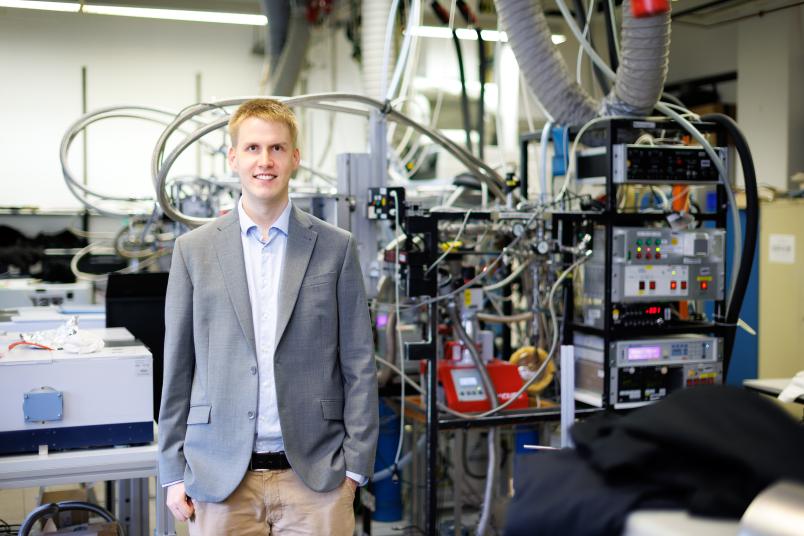
André K. Eckhardt has been awarded the coveted ERC Grant.
Chemistry
ERC Starting Grant for André K. Eckhardt
Reactive phosphorus compounds were essential for the emergence of life. But where did they come from? Possibly from space? The project 31PIRATE searches for answers.
Phosphorus is a crucial component of life; it is found in DNA, RNA, the energy carrier ATP, and elsewhere. Although phosphorus is abundant on Earth in the form of minerals, it is still unknown where the chemically reactive phosphorus compounds required for the first steps in the emergence of life even came from. “This so-called ‘phosphorus enigma’ is one of the central, unresolved questions about the origin of life,” says Dr. André K. Eckhardt, a chemist at Ruhr University Bochum, Germany. In his project 31PIRATE, he aims to determine whether the compounds may have come from space. The European Research Council is supporting his research with an ERC Starting Grant of almost €2 million over a period of five years.
In his ERC project, Eckhardt is investigating whether reactive phosphorus compounds could have formed in space and been involved in the initial chemical steps towards life after their arrival on early Earth. To do this, he replicates interstellar ice particles in a lab and exposes them to energetic radiation similar to the conditions found in space. Eckhardt then tracks which new phosphorus compounds form and whether they survive the transition from interstellar ice into an aqueous solution.
Using a globally unique combination of EPR spectroscopy and phosphorus nuclear magnetic resonance spectroscopy (31P-NMR), he intends to directly observe these short-lived compounds for the first time and track them into aqueous solutions. The project thus forms a direct bridge between astrochemistry and prebiotic chemistry, and aims to demonstrate the role that phosphorus from space may have played in the emergence of the first biologically relevant molecules.