
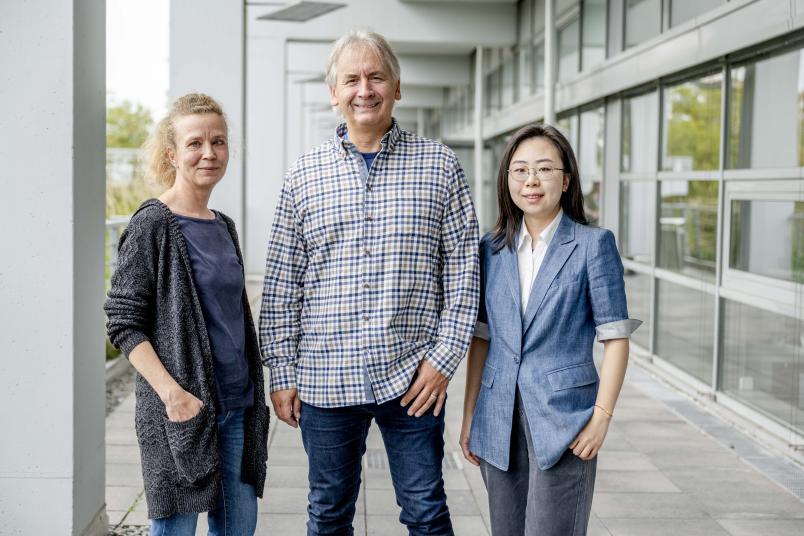
Anja Hemschemeier, Thomas Happe, and Zhaoya Yhang (from left) are part of the team of authors.
Biology
A Molecular Pendulum for Efficient Hydrogen Production
Enzymes that are particularly efficient at producing hydrogen have to capture protons from the solvent extremely quickly in order to do so. Researchers in Bochum have discovered how they accomplish this.
Nearly all metabolic processes require protons—positively charged hydrogen atoms. Although these are abundant in the cellular fluid, the biocatalysts involved depend on mechanisms for efficiently capturing protons and transporting them to the site where catalysis occurs. Enzymes from microorganisms can produce hydrogen (H2) by combining electrons with protons. These so-termed hydrogenases are so efficient that one biocatalyst can capture nearly 10,000 protons per second. A team of researchers from the Photobiotechnology group at Ruhr University Bochum, Germany, has discovered how they do this. The researchers report their findings in the Journal of the American Chemical Society from October 27, 2026.
How an inhibitor can help us understand biocatalysts
Zinc occurs naturally in many biocatalysts, where it is needed for the reaction mechanism. This metal ion binds to reactive groups of certain molecular components—the amino acids— of the enzyme. “Yet through this same bond, zinc can block biocatalysts,” explains Dr. Jifu Duan, first author of the current study. “It can also bind non-specifically to sites required for proton binding.”
Researchers at Ruhr University Bochum have examined how zinc affects the production of hydrogen by [FeFe]-hydrogenases—and made an interesting discovery. “Although we were able to see in crystal structures that zinc binds to various sites of the [FeFe]-hydrogenases, the interaction at only one very specific location resulted in inhibition,” says Duan. Notably, this point is in the direct vicinity of the previously known proton transport pathway of the hydrogenases.
Zinc blocks a proton-transporting pendulum
The team around Duan and Professor Thomas Happe was able to demonstrate that the binding of zinc and other metal ions blocks very specific amino acids, namely two histidines on the surface of [FeFe]-hydrogenases. Histidines in enzymes are known for binding protons, but their role in [FeFe]-hydrogenases was previously unexplored. When the researchers replaced one of these histidines with another amino acid, the biocatalyst remained highly active but became insensitive to zinc. However, when they replaced the other histidine, the [FeFe]-hydrogenase could only very slowly produce hydrogen.
By using various methods—protein crystallography, hydrogen production tests, electrochemistry, and molecular simulations—the team could demonstrate that one of these two histidines forms a sort of pendulum. When it swings to the surface of the enzyme, it can receive a proton from the other histidine; when it swings towards the interior of the enzyme, it transfers the proton to a known proton transport pathway. This pendulum also has a fixed fulcrum, which is another amino acid that the researchers only noticed by closely analyzing the crystal structures.
Has the evolution of the protein pendulum led to particularly efficient hydrogenases?
Today, we are aware of many different groups of [FeFe]-hydrogenases—but only those in Group A appear to achieve the particularly high production rates that make these biocatalysts so exciting and also of interest for biotechnological applications. “We looked for our pendulum in other groups of [FeFe]-hydrogenases as well, but it appears to be only present in Group A,” says Happe. “We believe that the two histidines are responsible for their swift capture of protons, and thus their high level of activity.”
In the course of evolution, this could have led to the specialization of this group of hydrogenases. This insight could help us to better understand the molecular mechanisms of other hydrogenases and, perhaps, develop biocatalysts that are better suited for bio-based industrial processes. However, the results are also important for understanding the H2 metabolism in living organisms that plays an important role for many ecosystems.