
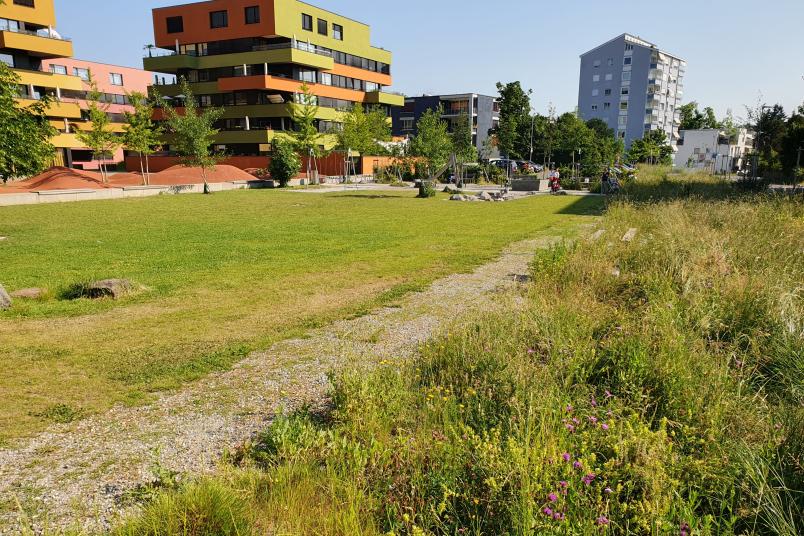
It's all about the mix: a mowed lawn sits right next to a wild green space.
Public green spaces
Biodiversity is a Priority for European Municipalities
A major ecological survey places municipalities at the center of attention for the first time. The results offer grounds for hope.
Biodiversity is a key motivation in the planning and management of urban green spaces for 85 percent of European municipalities, as revealed by a survey of administrative representatives in 574 municipalities in 18 European countries. Many municipalities conduct targeted employee training sessions (82 percent) and take measures to increase public acceptance of green space maintenance that supports biodiversity (75 percent). “For the first time, this makes it possible to document an encouraging progress in the systematic promotion of biodiversity in municipalities across Europe,” says Valentin Klaus, Professor of Urban Ecology and Biodiversity at Ruhr University Bochum, Germany. The results of the study were published in the journal Nature Cities from October 23, 2026.
As urbanization spreads worldwide, the loss and fragmentation of habitats are driving the global decrease in biodiversity. At the same time, urban green spaces like parks, meadows, and forests have the potential to contribute significantly to the conservation of biodiversity at the local and regional levels.
Municipalities’ role as key actors in the spotlight for the first time
Political initiatives such as the European Green Deal encourage cities to improve the ecological quality of their urban green spaces. “After all, such green spaces make up 40 percent of the land cover in European capitals on average,” explains Ellen De Vrieze of Ghent University and first author of the study. Recent legal regulations, including the EU Nature Restoration Regulation, also emphasize the necessity of improving the ecological quality of nature within cities. However, past research has rarely focused on municipalities, which are key actors in the management and design of urban green spaces and the biodiversity therein. “The extent to which cities and municipalities in countries and climate zones across Europe prioritize biodiversity when planning and managing urban green spaces was thus rather unclear,” says Valentin Klaus.
Research team conducts questionnaires in 18 countries
In order to better understand the importance attributed to biodiversity in public urban green spaces, the research team surveyed the people responsible for green space planning and management in 574 municipalities across Europe. The standardized questionnaire addressed the underlying motivation, management goals, and the measures the municipalities are taking to promote public acceptance of wild, species-rich green spaces.
The most important findings:
- 85 percent of municipalities surveyed stated that biodiversity is a key motivation in the planning and management of green spaces.
- 82 percent conduct targeted employee training sessions on biodiversity.
- 75 percent take measures to increase public acceptance of “wild” green spaces that promote biodiversity.
- Only 19 percent stated that the ecological condition of urban green spaces has deteriorated within the past year.
- Municipalities in countries with a higher quality-of-living index tended to view biodiversity with greater importance.
Particularly successful: involving the public
“The success of biodiversity-friendly urban green spaces does not solely depend on ecological expertise and engagement of city administrations but also hinges heavily on the involvement of and support by the local population,” Klaus explains. He therefore views it as particularly positive that many municipalities are taking measures to increase public acceptance of management practices that foster biodiversity, since biodiverse green spaces often look somewhat wilder and more natural than a manicured lawn. More than half of the cities also stated that they directly involve the public in the planning of green spaces. “This can also serve as a starting point for bottom-up initiatives on urban biodiversity,” says Klaus. “There are indications that participation offers benefits to the public and can strengthen both the social and the ecological resilience of the municipalities.”
The researchers hope that the results could reflect a shift in public administration toward post-materialist values in which urban administrations are increasingly able to look beyond human needs and also place value on promoting the coexistence of different species in the urban environment.