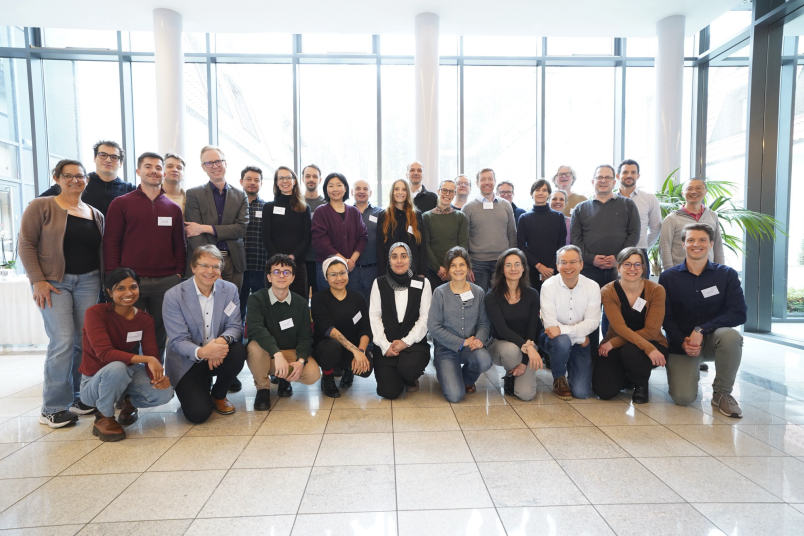
The team of the neu CRC Episodic Memory
Research Funding
New Collaborative Research Center Focused on Memory
Our memories of past experiences are, in part, constructed. What does this mean, for example, for our development, trauma, or even memory in animals?
Neuroscientific studies show: Our episodic memory—that is, memories of personally experienced events—is not a passive store, but an active process of construction. This insight raises fundamental questions: How do we define “constructed”? Why is there a lack of unified theory so far? And how do these gaps impact research into development, trauma, or animal memory? In the new Collaborative Research Center (CRC) “Episodic Memory,” researchers led by Professor Sen Cheng of the Faculty of Computer Science and Science Hub Neuroscience at Ruhr University Bochum, Germany, are investigating these questions. The German Research Foundation (DFG) will provide approximately 11 million euros in funding for the CRC starting January 1, 2027, for an initial period of four years.
Combining Memory Traces and Semantic Knowledge
At the core of the new Collaborative Research Center is an interdisciplinary framework that reimagines episodic memory as "scenario construction": mental simulations of past events are reconstructed from episodic memory traces and semantic information, adapting to social context or the self-model and filling gaps.
Seven central research questions guide this work, spanning from basic cognitive mechanisms to complex social functions. Through experiments combining behavioral studies, neuroimaging, and clinical trials, the CRC aims to develop new theories and computational models. This research will not only deepen our understanding of episodic memory but also pave the way for future diagnostics and therapies targeting memory processes and their pathologies.