
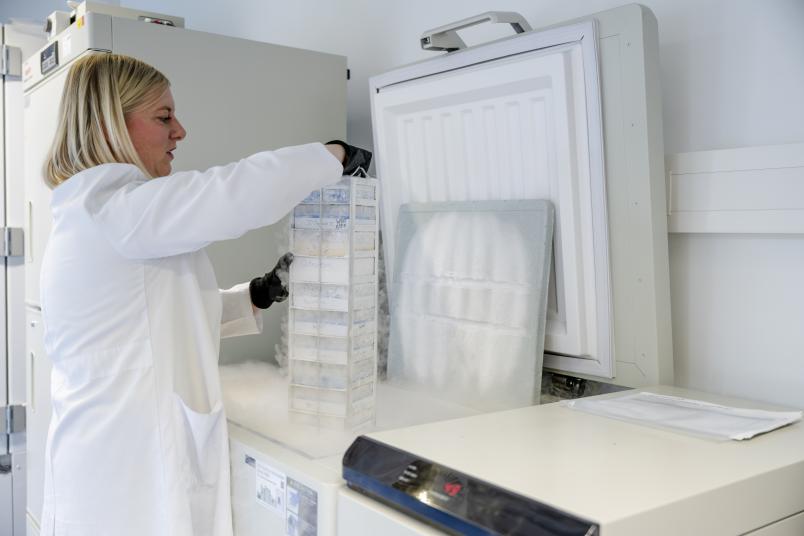
A treasure for cancer research: Britta Majchrzak-Stiller removes the frozen cells—from which organoids can grow—from cold storage.
Gastrointestinal organoids
A Treasure in the Freezer
Organoids are the link that connect patients’ tumors and laboratory cancer research. The miniature tumors examined in the lab make it possible to test the effectiveness of cancer medication on an individual model.
Pancreatic cancer is one of the most consequential types of cancer. It is often detected late and spreads quickly. Each tumor is as unique as the patients themselves. It is also very difficult to predict which medication will work. A research team at Ruhr University Bochum is exploring a new approach to test the effectiveness of chemotherapy treatments in advance: With great effort, the team is creating tumor organoids. Stored in a constantly growing biobank, these organoids also enable the testing of new substances. This is reported by Rubin, the science magazine of Ruhr University Bochum.
Everything has to run like clockwork
Ruhr University Bochum Hospital is one of the largest pancreatic medicine centers in Germany, which is the only reason the researchers can conduct their project here. This is because not every pancreatic tumor is an eligible source for organoids. About 60 of approximately 250 major pancreatic operations performed here every year meet all the requirements.
Everything must run like clockwork for the operation: Someone has to have an ice box at the ready in the operating room so that it can be transported by taxi to the pathology department as quickly as possible, where staff are ready to receive it. Here, the tissue is cut and processed before being reduced to small pieces and embedded in Matrigel, a gel-like protein mixture. The entire procedure is over within two hours.
Why organoids are better than 2D cell cultures
This is where things get exciting: Organoids do not grow in all cases. An organoid can only regrow from a cell that has already learned how to become an organoid. Compared to purchased cell lines, organoids have the major benefit of growing from the patient’s own material and reflecting the genetic diversity of the tumors. Their three-dimensional growth causes them to act more like the tumor within the body than other models. “For example, if I have a two-dimensional cell culture and administer a drug to it, the substance easily spreads everywhere and reaches every single cell,” explains Dr. Philipp Höhn from the research team. “But this does not reflect the reality. Organoids are much better in this regard.”
Detailed article in the science magazine Rubin